Desmedt bets on uptime
Belgian converter builds one of the world’s most automated narrow-web plants.
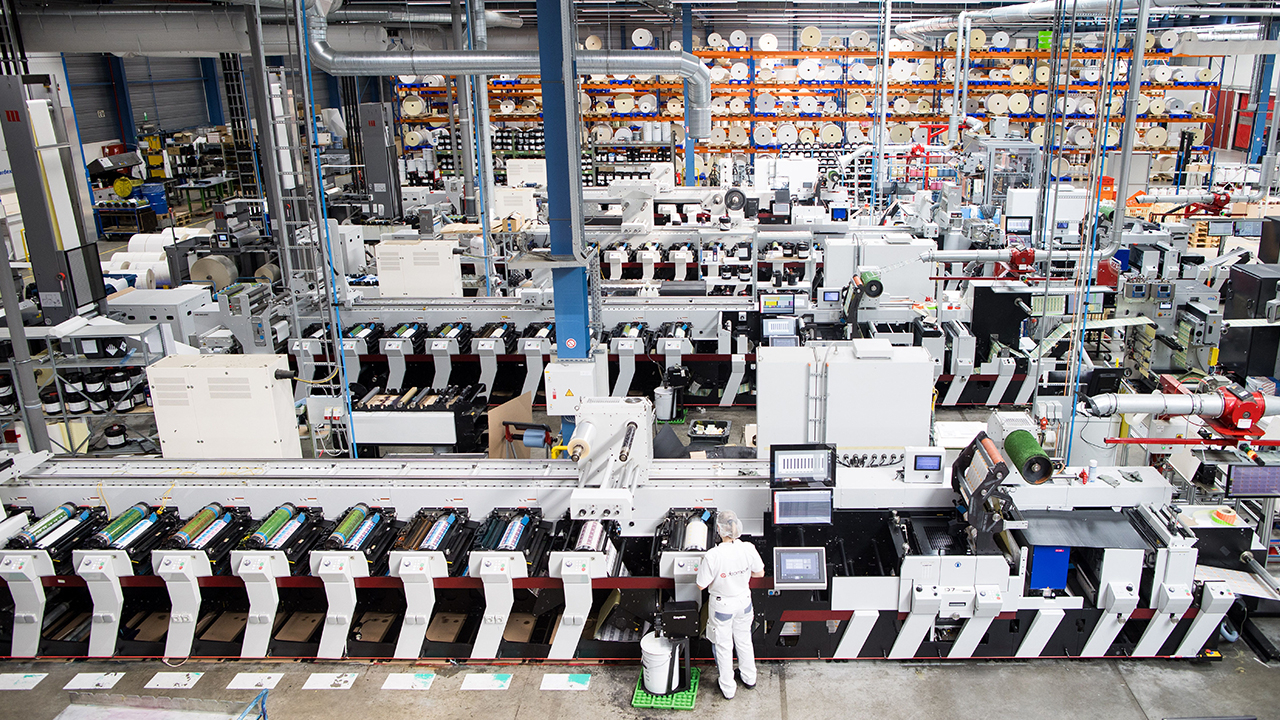
Desmedt Labels produces nearly 1.8 billion labels a year. It employs 47 people. When Henri Köhler, the company’s general manager, talks about competitiveness, he does not talk about adding headcount or buying bigger machines. He talks about eliminating five-minute interruptions.
“We look for mindset. People who are willing to learn and adapt can be trained internally, which has become more important than prior specialization”
In early 2025, the latest example arrived in Bornem, Belgium: a Mark Andy Digital Pro Max hybrid press paired with a Martin Automatic non-stop splicer, the first such combination anywhere in the world. Köhler estimates the pairing will recover roughly one hour of production per shift. Across a three-shift, five-day pattern, that works out to around 750 production hours a year. For a converter with annual sales of 15.5m EUR, those hours matter.
But the installation is not really the story. It is the latest move in a decade-long program that has quietly turned a small, family-owned printer into one of the most automated narrow-web operations in the label industry.
Five generations of reinvention
François Desmedt founded the company in Brussels in 1889, specializing in hot gold leaf stamping on leather. Gummed labels followed in 1931. In 1945, Desmedt became the first company in Belgium to manufacture self-adhesive labels, and in 1970, the first label converter in Europe to invest in flexographic printing. A digital offset press arrived in 2000, another Benelux first.
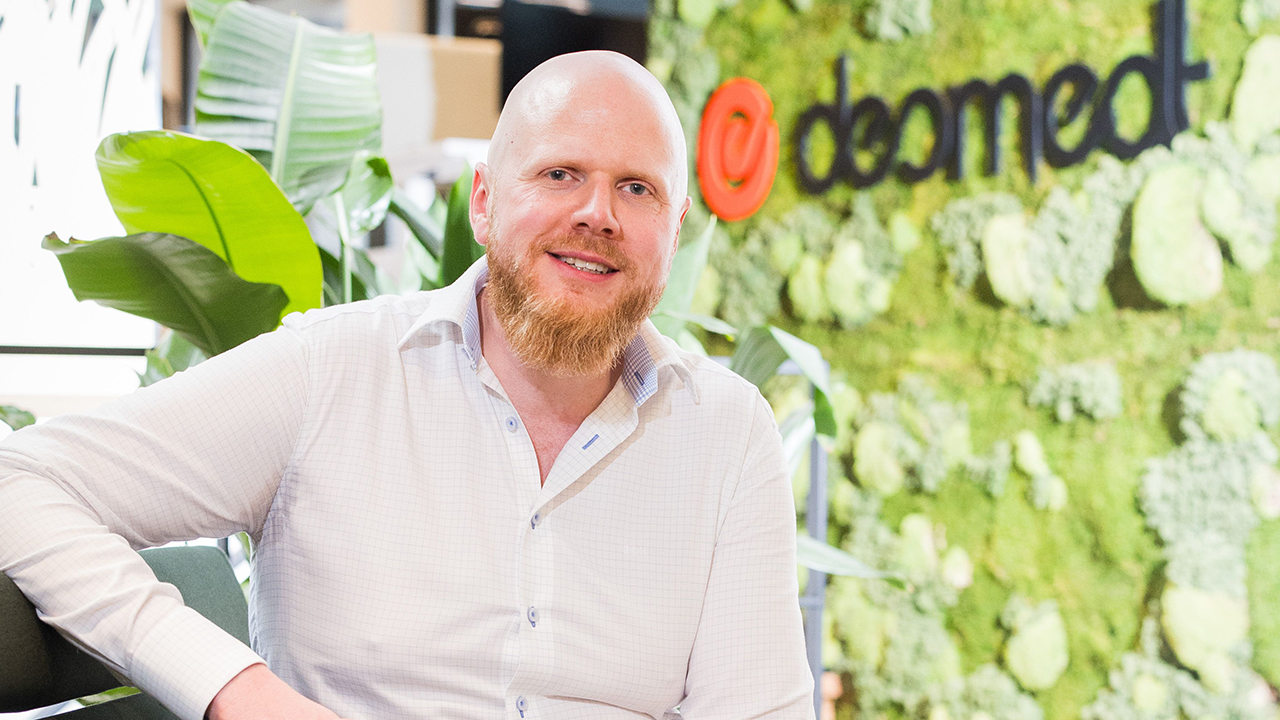
Köhler, who represents the fifth generation of family ownership, took over in 2008. Four years later came the decision that reshaped the business: relocating from the company’s 120-year-old site in Anderlecht to a purpose-designed facility in Bornem. Over more than a century, the former building had grown piecemeal. ‘It no longer supported a logical or efficient production flow,’ Köhler explains. Congestion and safety concerns in the neighborhood were making recruitment difficult.
People were the harder part. Not everyone made the move, and Köhler does not gloss over it. ‘We focused on being transparent about the reasons and the long-term perspective, and that helped create alignment.’ Those who did relocate gained something that the Brussels site could never have offered. ‘It gave us the opportunity to rethink the entire layout and organize production in a more structured and scalable way, with room for future development,’ he adds. Processes were standardized, new machinery installed and a proprietary Ultra HD flexo print standard adopted, which Desmedt says exceeds Full HD Flexo requirements.
Process before technology
‘If a task does not add value to the product, the question is whether it should exist at all,’ says Köhler. That sentence captures a philosophy that has guided every major investment since 2013, when he set out to replace one aging flexo press and ended up ordering three Mark Andy Performance Series P7 lines, each fitted with Martin Automatic MBSF butt splicers.
Output increased 25 to 30 percent once the splicers enabled continuous roll changes without stopping the press. Köhler is characteristically understated about this. ‘Automatic roll changing is not particularly visible, but it removes a recurring interruption and improves overall flow.’ He is less understated about the trap he sees other converters falling into. ‘Investments often focus on visible elements such as new presses, but if the process is not right, you risk adding capacity to inefficiency.’
By 2018, two 10-color P7 presses had replaced three existing flexo machines and a digital line. For business development work, a 12-color P7 followed. All three ran 430mm webs with UV LED curing, making the plant Mark Andy’s largest UV LED narrow-web installation at the time. Köhler had adopted LED curing early, in 2016, working closely with Siegwerk to develop a full range of LED-compatible inks for the flexo process when the technology was not yet widely established. Consuming roughly half the energy of conventional mercury vapor bulbs and lasting far longer, the lamps aligned with his preference for investments that compound over time. Martin Automatic units on each press were saving roughly five minutes per roll change, which he calculated to be about 1,200 extra production hours a year across the three lines.
“We look for mindset. People who are willing to learn and adapt can be trained internally, which has become more important than prior specialization”
Alongside the presses, a Matho Cuttopress waste-extraction system removes matrix waste from multiple machines into an external compactor. Martin’s LRD rewinder, fitted with in-line slitting and a mobility kit, could be wheeled between presses depending on which job needed automatic rewind. ‘Automation for us is about many small, consistent improvements rather than isolated, highly visible investments,’ notes Köhler.
By 2024, the fleet had grown to five P7 lines. One detail stands out. As the flexo presses became faster to change over, Desmedt began pulling short-run work back from digital to flexo. Most converters are moving in the opposite direction. ‘It’s not about speed, it’s about improving productivity by increasing uptime and reducing waste,’ Köhler explains. If a flexo press with non-stop splicing can change jobs in minutes and run continuously, the economics shift. On digital, by contrast, each manual roll change still costs roughly five minutes of production with the press standing idle.
Hybrid fills the gap
Mark Andy’s Digital Pro Max occupies a different space. It combines a 5-color CMYK plus white toner engine with servo-driven flexo stations on a 330mm web, running at 20 to 40m/min depending on the job. At Desmedt, the configuration includes a web cleaner, corona treater, flexo units on either side of the digital engine, laminator, semi-rotary die station and slitter. Its modular construction lets converters add capabilities retrospectively, which suits Köhler’s preference for equipment that adapts rather than gets replaced.
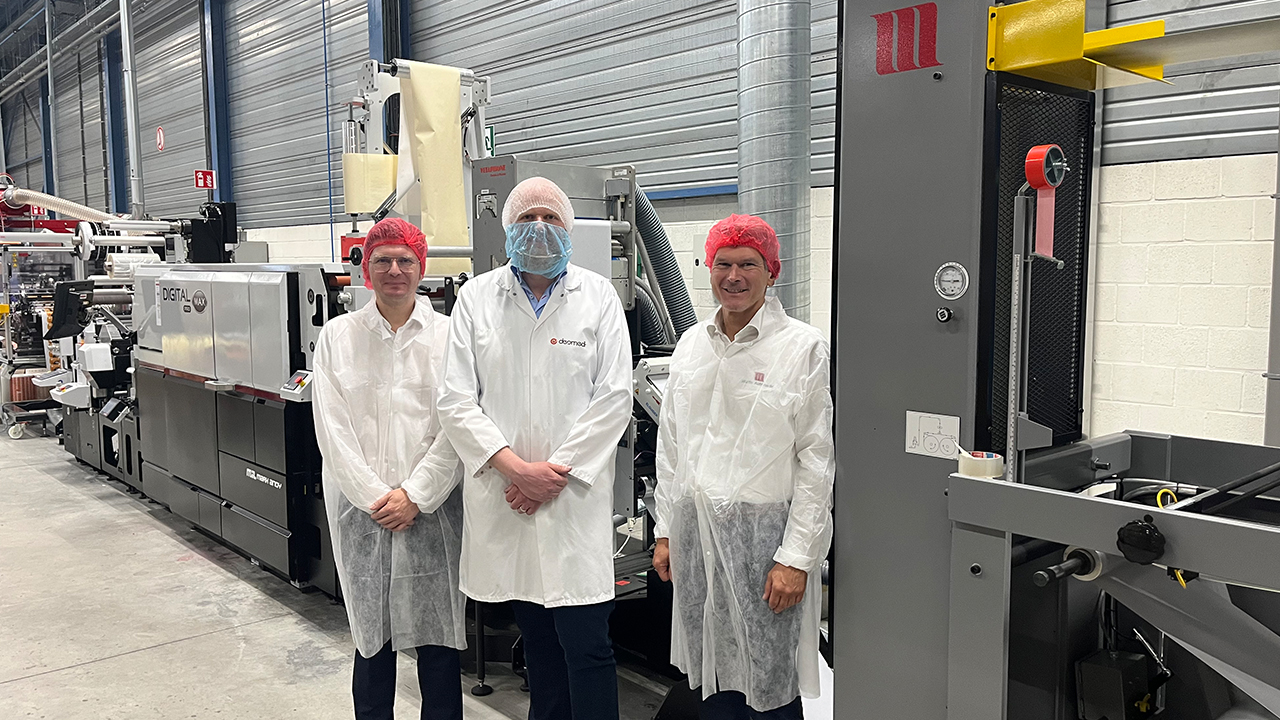
Paired with the press, a Martin Automatic MBSC compact splicer can load two full 4,000-meter rolls and features a laser-assisted tape alignment system designed to prevent matrix breaks. That non-stop feed is what generates Köhler’s 750-hour figure. Beyond the time saved, the system reduces material waste by maximizing roll usage down to the core and enabling operators to reload partially used rolls without stopping the press.
Recruiting for mindset
Automation has changed who Desmedt hires, not how many. Staff comes from 10 nationalities, and each employee averages around 49 hours of training a year. Collaborative robots now work alongside operators on the production floor, handling repetitive lifting tasks. Asked whether automation will eventually reduce headcount, Köhler draws a parallel with automotive: ‘They operate with large numbers of robots but still employ significant workforces. Repetitive tasks can be automated effectively, but variability remains difficult to handle.’
Operators now spend less time on manual work and more on process oversight. Finding people with traditional printing backgrounds has become harder, but Köhler says that matters less than it used to.
‘We look for mindset. People who are willing to learn and adapt can be trained internally, which has become more important than prior specialization.’
Sustainability as continuity
Hard data tells the environmental story more concisely than certifications. Between 2020 and 2025, Desmedt’s Scope 1 and 2 emissions fell 94.6 percent, from 331 to just 18 tons. What makes the figure striking is the breadth of operational changes behind it. A new HVAC system engineered for the production environment replaced high-GWP refrigerants with R290 propane. Central press cooling with free-cooling technology cut electricity demand. Compressed air systems were optimized after an energy audit revealed that reducing pipe pressure by one bar saved substantial power without affecting press performance. LED curing across the flexo fleet halved curing energy. An energy monitoring tool with sensors on power lines identified an additional 150 MWh in annual savings by eliminating standby consumption. Employee awareness programs targeting energy losses contributed too. Only after these reductions were locked in did Desmedt transition to 100 percent certified green electricity in 2025.
Ultra HD flexo now accounts for 77 percent of non‑pharmaceutical production. Ink consumption per square meter of label produced has fallen 23 percent since the 2020 baseline, while residual waste is down 11 percent. All paper labels use FSC-certified stock.
In 2024, Desmedt won the Best First Sustainability Report award at the Belgian Awards for Sustainability Reports, and the company holds EcoVadis Gold for a second consecutive year, placing it in the top five percent of rated companies worldwide.
None of this is framed as altruism. ‘More efficient use of materials, energy and processes typically leads to better performance and supports long-term profitability,’ Köhler says. ‘Sustainability has become a baseline requirement in the market. It does not necessarily win business on its own, but if you do not meet those expectations, you risk being excluded.’
Demand-driven logistics
Construction of a fully automated warehouse began in 2025. Rather than batch-driven logistics, the system is demand-driven. ‘Material handling becomes directly aligned with actual production needs and customer delivery requirements,’ says Köhler. ‘This is very much in line with the just-in-time principles: ensuring that the right material is available at the right moment, rather than moving and storing it earlier than needed.’
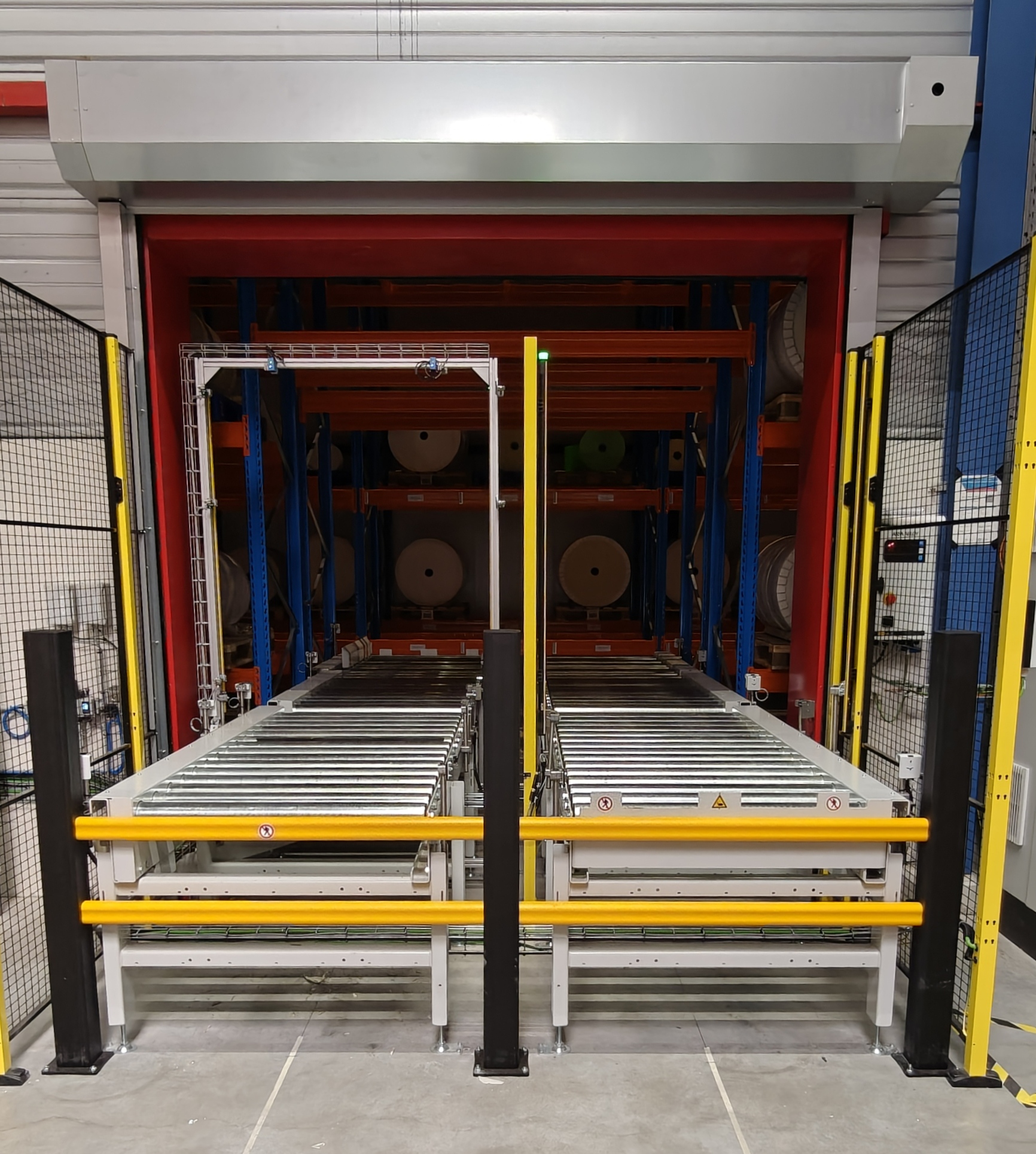
Safety is part of the rationale too, with less manual handling and fewer interactions with moving equipment.
Further flexo press investments are planned, each with non-stop splicers as standard.
Asked what sets the company apart, Köhler circles back to the same theme: ‘It is not a standalone initiative, but part of a long-term approach where we continuously reduce waste, improve flow and strengthen the resilience of our business. Ultimately, every investment is about ensuring continuity for our customers, our employees and the next generation.’
Stay up to date
Subscribe to the free Label News newsletter and receive the latest content every week. We'll never share your email address.