The rise of Lone Star Labels
For the last several years, the family-owned converter has experienced explosive growth, increasing its workforce, square footage and revenue.
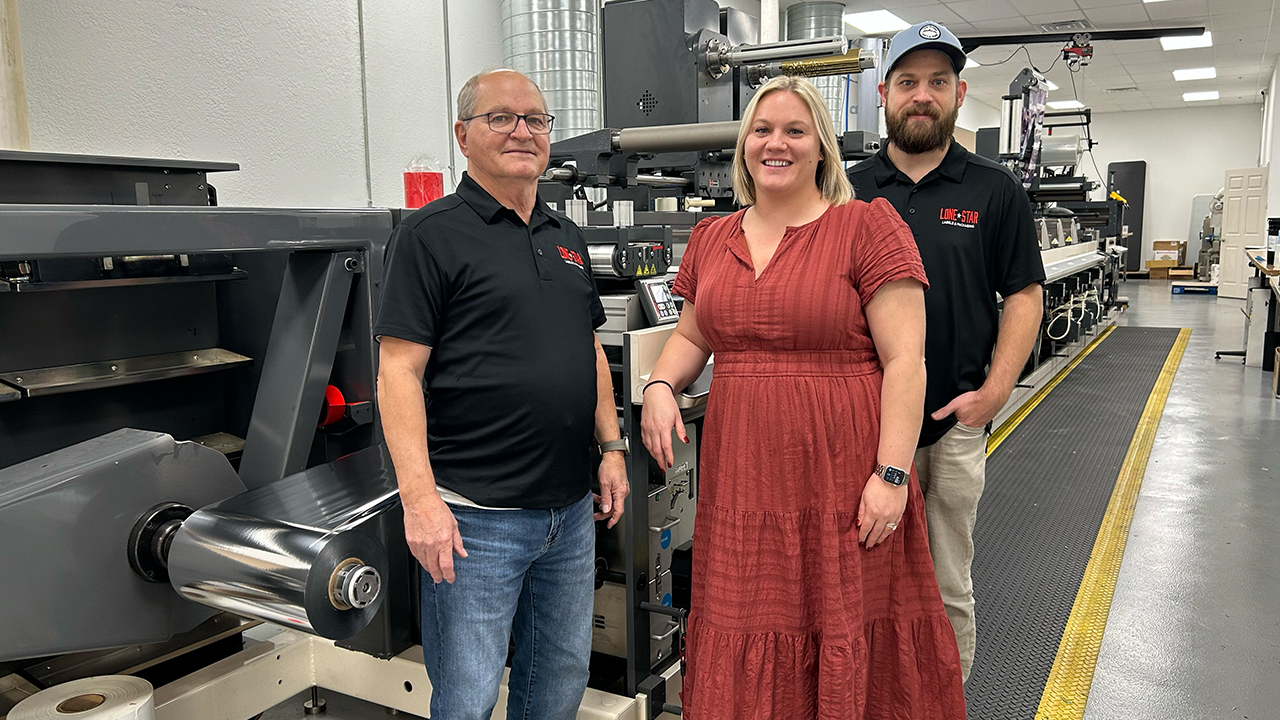
From left: Perry, Katie and Brandon Wray in front of a Nilpeter press
Lone Star Labels & Packaging’s physical presence has more than quadrupled in the last five years, from about 6,000sqft of facility space and a handful of employees, to 25,000sqft and 27 staff members.
With a recent building acquisition behind the company, and a potential significant workforce expansion ahead, Lone Star Labels sees itself at a moment of explosive growth.
Based in Lewisville, Texas, in the Dallas area, the converter is truly a family-run business. It is helmed by president Perry Wray and his two children, vice president of operations Brandon Wray and vice president of sales Katie Wray.
Katie’s husband, Blake Lewis, serves as director of marketing, while Perry’s wife, Carolyn Wray, manages finance for the company, and Brandon’s wife, Tatiana Wray, takes care of customer service and payroll.
For Lone Star Labels, the last five years have seen year-over-year revenue growth, significant investment in technology and a growing workforce. At the same time, the company has re-done its website and made Katie Wray’s LinkedIn profile a focal point for visibility.
The company, which currently runs just one shift, must now decide whether to add a second shift to maintain its growth momentum.
‘I always said we were little Lone Star Labels,’ Katie Wray says. ‘People were like, “Oh, I’ve never heard of you”. Then, all of a sudden, bam, we’re here. But that wasn’t by chance.
The past five years have been trying to build that, what it is now, but I hear that all the time. People often say, “Oh, I’ve seen your LinkedIn” or “I’ve heard of you, but I didn’t really know about your company”. That was intentional in a way, and now it’s time to rattle the industry a little bit.’
History
Perry Wray has worked in the labeling industry for decades. He spent eight years at Avery Dennison before deciding to work for himself, brokering for various label converters. During that time, he served for a year as president of Lone Star Labels, then a reseller. About 25 years ago, Perry bought the Lone Star Labels name and started his own business. Having started as a reseller, the company eventually began producing its own labels, which it sold to resellers.
“It’s a big deal that we’re family-owned, and that it’s run like a family-owned business, not a big corporation”
Perry Wray and Brandon Wray have worked together since 2003. To ensure that Lone Star Labels would last for his children, Perry Wray decided about 15 years ago to make a switch from selling to resellers to selling directly to end users, brand owners and co-packers.
That led the company to make another shift: from producing simple industrial labels to more complex decorative prime labels and shrink sleeves.
The company is certified by Graphic Measures International, a quality certification required by some major retailers such as Lowe’s, CVS and Target.
Today, about 15 percent of the company’s revenue still comes from industrial labels, while about 20 percent comes from flexible packaging.
The last 65 percent is split fairly evenly between prime labels and shrink sleeves. Its biggest end-use markets are health and beauty, and food and beverage.
Technology
Lone Star Labels produces its industrial labels on a Mark Andy 2200 press, which has run smoothly since Lone Star acquired it nearly 20 years ago.
To produce its prime labels and shrink sleeves, the company uses three presses, all of which it purchased in the last five years: an 11-color Nilpeter FA-17 press, a 10-color Nilpeter FA-17 press and a 13in HP Indigo 6K. The Nilpeter presses have adjustable anvil die stations and quick-change die stations and are set up for printing thin film. The HP, Lone Star Label’s newest press, which it purchased about two years ago, can print multiple SKUs.
‘The HP got us a lot more versatility,’ Brandon Wray says. ‘We could do stick pack or sachets, we could do shrink sleeves, we could do labels, all of that. Ultimately, the biggest thing was that it was what’s proven to work for digital shrink.’
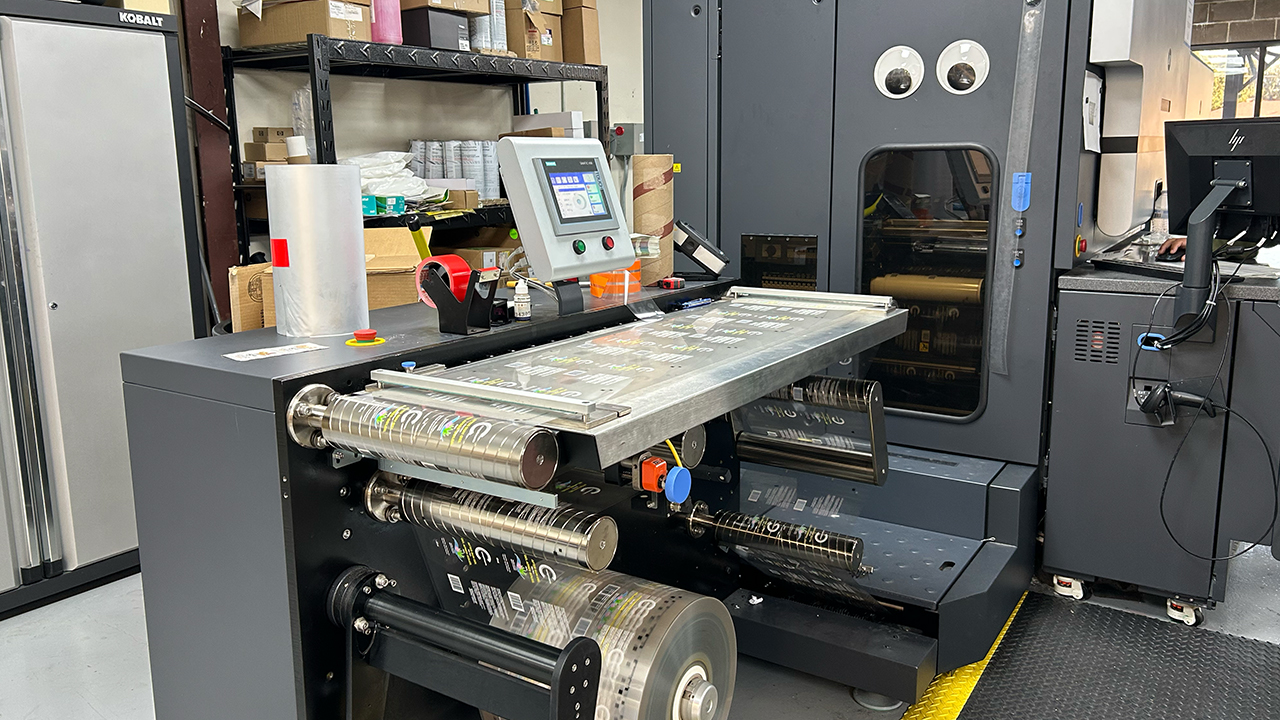
The converter also has a Grafisk Maskinfabrik GM 350 finishing unit and three CEI 17in slitter rewinders. The company’s most recent investment is a second 100 percent inspection CEI unit.
‘We needed more throughput in our finishing department,’ Brandon Wray says of the new CEI unit. ‘We were starting to get bogged down in there. We also got it geared more toward thin films and flexible packaging.’
Other impactful technology for the company includes its Label Traxx software, which helps automate job scheduling, and its BST inspection system, which is on the presses and finishing equipment.
Building acquisition
Lone Star Labels has been located in the same building since 2000. Over the years, the company gradually increased the amount of space it rented in the building until it eventually made financial sense for Lone Star to buy the entire building, which it did in July 2025.
‘We’ve looked at buying buildings at other locations, but this location is just perfect,’ Katie Wray says. ‘We’re close to the highway; trying to get in and out of here is easy. Centrally located; we have employees coming from all over the metroplex.’
Lone Star Labels does not currently occupy the whole space and still has one renter.
According to Perry Wray, the building acquisition sent a reassuring message to employees that the family was heavily invested in the company’s future and wouldn’t be selling the business anytime soon.
‘It sent a huge message to the people that worked here that we’re here for the long haul,’ Perry Wray says. ‘We’re not going to sell, and we’re not going to move somewhere that doesn’t make sense for them logistically to come into work.’
Sustainability
Lone Star Labels prides itself on being an early adopter of sustainable technologies, such as LED curing systems and CPET shrink film. The company says it was among the first in the US to invest in a Flexo Wash water-recirculation machine and has worked with its ink supplier to test deinking primers.
‘We’re always trying to stay ahead of what we can do, like on the flex pack side, with mono-material, laminations that are more recycling-friendly, stuff like that,’ Brandon Wray says. ‘Just trying to help our customers know what their options are as far as what can we make them that’s recyclable, or switching from some container that they’re using to a flexible package.’
The team stays educated on sustainability through conversations with their suppliers and by attending industry events.
Lewis adds: ‘We have to be ready to go when that client says this is going to be a requirement for them. We are going to be ahead of the curve and not be shocked by anything. Brandon is doing a great job with the R&D, so there won’t be any type of delay in either production or quality control, because we’ve already tested it. It already passes our QC.’
Company culture
Maintaining its family-run business culture is also important to Lone Star Labels. For instance, the company holds cookouts and Christmas parties for its employees. ‘We’ve established an incredible culture inside the four walls, that we’re all on the same page, and we’re all teammates, and we all want the same things, just to take care of people and have organic growth,’ Lewis says.
“Our biggest challenge is, how do we continue servicing the customer at the level that they’re used to, and take on new business without interrupting them?”
Lone Star’s culture is something the company is known for, and it helps with its workforce. The company has a low turnover rate and regularly receives employee referrals and frequent inquiries about available employment opportunities.
‘Those people are drawn in by the fact that Lone Star Labels is family-owned,’ Perry Wray says. ‘It’s a big deal that we’re family-owned, and that it’s run like a family-owned business, not a big corporation.’
Its location in the Dallas, Texas, metropolitan area, where there are many print shops, also provides them with a strong base from which to draw talent.
‘Everybody running all of our stuff is seasoned in the industry,’ Katie Wray says. ‘For none of our press operators is it their first time being a press operator. Everybody’s been in the industry for quite a bit of time.’
Looking ahead
The next step for Lone Star Labels is likely adding a second shift.
‘If you look at most big shops, they all run three shifts, so we’re only a third at capacity,’ Perry Wray says. ‘But we’re stubborn. We’re causing ourselves all kinds of aggravation in terms of production that we can solve just by doing a second shift. Everybody here has heard the horror stories about a second or third shift; it’s harder to manage.’
The immediate goal of adding a second shift would be to alleviate the pressure on the first shift workers. Adding that second shift would also enable Lone Star Labels to take on more business.
As a family-owned company, Lone Star Labels wouldn’t even necessarily feel enormous pressure to make sure the second shift pays for itself right away.
‘Our biggest challenge is, how do we continue servicing the customer at the level that they’re used to, and take on new business without interrupting them?’ Perry Wray asks. ‘The simple answer is to start a second shift.’
Additionally, Lone Star Labels expects flexible packaging, including wider-web flexible packaging, to be a larger part of its business going forward. The company anticipates eventually investing in wider-web machinery.
‘That’s an emerging market for us,’ Perry Wray says. ‘We haven’t really dived into that big time on that side, but it is going to be a big part of where we go going forward.’
Perry Wray is now 71 years old, and he does plan to eventually retire, at least part-time. With Brandon and Katie Wray (40 and 34, respectively) at the company, the future leadership of Lone Star Labels is secure.
‘We’re not trying to be as big as we can be. That’s not the point. The point is to be big enough to be relevant and still cover service to customers,’ Perry Wray concludes.
Stay up to date
Subscribe to the free Label News newsletter and receive the latest content every week. We'll never share your email address.