Printma’s digital turning point
Polish label converter installs a Durst Tau 340 RSC E and transforms its production in a matter of months.
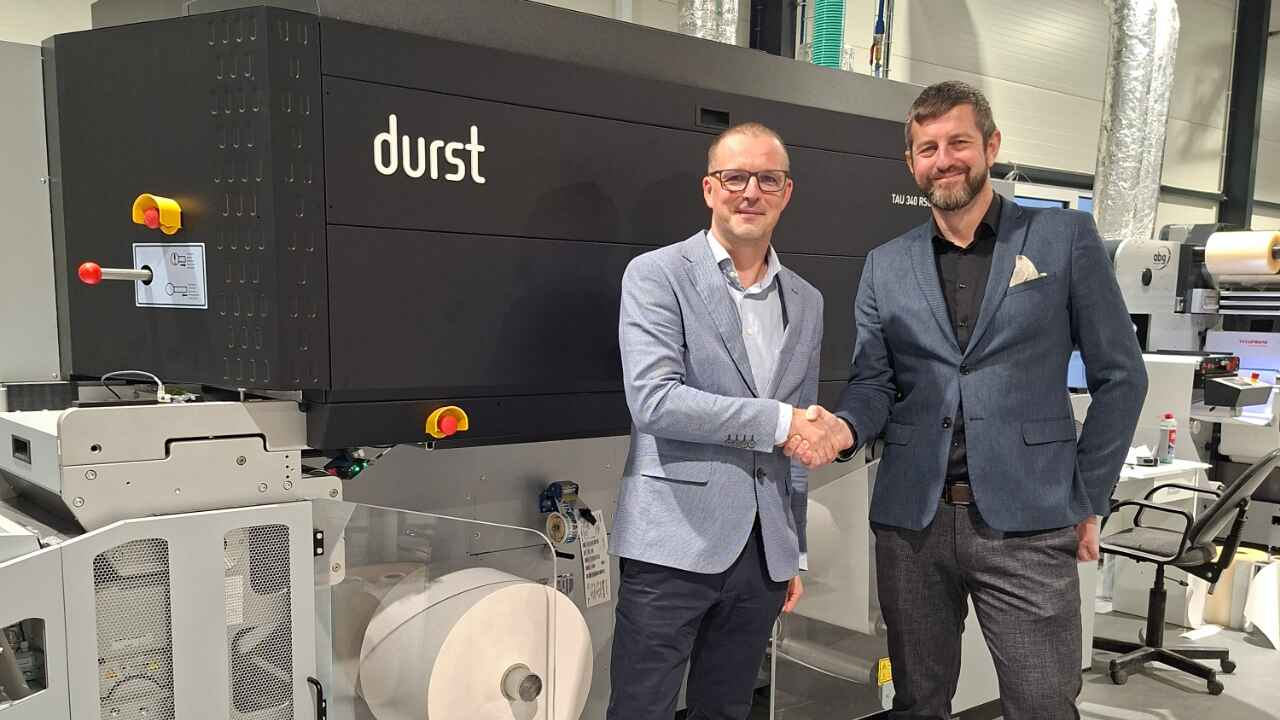
Patrycjusz Mamczarz, owner of Printma and Grzegorz Zielinski, labels and flexible packaging manager at LFP Industrial Solutions
In the three months following the installation of a Durst Tau
340 RSC E inkjet press at its facility in Lublin, Poland, Printma
produced more linear meters of labels than it had in the entire four years of operating its previous machine. Unit costs on comparable jobs fell by 60 percent. What had been a business constrained by substrate limitations, slow finishing speeds and a narrow customer base, within a single production quarter, became something materially different.
Road to independence
Printma was founded in 2019 by Patrycjusz Mamczarz, whose
connection to the printing industry goes back to childhood. His
father ran a printing company from the late 1980s through a period of profound economic change in Poland, and Mamczarz grew up around the business before eventually moving into it professionally.
‘I started doing basic things in the company, then holiday work
during my studies, even though my degree had nothing to do with printing,’ he says. ‘And later it just happened naturally. I moved into working at the company full time.’
His early career was spent running a separate sheet-fed digital and pre-press operation before establishing Printma as his own venture in 2019, initially in sheet-fed digital and later adding a roll-fed press to serve customers moving toward automated label application. For around four years, that configuration sustained the business. Then its limits became a problem.
The substrate ceiling
Dry-toner technology imposes firm material boundaries. For
Printma, that meant polyethylene, thermal paper and metalized substrates were all beyond the press’ capability, a structural exclusion from a significant portion of the label market.
‘I couldn’t do thermal labels, polyethylene and metalized
materials. Anything with polyethylene, thermal paper or using
white color was simply off the table,’ explains Mamczarz. ‘A lot
of jobs were falling through. There were customers who wanted to work with me, but I simply couldn’t serve them. The thought started growing: I needed to invest in something that would expand my product portfolio.’
The finishing side was also problematic. A plotter running at
12m/min on larger labels and as little as 1.5m/min on small ones was a hard ceiling on throughput, and the toner press required dedicated specialty substrates at a price premium over standard materials. Across substrates, speed and cost, the existing setup had exhausted its potential.
Evaluating the options
Mamczarz approached the investment decision methodically,
evaluating hybrid presses, electrophotographic digital technology and inkjet, gathering commercial proposals for each. Hybrid presses were set aside on economic grounds.
‘I also looked at hybrid presses, but when I ran the economics, the cost of the machine versus the volumes and customers I had at the start, didn’t add up,’ he notes. ‘A hybrid is for a company running two or three shifts with solid volumes. Not for someone starting out in this market.’
“This isn’t marketing, it’s mathematics. I calculated it on real jobs. 60 percent cheaper. Period”
The electrophotographic option offered strong color capability
but carried a mandatory monthly service contract. Inkjet offered Mamczarz a clearer running cost model.
‘The service contract was a significant monthly commitment on top of financing the machine. The technology is great and gives you a lot of color possibilities, but I decided I didn’t want to commit to that monthly burden,’ he adds.
The case for Durst
Within inkjet, the decision in favor of the Durst Tau 340 RSC E
was shaped by a visit to Durst’s headquarters in Brixen, northern Italy, and by the conduct of LFP Industrial Solutions, Durst’s Polish distributor, throughout the evaluation process.
At Brixen, Mamczarz tested his own substrate samples at the
Customer Experience Center. The results matched what he had already seen in printed samples sent earlier, with no difference between the demonstration environment and real-world output. ‘Those tests confirmed everything I had seen earlier,’ he recalls. ‘Theory matched practice perfectly. And one thing struck me positively: Durst doesn’t make a lot of marketing noise about itself. The brand is a bit understated. Paradoxically, that works in its favor. Here, quality speaks for itself.’

LFP Industrial Solutions structured the sales process around
Printma’s specific situation. Grzegorz Zielinski, labels and
flexible packaging manager at LFP Industrial Solutions at the
time, describes an approach built on detailed pre-sale analysis. A questionnaire covering budget, transition timeframe and the customer’s key performance indicators generated multiple investment scenarios. LFP worked with Mamczarz to ensure the machine configuration matched the reality of the business rather than an idealized version of it. LFP sees clearly that converters are increasingly looking not just for efficiency, but for predictability and control over their production process.
‘The entire process, working from the general to the specific,
culminates in a tailored configuration that, from the moment of
installation, is already performing the tasks it was designed for,’ he says. Mamczarz experienced that process directly. ‘I received complete information: fast, concrete, without storytelling,’ he comments. ‘I felt that if I bought something, I would have a partner, not a salesperson.’
Preparing for the installation
Before placing the order, Mamczarz built a new production hall. The existing premises could not accommodate the Tau 340 RSC E’s footprint, and he resolved that before the machine arrived. Installation took place in June 2024. It was carried out by LFP’s service team, which handled setup, configuration and operator training. Operators adapted to the press interface quickly, practical features such as web rewinding to minimize substrate waste were in use from the first week, and there was no gap between what had been demonstrated in Brixen and what the press delivered on the
production floor.
A parallel investment in a semi-rotary finishing machine,
made alongside the press order, addressed the throughput
ceiling. Finishing speeds increased dramatically, removing the last constraint on production capacity.
The results
The production figures reflect several factors converging
simultaneously: the Tau 340 RSC E handles substrates the toner technology could not; throughput is substantially higher; standard inkjet substrates replaced the toner-specific specialty materials; and the removal of a fixed monthly service overhead reduced the cost base immediately. Mamczarz puts it plainly.
‘This isn’t marketing, it’s mathematics,’ he comments. ‘I
calculated it on real jobs. 60 percent cheaper. Period. And the
volume: after the Durst installation in the second half of last year, I produced more than I had in the previous four years.’
The commercial impact has been equally significant. Printma’s
few-day delivery lead time, compared with eight to 15 days at
larger conventional print shops, has become the company’s primary sales argument. A customer who had previously been unable to source metalized labels because of the toner press limitation returned once the Tau 340 RSC E was installed.
‘He brought his label and said: if you can match the quality
of this sample, I’m in,’ Mamczarz recalls. ‘Shorter delivery time, compared with his previous supplier, was another argument for working with us.’
Most new business at Printma now arrives through referral
rather than marketing.
After-sales and monitoring
The after-sales relationship with LFP has been a meaningful part of the operational experience, with remote monitoring through the Durst Analytics platform, meaning potential machine issues are identified and acted on before they reach the operator.
‘LFP service sees a message on the machine before I even realize something might be wrong,’ Mamczarz explains. ‘I’ve been an entrepreneur for years, and I know how painful downtime can be. And suddenly I have no stress. That’s truly a new experience.’
Zielinski describes Durst Analytics as operating across three
areas. ‘The first is reactive service: sensor density throughout
the machine allows LFP engineers to remotely diagnose and
resolve most operational issues, at a success rate he puts at
over 80 percent. The second is proactive maintenance, in which consumable components such as UV lamps are monitored against usage intervals, enabling planned replacements coordinated with the customer’s production schedule and supporting a higher OEE rate. The third is operational intelligence.
‘We accumulate knowledge about each customer’s production
and the challenges they face day to day,’ he notes. ‘If the data
shows the machine recording increased idle time on certain substrates, that may indicate an opportunity to discuss production planning with the operator and suggest some optimization.’
“It’s not just about printing faster and cheaper. It’s about the quality of my life as an entrepreneur. Durst opened a new chapter for us”
All remote access sessions take place with the customer’s full
knowledge and explicit consent.
What comes next
The Tau 340 RSC E currently runs one eight-hour shift a day, and Mamczarz is candid about the pressure that is building.
‘I’m still only running one shift. I’ll probably need to think about
additional staff, because jobs that used to take two or three days are now taking longer simply because there are more of them,’ he explains.
‘I also have plans to add some kind of digital enhancement
capability, digital varnish perhaps, or a 3D effect. We currently
have one flexo station and cold foiling on the finishing side, so
some basic spot coating is possible. But a next step toward more decorative labels is something I’m thinking about, probably not this year, maybe next.’
A second press is the medium-term ambition. The production
hall was designed with expansion in mind, and additional floor
space is already reserved.
‘I prefer to grow steadily so I don’t end up with financial
problems or a machine I can’t keep running,’ Mamczarz says.
What the past 12 months have demonstrated is that a
five-person team working one shift has multiplied its output many times over, reduced its unit costs and opened customer segments it could not previously reach, all within its first production quarter on the new press.
‘It’s not just about printing faster and cheaper,’ Mamczarz
concludes. ‘It’s about the quality of my life as an entrepreneur.
Durst opened a new chapter for us.’
Article update
Since this article was published, Grzegorz Zielinski has left LFP Industrial Solutions. The company employed Wojciech Talarek, who took responsibility for label division development and client projects.
Stay up to date
Subscribe to the free Label News newsletter and receive the latest content every week. We'll never share your email address.