Liberty Marking Systems grows from thermal transfer roots
Throughout its 38 years of operation, the Cincinnati label converter has remained committed to its company culture.
Tim Beam founded Liberty Marking Systems in 1988, with just two employees selling thermal transfer labels and ribbons out of a basement. He wanted Liberty Marking Systems to be the best place that his employees had ever worked, and for the company to prioritize work-life balance.
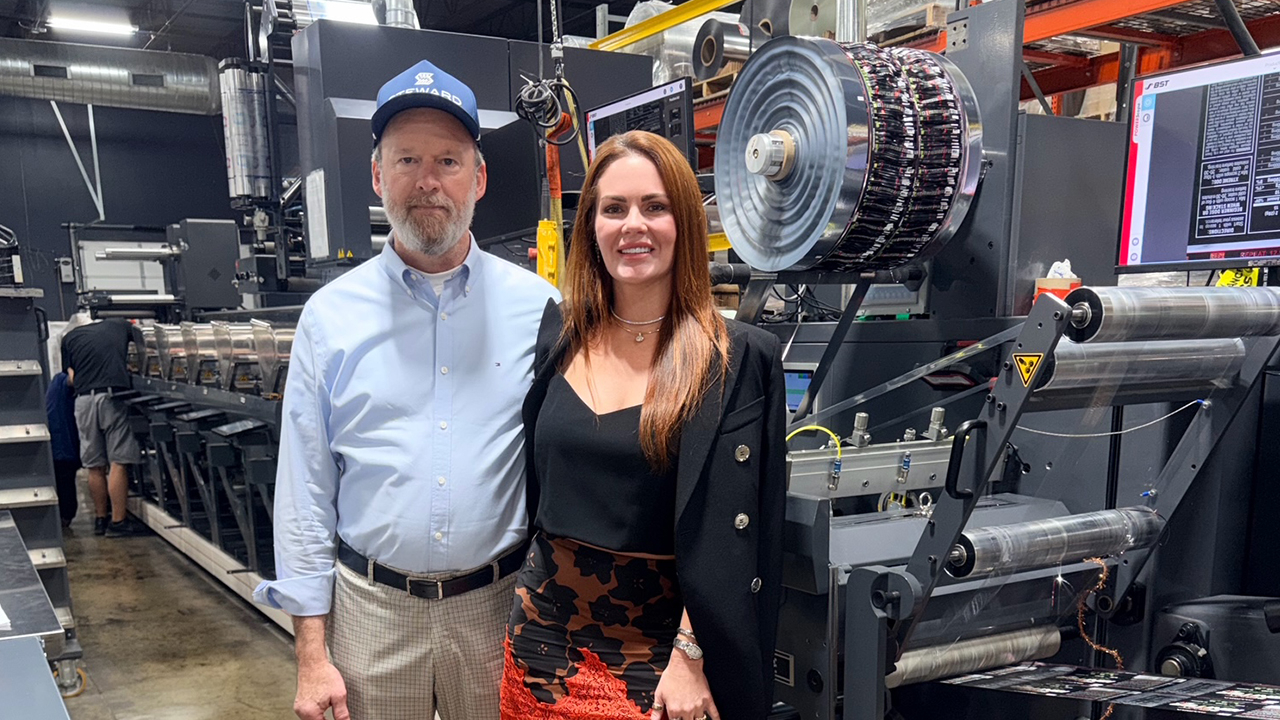
Now, 38 years later, much has changed at Liberty Marking Systems. The Cincinnati, Ohio, converter has 33 employees, occupies a 30,000sqft facility space, runs six presses and brings in 12 million USD in revenue annually. Tim Beam’s son, Brian Beam, helms the company. But one thing that has stayed the same is Liberty Marking Systems’ commitment to its culture.
‘When Tim started the company, he said: “We’re going to make sure that the people that come work for us, we take care of them; and that family is still their number one obligation,”’ president Brian Beam says. ‘If [you’re] at work and something happens, not only are we going to allow you to take care of that, we expect you to go take care of your family.’
Today, the vast majority, about 95 percent, of the Liberty Marking Systems’ products are pressure sensitive labels, half of which are printed and half blank. The other five percent are tags.
The company specializes in functional, industrial and thermal transfer labels. Its biggest end-use markets are automotive, chemicals, warehousing and distribution, and food and beverage. Some examples of the company’s labels include automotive labels found under car hoods and bakery labels with ingredient and nutritional information.
For many of its labels, Liberty Marking Systems produces printed and branded pressure-sensitive labels for a customer, and the customer then adds information via on-demand variable printing.
History
Before Tim Beam established Liberty Marking Systems, he worked for another company, repairing and selling thermal transfer printers. The clients he visited often asked him to sell them labelstock and ribbons, but the company wasn’t interested in doing that. So, Tim Beam decided to start Liberty Marking Systems to sell those products himself.
The company expanded by adding a die-cutter and a Zebra printer, enabling Liberty Marking Systems to start selling printed labels. In 1991, it moved into its first building. One of the company’s biggest clients in its early days was Kimball Electronics in Jasper, Indiana, which helped establish Liberty Marking Systems in the industrial industry.
Tim Beam still serves as chief financial officer, and he meets regularly with his son to go over the company’s financials. Brian Beam has been with the company since he graduated from college in 2007.
‘I did major in entrepreneurship at the University of Dayton, so I knew I wanted to own and run my own business,’ Brian Beam says. ‘Seeing my dad do that, it always looked challenging, fun and flexible, but I was never really involved much in the business growing up, so I didn’t just expect or anticipate taking over the business or working for the business. But after spending a few months after graduation looking at different things, somebody made the recommendation to me that if I could work for my father, it’s worth giving it a shot.’
Brian Beam started in the sales team for the company and, around 2014, he became a minority owner. A few years later, he began taking over operational leadership responsibilities, focusing on building out the company’s software system.
Functional and industrial labels
Specializing in functional and industrial labels brings its own set of considerations at Liberty Marking Systems.
For instance, much of Liberty Marking Systems’ work requires durable material, which is often more expensive and can pose challenges.
“Ensuring that the print is durable enough for the environment where the labels are used is certainly something we must consider”
‘Printing on durable materials is not always as simple,’ Brian Beam says. ‘We found that material might work well for the first couple thousand feet, and then you hit areas where the coating or the thickness of the material impacts the print that we’re doing. Ensuring that the print is durable enough for the environment where the labels are used is certainly something we must consider. We use mostly water-based ink for our flexo presses, so we typically must put an overlaminate on those, which then just adds another element of quality control, making sure the laminate is flat, it’s not wrinkling or bubbling, and not causing the labels to curl.’
Version control is also essential, as many of the labels they produce look similar.
Additionally, many of Liberty Marking Systems’ labels require the brand to perform some of its own printing, such as for nutritional information. Liberty Marking Systems prefers to provide all the elements a brand might need for this, so it can better support its customers.
‘It’s another variable that either needs to be taken into account, or that could go wrong, which is why we like to support everything from the software, the labels, the ribbon, the printers, the applicators,’ Brian Beam says. ‘If something isn’t working at optimal levels, we don’t have a lot of finger-pointing going on. We just say we’ve provided the whole supply chain. From the label project perspective, we’ve got to fix it. It is another element and another challenge, but it’s also a major selling point for us that we can provide the whole gamut.’
Liberty Marking Systems does some work with prime labels, often for hardware store products that are not heavily brand-forward. The company has not pursued this segment more in part because of the high level of scrutiny, which requires practically flawless inspection and quality control.
Printing technology
Liberty Marking Systems has five flexo presses and one digital press.
The converter has four Nilpeter FB-Line presses and one Mark Andy 2200 press with a Domino printbar. Liberty Marking Systems invested in the printbar about three years ago, enabling it to expand its variable-data printing offerings. All its flexo presses are 13in.
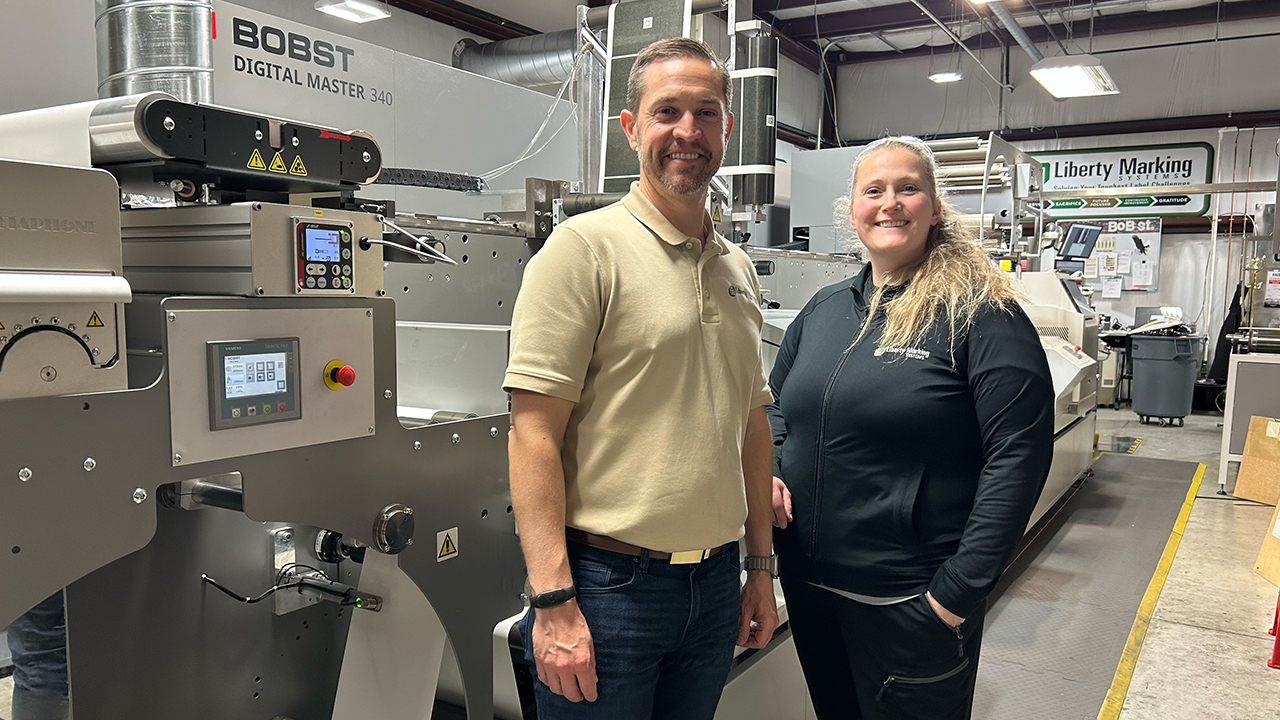
Its digital press, a Bobst Digital Master 340, is the company’s newest installation. Liberty Marking Systems used to outsource its digital printing jobs until it decided to invest in its own digital press, which was installed in October of 2024. The press offers faster turnarounds, with speedier set-ups and no changeovers or cleanups.
Digital has also enabled Liberty Marking Systems to do some prime label work.
‘Long-running single SKUs, or large volumes of single SKUs, still make sense to run on a flexo,’ Brain Beam says. ‘Digital is where your small and medium runs really start to play; lots of different SKUs, front-back combinations, things of that nature.’
For finishing technology, the company has three die-cutters from Kor Engineering, Pac-35 and Arpeco and five Mark Andy Rotoflex slitter rewinders.
Custom software
Liberty Marking Systems has its own custom software, which it began developing in 2016, when it transitioned to a new order entry system. This system grew to encompass job tracking, inventory, purchasing, quoting and accounting. It helps automate processes, something that has
been a passion of Brian Beam’s.
Liberty Marking Systems developed the software with a contractor. Brian Beam decided to go this route rather than with a software supplier because he wanted to create a system that built on what long-term employees were already doing.
“If we take care of the employees right, the rest of this will just fall into place”
‘At that point, we had probably 25 employees. Most of them had been here for two decades or more, so they were very comfortable, familiar and successful with doing things the way we’ve always done,’ Brian Beam says. ‘I knew that we wouldn’t be able to continue to let everybody have their own Excel spreadsheet and put information in their own silo, and I just felt like the custom
system was meeting them where they were, versus a complete SAP overhaul or going with Oracle or Label Traxx.
‘I just thought, this gives me and the team the control to do things the way we want to do,’ he continues. ‘We hadn’t had a lot of experience with out-of-the-box software, and we had success with our first system.’
Liberty Marking Systems has been using this custom software successfully for the past 10 years.
‘We certainly wouldn’t be where we are today without it,’ Brian Beam says.
Artificial intelligence
Brian Beam is also a proponent of AI, and he strives to make Liberty Marking Systems an ‘AI-first company’. He has encouraged his leadership team to experiment and become familiar with it. He even hired a local leadership organization, Leadership Excelleration, to conduct a four-week-long AI workshop with Liberty Marking’s leadership team.
Liberty Marking Systems primarily uses ChatGPT for its AI needs and has also utilized Microsoft Copilot. It has leveraged AI to address a variety of challenges, such as analyzing job-level profitability to help the converter determine how to focus its time and effort.
Liberty Marking Systems created an AI policy, shaped by security and privacy needs, to guide employees on using the technology and to protect the company.
‘We make sure that it’s an effective document. Also, if there are other models or platforms people want to use, we should know which ones. We can test them, vet them, and ultimately, if they do become approved AI platforms, we can then make everybody aware of it,’ he says.
 Vision charter
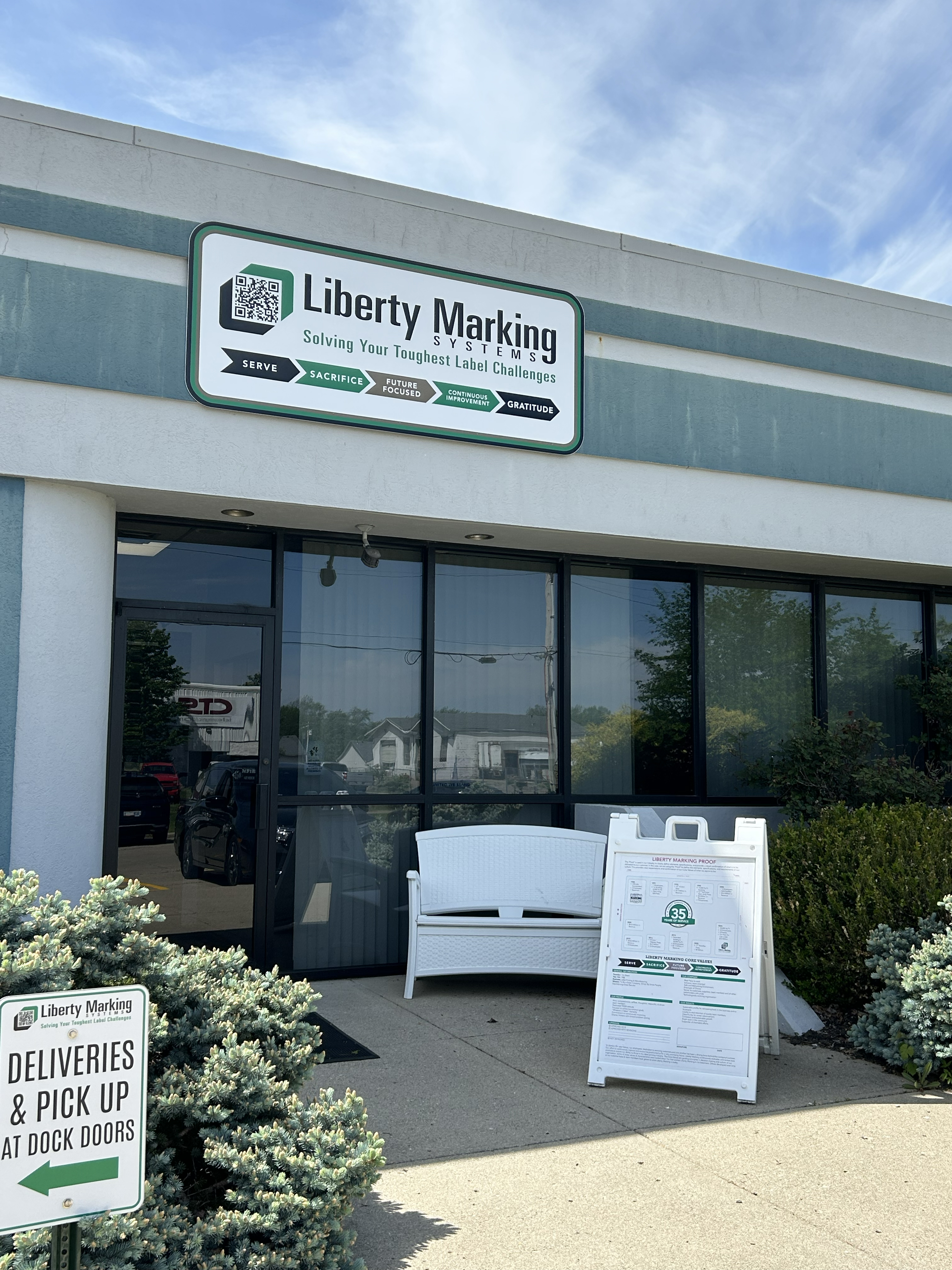
With its 40th anniversary coming up in 2028, Liberty Marking Systems created a vision charter outlining goals for the company.
The charter focuses on six pillars: employee experience, culture of operationalizing, sales and marketing, finance, other stakeholders and the customer experience. Each pillar comes with five goals or success statements.
These include employees having more frequent check-ins with managers and ensuring that standard documentation procedures are written down.
Of these pillars, Brian Beam feels that employee experience carries the most weight. Beyond the vision charter, the company’s employee perks and benefits include access to educational workshops and a financial wellness program.
Employees can offer each other recognition through its ‘Thnks’ program and gift each other a coffee, a lunch or an experience, funded by Liberty Marking Systems.
Employees can also earn Core Value Cards that can be redeemed for experiences like sporting events.
‘If we take care of the employees right, the rest of this will just fall into place,’ Brian Beam concludes.
Stay up to date
Subscribe to the free Label News newsletter and receive the latest content every week. We'll never share your email address.