Four generations of reinvention at Candle United
A 50-year-old Haryana print business successfully pivoted from ticket production to advanced pharmaceutical label converting.
It could be said that the modern trajectory of Candle United was changed by a humble movie ticket. Of course, for a 50-year-old printing business based in Yamuna Nagar, Haryana, India, there were many operational shifts before high-precision label conversion redefined its market position. But to understand the sheer scale of the company’s industrial evolution, one must return to its origins in regional transit and
entertainment ticketing.
During the 1970s, the family-owned enterprise operated as a small, home-based commercial job printer. Utilizing traditional,
manual letterpress technology, the workshop’s daily survival depended on producing mass-produced bus and cinema tickets, as well as standard office stationery, for the local market. Today, that same business operates out of a newly developed 70,000sqft industrial facility, deploying advanced dry-toner digital technology to print tight-tolerance pharmaceutical barcodes on labels designed for small-volume packaging.
Diversifying into screen and offset
‘As the regional economy expanded in the 1980s, the company recognized that relying exclusively on transit and cinema tickets left its revenue vulnerable to shifting local dynamics,’ shares managing director Vansh Kapoor. ‘To broaden its market reach, the company invested in silk screen printing equipment alongside its original letterpress machines.’
‘However, the true turning point toward the modern packaging value chain occurred in the 1990s,’ says Kapoor. ‘Recognizing that standard commercial job printing was becoming increasingly commoditized, we made a strategic decision to enter the sticker and label printing segment. This transition was marked by a major upgrade in shop-floor technology, as our company diversified by investing in sheet-fed offset printing machinery and hot stamping foil systems.’
To support these new technical capabilities, Candle United established its first dedicated industrial footprint: a 2,000sqft manufacturing facility. This specialized space brought together four distinct production processes under one roof, combining high-opacity screen printing used to produce durable stickers and marking labels for utensil manufacturers and construction material industries, specifically plywood and panel manufacturers, hot foil stamping to achieve metallic finishes for premium product decoration, offset printing to deliver fine halftone imagery and in-house adhesive gumming operations to develop chemical expertise in substrate coatings and adhesive behavior.
Over the years, this gradual transition provided the family with
decades of hands-on experience in labels, printing technologies, finishing processes and specific customer requirements before they ever entered advanced digital label production.
“Setting up a conventional press for a short-run was highly uneconomical”
Between 2000 and 2020, industrial manufacturing moved rapidly away from manual, sheet-fed sticker application
toward high-speed, automated label‑dispensing lines. To keep pace with these changing assembly lines, Candle United expanded its existing production operations to approximately 4,000sqft.
‘During this two-decade phase, the company gradually transitioned into roll-to-roll sticker printing by integrating in-line hot foil stamping with robust rotary and flatbed die-cutting
capabilities,’ notes Kapoor. ‘This allowed the company to begin delivering self-adhesive labels in roll formats, ready for high-speed automatic applicators.’
The flexographic upgrade
A major turning point for Candle United came in 2021 with a formal transition in corporate leadership. Kapoor, representing
the fourth generation of the family print business, returned to India to assume control as managing director after completing his bachelor of business (honors) degree, majoring in accounting and financial planning, from La Trobe University in Australia. He arrived on the shop floor with a highly structured,
analytical objective to modernize and scale the family business into a future-ready label manufacturing company capable of serving India’s rapidly growing packaging industry. Following Kapoor’s return, the company significantly accelerated its modernization strategy, and his first major
capital investment was the installation of a narrow-web LED roll-to-roll flexo press.
This press allowed Candle United to break out of the regional industrial sticker market and enter highly regulated corporate packaging sectors, with an explicit focus on serving the high-
compliance pharmaceutical sector, fast-moving consumer goods brands and the high-volume packaged drinking water
industry. Flexo changed the direction of the business, but as brand requirements shifted, conventional technology eventually hit a hard operational ceiling.
The short-run challenge
Brands faced intensifying pressure to reduce physical inventory overheads, manage frequent regulatory text updates, launch localized marketing variations and support a massive proliferation of individual stock-keeping units.
‘As the market evolved, customers increasingly required smaller order quantities, faster turnaround times, multiple SKUs and greater flexibility, making digital printing an ideal choice for our operations,’ explains Kapoor.
Before adopting digital technology, the company faced major operational bottlenecks when attempting short-run corporate jobs on conventional flexographic equipment. ‘Setting up a conventional press for a short-run was highly uneconomical
because it involved extensive setup times, mechanical plate adjustments, ink balancing and substantial substrate waste
during initial registration,’ shares Kapoor.
‘Furthermore, our growing pharmaceutical clientele was frequently demanding exceptionally sharp text, fine details and flawless barcode clarity for small-volume packaging, such as 1ml and 2ml vials. Attempting to consistently hit these tight
tolerances on conventional machines for tiny order volumes was eating into our overall profitability.’
Selecting the technology
Kapoor approached the digital investment decision methodically, analyzing multiple equipment options in the market. The team evaluated several alternative digital label
printing machines, including inkjet-based systems from Monotech, high-end Xeikon digital presses and various Chinese digital printing machines.
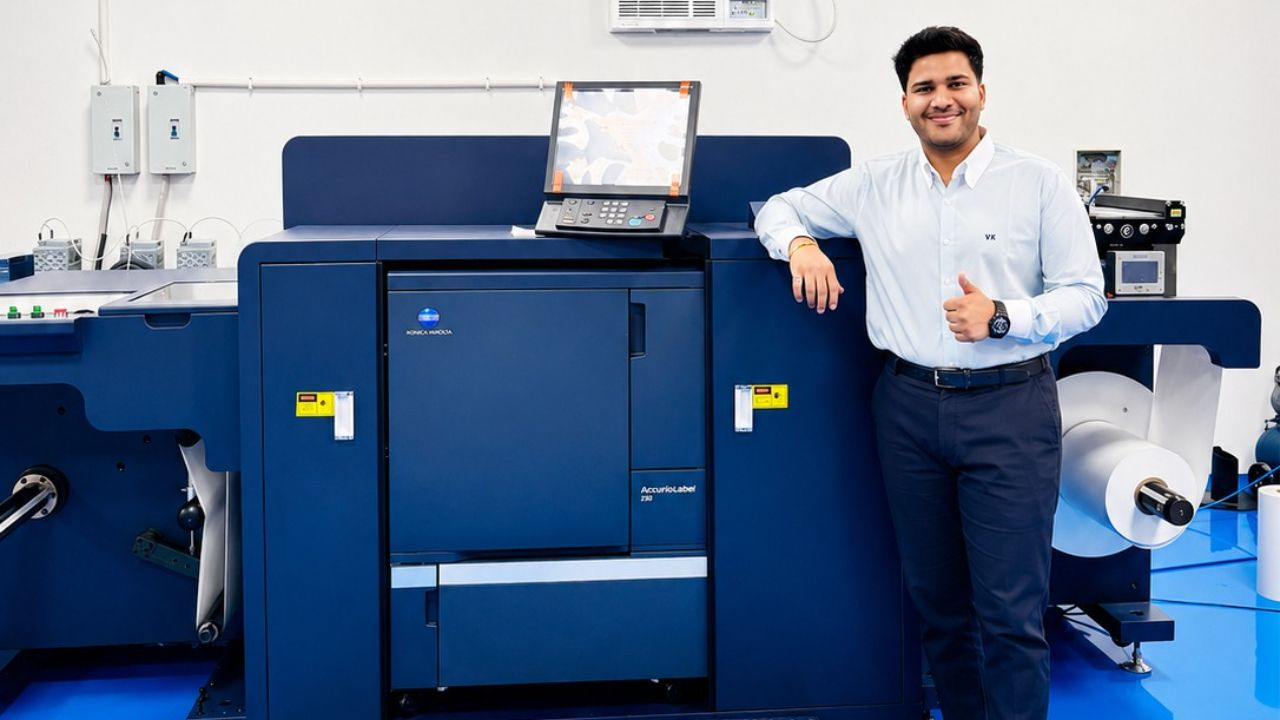
‘Candle United chose the Konica Minolta AccurioLabel 230 primarily because of its dry toner technology, which delivers
excellent print quality and consistency for short-run label production,’ Kapoor notes. ‘It was a perfect fit to meet the pharmaceutical label standards, our immediate short-run production requirements and long-term growth plans.’
The impact of digital infrastructure
The installation of the Konica Minolta AccurioLabel 230 digital press instantly transformed production dynamics at the Yamuna Nagar plant. The investment allowed the company to split its production strategy neatly down the middle, meaning
that long, high-volume runs remained on the flexo press, while complex, short-run, multi-SKU corporate orders were immediately routed to the digital line. Since commissioning the machine, Candle United has experienced significant, measurable benefits in terms of daily productivity, overall operational efficiency and regional business growth.
“Our growing pharmaceutical clientele was frequently demanding exceptionally sharp text, fine details and flawless barcode clarity”
‘The machine has enabled faster job changeovers and reduced setup times, allowing the company to process multiple short-run pharmaceutical label jobs more efficiently,’ Kapoor states. ‘Its high-quality dry toner output ensures sharp text, fine details and barcode clarity, which are critical requirements for small pharmaceutical labels.’
By moving short-run friction away from their conventional presses, Candle United eliminated the front-end bottlenecks
that typically plague growing converters, significantly reducing unit manufacturing costs for versioned label sets and eliminating the need for physical plates, heavy substrate startup waste or extensive color-matching adjustments.
Building for scalability
To fully leverage this advanced digital capability, Candle United undertook its largest capital expansion to date during
2025–2026. Moving away from its historically space-constrained workshop, the company completed the acquisition and development of brand-new, purpose-built industrial premises spanning nearly 70,000sqft of land.
‘Designed from the ground up to accommodate lean manufacturing workflows, clean production zones required for sensitive pharmaceutical labels and automated material handling, the site reflects a long-term corporate vision focused on scalable manufacturing, automation and next-generation label production,’ says Kapoor. Importantly, Kapoor has built the facility with massive future capacity in mind. ‘I plan to develop the newly acquired site through phased development workflows that offer clear potential to scale up to nearly 200,000sqft through multi-story construction as regional volume demand increases.’
To complement the Konica Minolta press, Candle United also installed advanced finishing and converting machinery from
Denchern, China, alongside its existing sheet and roll-handling assets. Today, the company operates an integrated fleet of approximately seven to eight machines across its printing and finishing operations, a balanced configuration that allows it to remain highly responsive and agile, handling short, medium and long runs with identical commercial efficiency.
‘With the successful commissioning of its new manufacturing facility and the Konica Minolta AccurioLabel 230, Candle United is now focused on expanding its production capabilities and customer base,’ Kapoor concludes. ‘The company plans to further strengthen its presence in the pharmaceutical, FMCG and packaged goods sectors while increasing its share of short-run and premium label applications.’
The roadmap ahead
The future roadmap for the Yamuna Nagar converter is clearly defined. With continued investments in technology, infrastructure and deep operational modernization, the company aims to position itself as the primary flexible, technology-driven label manufacturing partner for both emerging and established brands across India. Kapoor says that going forward, the company intends to invest in additional
automation, advanced printing and finishing technologies and expanded manufacturing infrastructure to support long-term growth.
Stay up to date
Subscribe to the free Label News newsletter and receive the latest content every week. We'll never share your email address.