Lauterbach Group undergoes digital transformation
The Wisconsin-based company is expanding into digital flex pack, enhancing its software ecosystem and adding automation, all while embracing continuous improvement.
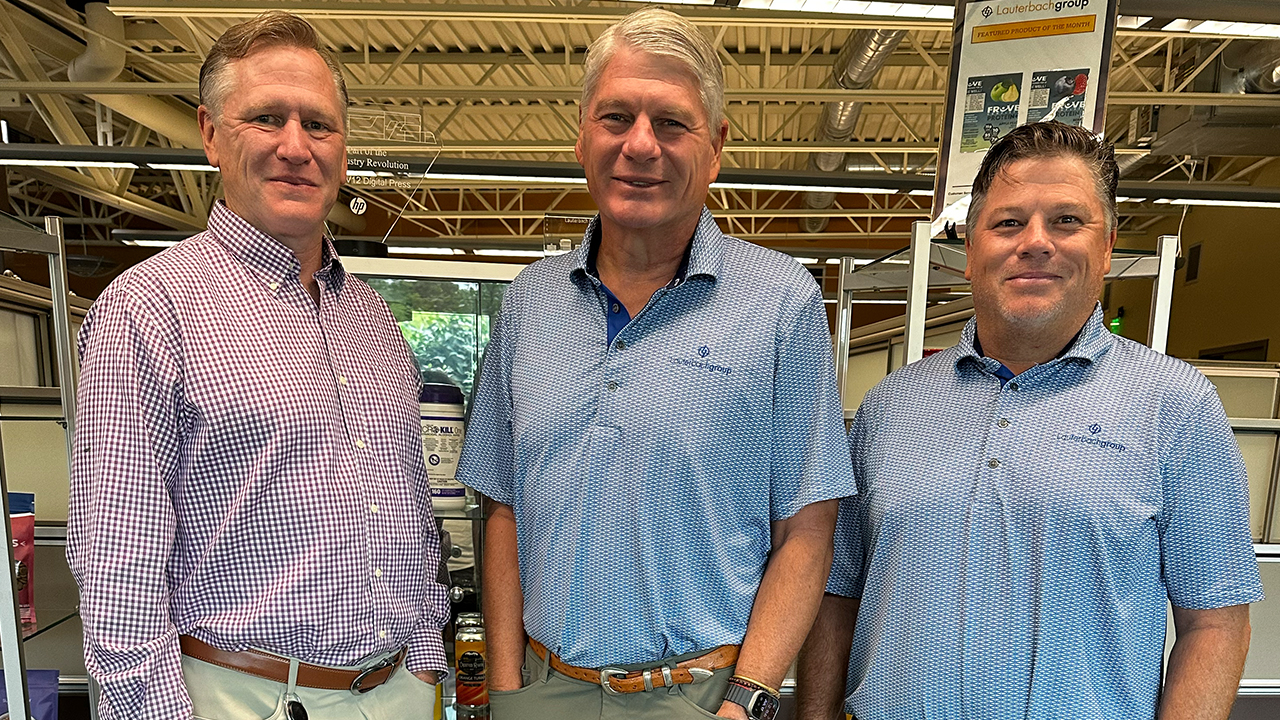
L-R: Heath, Shane and Brent Lauterbach
In 2022, CEO Shane Lauterbach returned from Labelexpo Americas and informed the Lauterbach Group team that the company was purchasing an HP Indigo 25K.
While the converter’s senior leadership team is engaged in the day-to-day operations driving the business, Shane Lauterbach’s role is to look ahead and anticipate future opportunities and challenges, helping to define the direction that the leadership team will execute next. The rapid change of the industry required the Lauterbach Group to enter the packaging market quickly.
They were determined to succeed. They developed a plan for the new press, evaluating which clients to target and material suppliers to use; they scaled up the press and got it to full production in about six months.
Over the past several years, the Lauterbach Group, a family-owned company, has been on a digital journey as it invests in digital flexible packaging technology, develops a more robust software platform and brings in automation and manufacturing consultants.
Based in Sussex, Wisconsin, the Lauterbach Group is an employee-focused business led by Shane Lauterbach and his two brothers, Heath Lauterbach, chief operating officer, and Brent Lauterbach, chief development officer. The company has about 60 employees, called group members, and the company makes use of consultants for IT, marketing and more.
The Lauterbach Group manufactures pressure-sensitive labels, blank stock labels, shrink sleeves and flexible packaging. Its biggest end markets are food, nutraceuticals, health care, cannabis and pet food. Lauterbach Group specializes in middle-market brands.
As it undergoes its digital transformation, the Lauterbach Group is working to greatly expand the percentage of its business focused on flexible packaging. For 2025, the company expects its revenue to come from 10 percent flex pack, 60 percent PS labels, 5 percent shrink sleeve and 25 percent stock products, such as blank labels, thermal labels, wafer seals and now stock flexible pouches. By 2028, the company wants to see those numbers evolve to 30 percent flex pack, 30 percent PS label, 10 percent shrink sleeve and 30 percent stock product sales.
The Lauterbach Group’s transformation has been so significant that the company is even reconsidering its identity as a label converter, as the most challenging components of its technical work are now pouching, rather than printing or converting.
‘We manufacture,’ says Shane Lauterbach. ‘We’re not printers. I’m not even sure we’re converters anymore.’
From labels to flex pack
Lauterbach Group was purchased by the Lauterbach brothers’ father, Bill Lauterbach, in 1985. At the time, it was a reseller of stock labels and tags. After a few years, Bill Lauterbach asked Shane Lauterbach, his eldest son, to step in and run the company. The Lauterbach Group eventually expanded into producing its own labels, rather than just reselling them. Much of its label business was producing direct mail promotional labels on flexo presses.
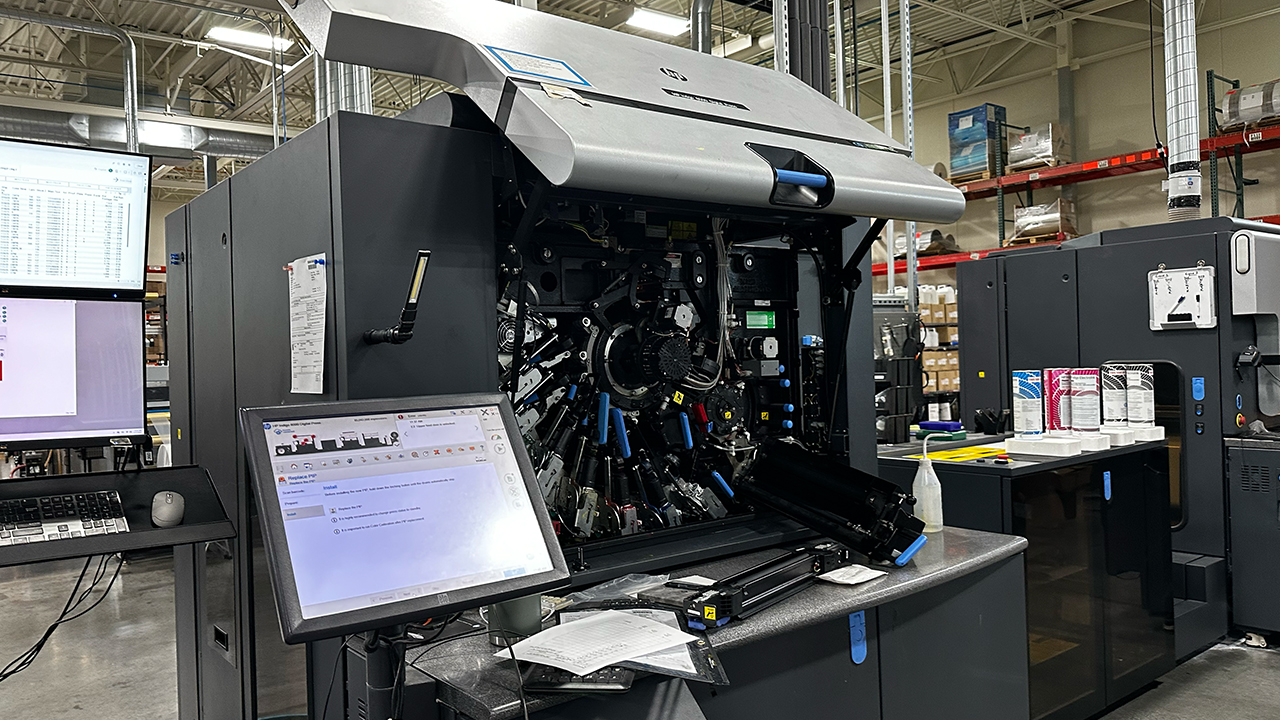
Lauterbach Group’s investment in an HP Indigo 8K in 2017 marked the beginning of its digital transformation. The company went on to purchase from HP an 6K in 2022 and a 25K in 2023.
“We believe flexible pouches and packaging represent a dynamic and rapidly growing segment of the packaging industry, especially when powered by a digital ecosystem and production environment”
The company did not have any clients asking for digital flex pack when it began developing that side of the business. Up until that point, Lauterbach Group’s client base had been primarily direct mail labels and food segments, which weren’t interested in flexible packaging. The company had primarily grown through referrals.
Despite that, the Lauterbach Group wanted to expand into flex pack because of the segment’s strong growth potential.
‘We believe flexible pouches and packaging represent a dynamic and rapidly growing segment of the packaging industry, especially when powered by a digital ecosystem and production environment,’ Shane Lauterbach says. ‘This approach enables the creation of high-quality, sustainably produced and brilliantly decorated packaging with unmatched speed.’
This meant that the team needed to grow its client base more aggressively than it had in the past. Lauterbach Group expanded its sales team to meet the challenge.
Lauterbach Group sees several benefits in focusing on its digital print technology.
The integration of digital printing technology with the Lauterbach Group’s proprietary software system enables the Lauterbach Group to deliver products to clients quickly with a high level of consistency in quality. This allows clients to hold smaller inventories of packaging.
Digital printing has also opened up new product lines, bringing more cross-selling opportunities. For example, the company now also manufactures shrink sleeves with its digital printing technology.
Technology
Alongside these benefits, digital presses also have their own challenges. Unlike flexo, which can be maintained and used for decades, digital presses become obsolete rapidly, requiring more frequent reinvestment.
‘It’s an exciting time because you have to grow quickly,’ Brent Lauterbach says. ‘You must put a bunch of capital into the equipment. You didn’t have to do that 15, 20 years ago. Now it’s every two, three years.’
In addition to its digital presses, Lauterbach Group has a number of 10- to-20-year-old Mark Andy flexo presses. The company anticipates replacing them with machines that offer more automation. Along with the digital presses for flexible packaging, Lauterbach Group has added a Karlville pouching machine to its production fleet. Not having to outsource pouching is one of the Lauterbach Group’s greatest assets, Brent Lauterbach says.
Lauterbach also has finishing and laminating equipment from Delta ModTech, laminating machinery from Gonderflex and rewinders from Grafotronic.
Digital ecosystem
A crucial component of Lauterbach Group’s digital transformation has been its integrated software system, which the company calls its ‘digital ecosystem’, or its OmniMark platform. Lauterbach Group hired consultants to build this technology.
This ecosystem, built on Label Traxx and Hybrid Software as well as proprietary client-facing and middleware software, allows clients to submit orders, approve proofs and monitor progress. It also handles production workflow and job management.
‘This system brings together all components of sales, service, production and client interaction,’ Shane Lauterbach says. ‘We want to eliminate redundant activities and transactions, make it easier for clients and our group members to do their jobs and deliver greater value to both, in addition to a high-quality product.’
The digital ecosystem provides clients with more flexibility, allowing them to place orders and upload artwork 24/7 at their convenience. Meanwhile, Lauterbach Group employees no longer need to interact with the order, giving its group members more time to focus on helping clients.
‘It’s opened up some opportunities, because there are certain companies that wouldn’t work with you unless you had something like this,’ Brent Lauterbach says.
Lauterbach Group does not see its systems as complete and continues to develop and improve its technology and processes. It is a living and continually improving environment.
‘In the digital pouching world, there are so many opportunities,’ Brent Lauterbach says. ‘We’re focused on speed to market and total quality. If we can turn pouches in a week on average, we’re ahead of most. That’s where we’re at because of the whole OmniMark ecosystem. The more people use it, the more it goes straight to the press. It saves days in production.’
Automation
Lauterbach Group uses a signifi cant amount of automation, particularly through its OmniMark system for receiving orders, handling pre-press work and managing workflow.
The company has seen automation increase revenue and productivity significantly, which in turn has meant that the company has needed to hire more employees, particularly in sales, client services and process flow.
Lauterbach Group is also able to pay employees more as a result of the automation tools in place.
Instead of performing routine tasks, which automation and AI can handle, employees’ time is spent on more complex or human-oriented work, like building relationships with clients.
‘It’s growing more work, but it’s a different type of work,’ reflects Kaia Peterson, director of core business development and client services. ‘I oversee our inside sales and our core development sales, as well as our client services. Where it has helped is that it’s taken away tasks. We’re no longer paying people just to do a task, to enter orders.’
Time is a valuable asset to the Lauterbach Group and its clients. Automation allows the company to service clients at a higher, more direct level.
People-centric
Lauterbach Group embraces constant learning.
To successfully expand into flex pack, Lauterbach Group has trained sales staff on how to answer questions from new flexible packaging customers and has educated technical staff on new technology, such as the pouching machinery.
‘Our job is to help our group members create value for themselves, so they can create value for our clients,’ Shane Lauterbach says. ‘Then, they make great products. They service clients at a high level.’
Lauterbach Group often brings in outside consultants and organizations to provide education. For example, the company has brought in consultants from WMEP, a nonprofit firm that helps develop Wisconsin manufacturers. This year-long project is focused on creating ‘transformational change’ within the organization.
The Lauterbach Group also brought in a Nobelus staff person to educate employees on flexible packaging materials.
“It’s an exciting time because you have to grow quickly. You must put a bunch of capital into the equipment. You didn’t have to do that 15, 20 years ago”
Outside perspectives help drive grassroots change at the company, Heath Lauterbach notes. It helps develop the entire thought process within the company to become more open to change and handle operations in new ways, especially when the industry and the company are evolving rapidly.
‘The beauty of it is it’s not coming from me,’ Heath Lauterbach says. ‘I’m helping direct it, but it’s an outside view, and they’re just being very upfront, and they can give you a perspective that somebody here has never seen before.’
Shane Lauterbach himself has learned from outside sources.
For example, he has absorbed lessons about automation from the commercial print world, which he describes as about a decade ahead of labels and packaging in automation.
According to Shane Lauterbach, continuous education and development are essential to keeping up with the industry’s rate of change.
‘The world is fundamentally transforming in our industry,’ Shane Lauterbach says. ‘You don’t have to be the leader, but you’ve got to be involved in the game.’
Stay up to date
Subscribe to the free Label News newsletter and receive the latest content every week. We'll never share your email address.