Experts launch algae UV ink
Collaboration between Actega, Living Ink Technologies and Waiākea has brought algae-derived UV flexo ink technology from concept to reality.

The search for more sustainable packaging materials has largely focused on substrates and recycling infrastructure. Equally important are inks, an essential component of every printed package and label.
A new collaboration between inks and coatings manufacturer Actega and bio-based pigment expert Living Ink Technologies has introduced what the companies describe as the first commercially-available UV flexo ink formulated with carbon-negative algae-derived black pigment.
The launch of ACTExact UV Black Algae Ink marks the commercialization of a technology years in development, overcoming technical barriers that had limited the use of algae-derived pigments in demanding UV flexo printing.
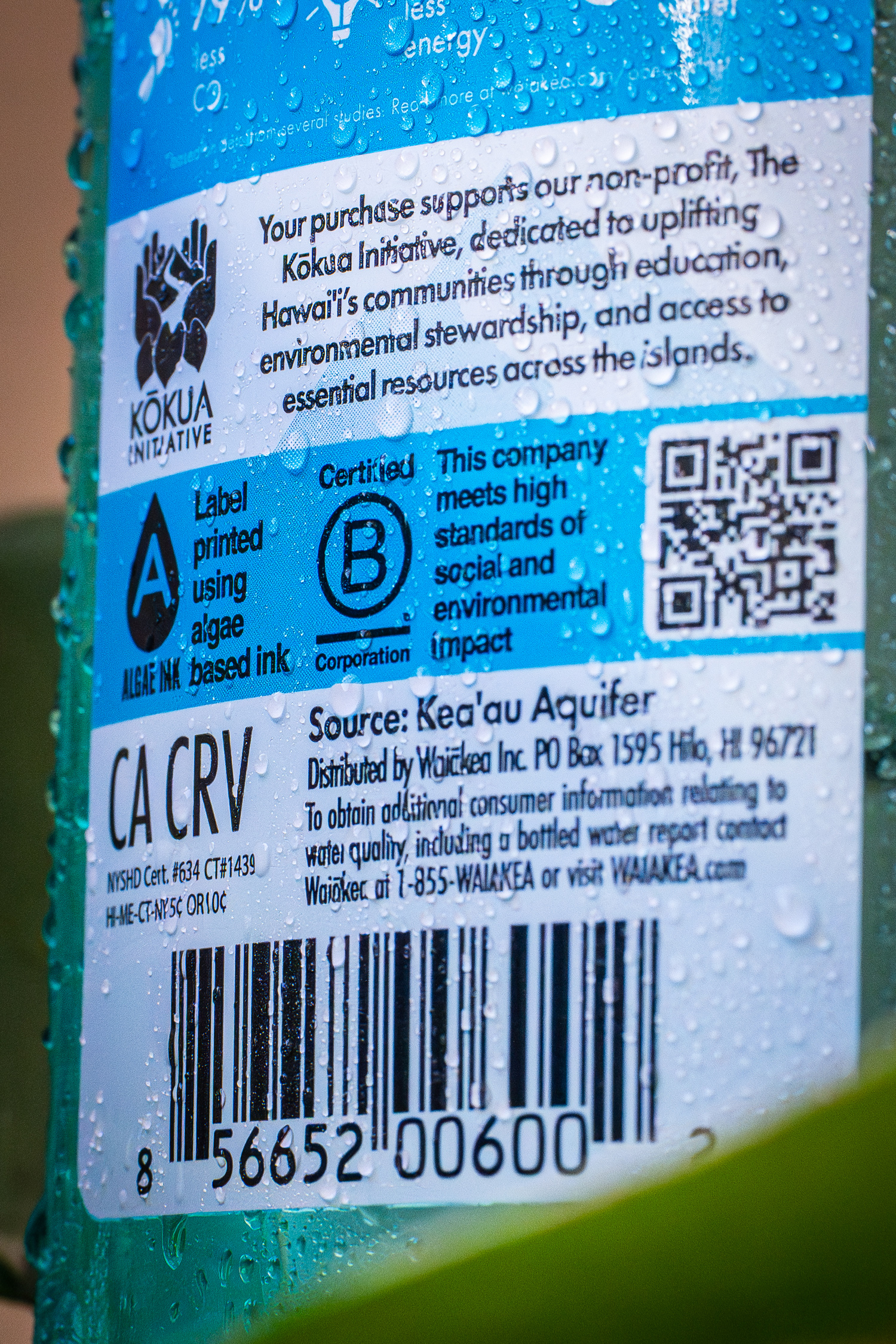
US converter NextGen Label Group has already commercially validated the ink for Waiākea Hawaiian Volcanic Beverages labels, the first food and beverage brand to adopt algae-based ink commercially across its label supply chain.
From concept to reality
The innovation was sponsored and supported by Waiākea, which first began R&D with partner Living Ink Technologies five years ago to replace petroleum-derived carbon black ink with an algae-derived alternative for all flexo applications.
Ryan Emmons, co-founder and CEO of Waiākea, says: ‘From the beginning, we’ve felt a responsibility to build a brand that constantly pushes sustainability forward in CPG. After becoming the first beverage brand in North America to commercialize 100 percent post-consumer recycled bottles in 2012, we began an eight-year R&D cycle focused on nano-additives that could address end of life while simultaneously focusing on rigid biopolymers derived from algae.’

The brand selected 100 percent rPET for its environmental benefits and existing infrastructure, then focused on carbon-based inks used in flexographic and lithographic label applications, which are among the broadest applications across CPG products globally.
The brand had experimented with multiple sustainable inks starting in 2018, but none offered print quality, production reliability and measurable carbon reduction required for large-scale deployment.
We brought together Living Ink Technologies, Actega, and NextGen Label Group because each organization saw the opportunity to help move the packaging industry forward
The previous iterations failed across three critical performance standards unique to the beverage industry. Early water- or soy-based eco-inks completely broke down when exposed to the heavy condensation of a refrigerator or an ice bucket. The labels would bleed or smudge when a consumer gripped the bottle. Bottled water undergoes immense vibration and friction during transit. Previous sustainable options lacked the rub and friction resistance of carbon black ink. By the time the pallets arrived at retail, the text on the back labels was scuffed, scratched and unreadable.
Water bottles are handled, squeezed and twisted by consumers. Early sustainable formulations were brittle; they didn’t bond seamlessly with recyclable polypropylene (plastic) labels. The ink would flake off under physical stress.
In 2024, Actega, Living Ink Technologies, NextGen Label Group and Waiākea partnered to combine bio-based pigment expertise, ink formulation capabilities and packaging technology to develop a high performance, UV-curable flexo ink with reduced carbon emissions.
Carbon-negative pigment
Unlike conventional carbon black, derived from petroleum, Living Ink’s Algae Black pigment is produced from discarded algae biomass generated as a by-product of large-scale algae cultivation for the natural food colorant and nutrition industries.
‘It is a true waste product that would otherwise go to a landfill,’ explains Dr Scott Fulbright, CEO and co-founder of Living Ink Technologies. ‘To ensure consistency as we scale, we work with a large commercial partner for a reliable, high-volume supply. We put this raw biomass through a strict purification and stabilization process to normalize any natural variances and meet a precise chemical profile, ensuring every batch performs identically on press.’
According to Dr Fulbright, this approach contributes to the pigment’s carbon negative Life Cycle Assessment (LCA), which reports a net footprint of -4.16kg CO2 equivalent per kilogram of pigment.
‘This calculation accounts for the carbon absorbed by the algae during photosynthesis minus any emissions generated during our pigment manufacturing process. Because we use discarded waste biomass, our model includes landfill avoidance, preventing the release of methane and CO2 from decomposition. The amount of carbon the algae permanently traps outweighs the emissions generated during our processing, making our pigment into a tool for permanent carbon sequestration on the printed packaging,’ he adds.

UV flexo challenge
Although Living Ink had previously commercialized algae-based inks for conventional flexo, offset and screen printing, UV flexo presented an entirely different challenge.
The biggest challenge was ensuring consistent performance in flexo and litho label printing under demanding commercial conditions. Key hurdles included formulation, curing, print consistency, scalability and compatibility with existing manufacturing systems.
‘UV flexo printing runs at ultra-high speeds with very thin ink layers, requiring instant curing without smudging,’ Dr Fulbright explains. ‘The algae biomass itself remains the same, but at a later stage, Algae Black pigment is surface-treated to be compatible with Actega’s UV materials and formulation. This ensures it doesn’t interfere with the UV chemistry and allows it to cure flawlessly on high-speed presses.’
Actega’s R&D team tackled these formulation challenges to successfully integrate the algae-derived pigment into a commercially viable UV-curable ink.
We’ve even received feedback from some partners that Algae Black actually surpasses the depth and richness of the petroleum-based standard they used previously
‘The pigment did not originally provide an intense black color; it was a bit grayish. Also, the UV inks made with it had a very high viscosity, which would increase even further in a relatively short time,’ explains Claudio Kristeller, head of global R&D technology group – inks at Actega.
The development focused on achieving optimal pigment dispersion to address formulation challenges. Rather than redesigning the ACTExact ink platform, Actega developed a pigment dispersion that closely replicated the physicochemical properties of conventional pigments, for seamless integration into a commercially viable UV ink.
‘The ACTExact system, its resins, photoinitiator packages and additives, already had a robust performance that allowed the final ink to run on press directly replacing a standard carbon black-based ink,’ Kristeller says.
This compatibility means converters can integrate the algae-based ink into conventional UV flexographic production without modifying existing equipment or press configurations.
According to Dr Fulbright, another hurdle was overcoming perceptions of bio-based pigments. Early alternatives often produced a washed-out charcoal gray that brands found unacceptable. Through proprietary milling and formulation techniques, Living Ink optimized pigment loading and dispersion to match the performance of conventional carbon black.
‘We’ve even received feedback from some partners that Algae Black actually surpasses the depth and richness of the petroleum-based standard they used previously,’ he notes.
Commercial validation on press
Commercial acceptance of the ink depended on press performance, and NextGen Label Group subjected the new ink to extensive qualification before approving it for Waiākea’s labels.
‘The product ran with minimal operational changes,’ says Paul Roux, chief technical officer at NextGen Label Group. ‘By final qualification, we were using press settings consistent with conventional UV-cured products, which made integration straightforward for our press team.’
Importantly, throughput remained comparable to existing conventional UV inks and coatings.
Before commercial approval, the ink successfully met the requirements for workability, durability and fitness for the intended application. That included multiple press trials, environmental simulation studies and standard pressroom testing such as density, rub, coefficient of friction and tape testing to confirm consistent on-press performance.
The current formulation replaces 100 percent of Waiākea’s conventional black ink with algae-derived pigment.
‘With our penultimate algae-based ink, we successfully developed a high performance, UV-curable flexo ink. It provides the exact same rich visual density, high rub resistance and waterproof adhesion as traditional carbon black, but with a net positive environmental footprint. It is a seamless “drop-in” replacement that withstands freezing, squeezing and shipping friction without changing printing equipment,’ Emmons explains.
While the technology is presently limited to black, Living Ink Technologies confirmed that development of additional colors is already underway.
‘We brought together Living Ink Technologies, Actega and NextGen Label Group because each organization saw the opportunity to help move the packaging industry forward, and a big part of this was the understanding that we would commit our entire supply chain yet also open source to the public,’ Emmons says. ‘NextGen understood that if we could successfully commercialize a carbon-negative pigment that performed at the same level as conventional inks, the impact could extend far beyond Waiākea. They invested their time, expertise and press capacity because they believed in the long-term potential of the technology.’
Barrier to adoption
Despite its technical success, the companies acknowledge that widespread adoption will depend on the economics of scale.
Because production volumes remain relatively small, the algae-based UV ink carries a premium over conventional petroleum-based carbon black inks.
Kristeller of Actega believes this cost gap will narrow as manufacturing scales up. ‘While this ink currently carries a higher cost than traditional carbon black-based
alternatives, primarily because the technology is still scaling and economies of scale have not yet been fully realized, we anticipate that costs will decrease as adoption grows.’
He also notes that black ink represents only a small proportion of the overall label cost, making its impact on finished packaging relatively limited compared with substrates, coatings and other converting materials. ‘Importantly, this innovation enables a meaningful reduction in carbon footprint, which is increasingly significant for brand owners and, ultimately, for society as a whole,’ he adds.
NextGen Label sees a similar picture. ‘Like many emerging sustainable technologies, this ink carries a premium versus conventional alternatives, so adoption depends on a brand’s willingness to balance environmental benefit with commercial realities,’ Roux says.

Beyond flexo
The innovation could extend further than UV flexo.
Because the breakthrough lies in the pigment rather than a specific ink chemistry, NextGen Label Group believes algae-derived products could eventually find applications in digital inkjet and other printing technologies.
For now, ACTExact UV Black Algae Ink is available for commercial trials and bulk ordering across North America, with wider geographical rollouts planned.
Stay up to date
Subscribe to the free Label News newsletter and receive the latest content every week. We'll never share your email address.