Hybrid variations
Will automated flexo, hybrid or standalone digital be the winners as we move into an era of even shorter runs? Find out.

For this issue of Labels & Labeling, I interviewed Dario Urbinati, CEO of Gallus Group, about the extraordinary turnaround he has accomplished at the company, turning it from a conventionally-minded narrow-web production company to a ‘digital first’ mindset and production program in just a few years.
In concrete terms, this resulted in the development of the Digital One inkjet press, followed by the more recent launch of the Digital Five at Labelexpo Europe, all forming part of a modular system based around the Labelmaster flexo press platform.
Apart from being a major feat of change management, Urbinati’s future vision for Gallus shines a spotlight on the range of choices facing label converters as we move forward into a landscape of ever-shorter runs and multiplying design variants.
Urbinati does not believe conventional printing is dead, far from it. Gallus continues to develop its Labelmaster and RCS press platforms. But Urbinati believes that with 80 percent of label jobs now under 10,000 linear meters, a hybrid platform with a digital print engine provides the lowest TCO.
A different view
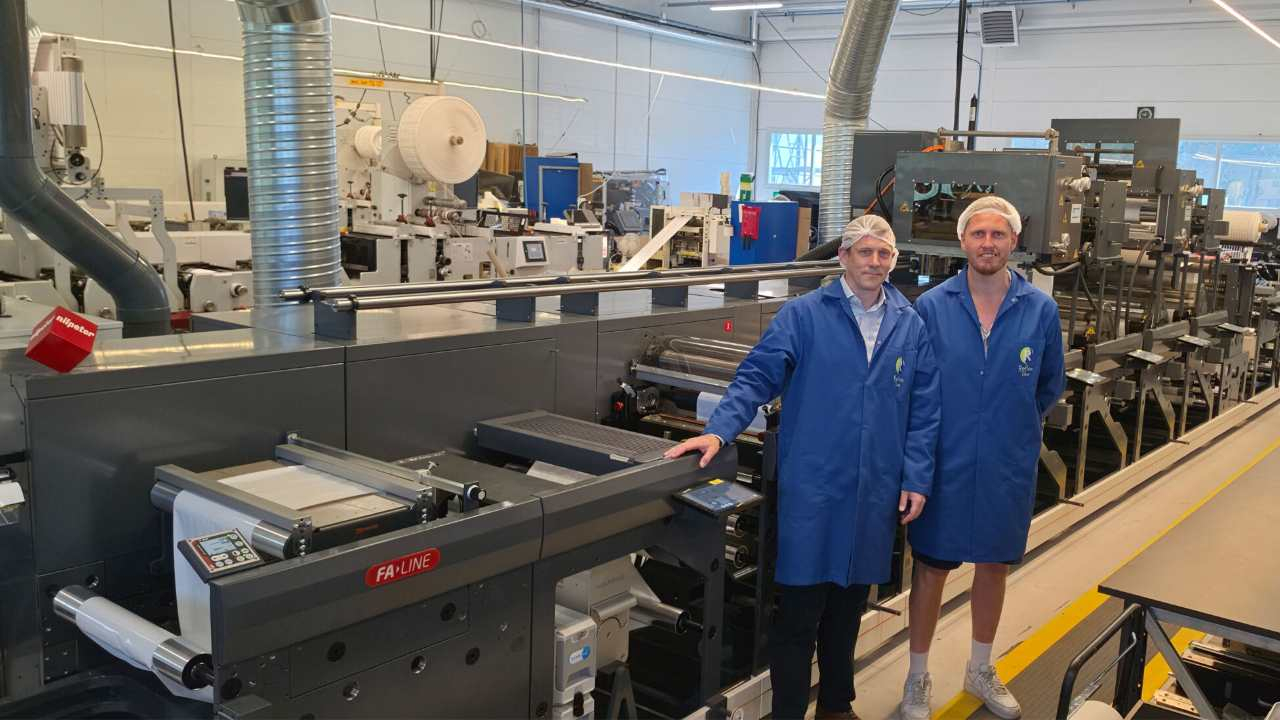
Contrast this with Nilpeter. In an interview in Labels & Labeling (Issue 3, 2025) last year, CTO Carsten Clemenson indicated Nilpeter has moved away from the hybrid model, focusing instead on further automating its flexo press technology to reduce the need for operator intervention and fully automating job changeovers on the run.
At Labelexpo Europe in Barcelona, the company demonstrated a ‘live’ changeover between two four-color jobs on a running FA4 press, with just a few meters of waste between them. With two die-cut units on the press, it would also be possible to change the die-cut on the fly.
Clemenson’s view is that this technology eliminates the
need for a hybrid press, allowing for a full-color change or just
a black-plate change while remaining within a converter’s
established flexo ecosystem.
This is a fascinating and energizing difference of philosophy,
presenting the label converter with different ways to organize
production for an environment where short runs, proliferation of variants and inventory reduction are unstoppable trends.
The other flexo press manufacturers take positions somewhere between Nilpeter and Gallus, choosing different points at which hybrid will be preferred over flexo and vice versa.
Finishing landscape
The increased automation of flexo technology and the
integration of flexo presses into digital networks have certainly
reshaped our understanding of where flexo fits in the shorter
run, multi-SKU environment.
At the same time, flexo automation and digital integration
have powerfully impacted the efficiency of hybrid press systems, reducing overall job setup and changeover times.
Converting technologies such as high-speed semi-rotary dies
have impacted the efficiency of both flexo and hybrid systems, as has the increasing use of sleeve technology.
What these two approaches have in common is viewing the
label converting process as an in-line operation, from the roll to a printed, embellished and die-cut piece.
This is the traditional narrow-web workflow from the days of
rotary letterpress onward, adapted in various ways to a world of ever-shorter run lengths.
Where does this leave standalone digital presses with off-line
(more accurately near-line) finishing? Will the increasing efficiency of automated flexo and hybrid overtake and eventually eclipse the two-stage digital print and converting model?
A two-stage workflow involves work in progress, generates some waste by re-registering pre-printed jobs for off-line converting processes, and, despite the depth of automation around the digital press, still requires manual operator skills on the finishing side.
It might be argued that two-stage digital print and finishing only became the dominant configuration because, in the early days, digital presses were so much slower than converting systems. Does it make sense to finish off-line now that we are approaching flexo productivity at speeds of 75-100m/min and upwards?
But separating the print and converting steps still has key
benefits compared to an in-line approach.
Flexibility is key
The most obvious advantage of a two-stage model is flexibility. The digital print engine keeps printing, no matter the complexity of the finishing steps required for each job on the roll. Also, finishing can be easily scaled to reflect increased productivity on the press.
Perhaps most exciting is the potential to automate the finishing step, where a quiet revolution is already underway. The Mercian Labels automation project (scan the QR code below to read the full story on the L&L website), demonstrates the impact this will have on the overall efficiency of the two-stage process, with the setting and operation of the converting line moved from the operator to a new programming layer within the company.
What seems clear is that each approach, automated flexo, hybrid and near-line converting, has its own unique advantages, meaning that for the foreseeable future they are likely to co-exist.
The tough question for converters is to decide how the pieces
of the jigsaw fit into the workflow architecture of their long-term strategic plans.
Stay up to date
Subscribe to the free Label News newsletter and receive the latest content every week. We'll never share your email address.