New technologies improve food-safe flexible packaging
Advancements in materials, coatings and UV curing are improving the recyclability and safety of flexible packaging for food applications.
Flexible packaging is the second-largest packaging segment
in the world. It is also one of the fastest growing, at a CAGR
of 4.7 percent, according to Grand View Research. In Europe, flex pack dominates on grocery store shelves. In the US, it accounts for more than 20 percent of the value of the packaging market, or 42.6bn USD, according to the Flexible Packaging Association’s 2025 State of the US Flexible Packaging Industry Report.
Sustainability is driving much of this growth, as flex pack’s
lightweight material provides more energy-efficient transportation.
Food is the largest end-use segment for flexible packaging,
providing a range of benefits beyond branding and energy-efficient transportation. Flexible packaging also poses unique challenges.
‘Packaging may often seem like a secondary product to the
product itself,’ says Martin Tielberg, global marketing manager at Nilpeter. ‘But in reality, it, of course, plays a vital role in protecting the product and in branding. It ensures shelf life, it prevents contamination, and it safeguards the consumer. If the packaging fails, it can actually be a real threat to the brand reputation and to consumer safety.’
Currently, multilayer substrates ensure food safety and shelf
stability. But those same substrates also create barriers to
recyclability. Companies across the packaging supply chain are working to improve this, particularly with new monopolymer materials and low-migration inks.
These innovations were highlighted at a Nilpeter open
house hosted at the press manufacturer’s Technology Center in Cincinnati, Ohio in April. There, Nilpeter presented its FA-26 press, capable of producing both labels and flexible packaging, alongside a day of education on the latest advancements in the food safety and sustainability of flexible packaging.
Throughout the event, suppliers emphasized the importance of collaboration to address these challenges.
“If the packaging fails, it can actually be a real threat to the brand reputation and to consumer safety”
‘Expectations are rising across the board,’ Tielberg says. ‘Regulators are tightening requirements, particularly around migration and documentation. Brand owners expect full transparency and accountability. Consumers are more aware of the packaging and its potential impact. All of this creates a lot of pressure on all of us, whether you are a press manufacturer, ink supplier or material supplier, but it’s also what drives innovation.’
Substrates
Regulations, such as Extended Producer Responsibility (EPR) laws, are driving material suppliers to develop monopolymer substrates to meet recyclability requirements.
At the Nilpeter open house event, David Parsio, vice president of sales and marketing at Multi-Plastics, a film supplier, explained that packaging that once required a multilayered substrate with three or four polymers can now be achieved with an advanced single-polymer film. The industry is shifting toward using 100 percent monopolymer laminations in polyethylene and polypropylene substrates, such as specialized blown film polyethylenes and cast-tentered polyethylenes, which can replace some multipolymer materials.
However, these new substrates come with their own set of
challenges. They have lower stiffness and higher elongation,
affecting how they run on presses. This makes tension precision critical to maintaining registration, emphasizing the importance of press control systems. Product design can also play a role, as stronger engineered surface layers can help with the elasticity of these more sustainable materials.
At the same time, sustainability demands are also driving the
development of more sustainable multi-plastic films. These new films are becoming thinner.
While more lightweight, these thinner films make web breaks more likely, again underscoring the importance of press control systems for stable production.
Overall, these new sustainable substrates are less stable,
and running presses at their maximum speeds isn’t necessarily economically advantageous with these new materials.
‘Every day, we’re in the field helping converters balance that
speed and press variability,’ Parsio says.
Parsio notes that brand owners are highly interested in materials made of post-consumer recycled (PCR) content, and the cost difference between PCR and virgin material is not as significant as it used to be.
‘The next three or four years of flexographic performance won’t be defined by just speed alone,’ Parsio says. ‘It’s going to be defined by how we handle increasingly complex and variable substrates, and that’s going to require close collaboration across the entire value chain.’
Inks and coatings
Standard inks and coatings can migrate through packaging. In food, this is a threat to safety and can also impact taste and odor.
As a result, low-migration inks and coatings, which are specifically designed to prevent this migration, have become the industry standard across a wide range of applications.
Food is the primary driver of these low-migration inks and coatings, but they are also used in pharmaceuticals, baby products, tobacco and cosmetics industries.
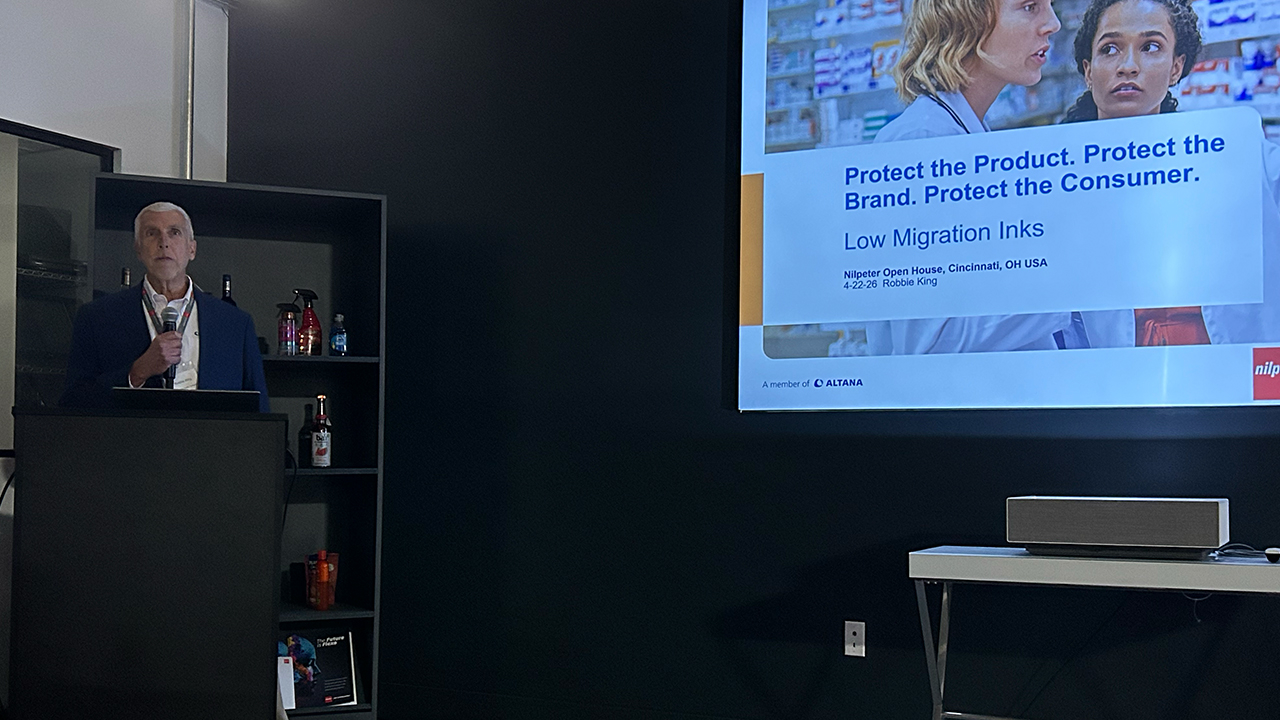
‘If it goes on a flexographic press, and there’s a chance it could affect taste, smell or safety, low-migration inks are your standard,’ says Robbie King, strategic account manager at Actega.
There is no global legal standard for low migration. The term simply means that the components stay below certain safety levels to prevent migration.
“Low-migration inks and coatings aren’t just nice to have. They’re how we make sure nothing unwanted crosses the line”
Despite that, the industry does follow two primary benchmarks, the Swiss Ordinance and the Nestlé Guidance Note on Packaging Inks, in defining what ingredients are allowed in low-migration packaging inks. The lists of acceptable ingredients are regularly updated. If a raw material is not on either benchmark, then it must demonstrate migration below 50 parts per billion.
‘Low migration is not a marketing term,’ King says. ‘It’s about protecting your customer from recalls, protecting your plant from liability and protecting your long-term contracts.’
King urges converters to get third-party certifications, such as those from Rutgers University, for low-migration products.
On the future of what sustainable inks could look like, King looks to one brand: Waiakea Hawaiian Volcanic Beverages. This water bottle and coffee company worked with converter NextGen Label Group, Living Ink Technologies and Actega to successfully use Actega’s ACTExact UV Black Algae Ink in its labels. The implementation of this algae-derived ink is carbon neutral, and came following five years of R&D.
King concludes: ‘Low-migration inks and coatings aren’t just nice to have. They’re how we make sure nothing unwanted crosses the line.’
UV curing
UV curing is a popular method of drying inks, coatings and adhesives in flex pack because of its environmental benefits. Compared to systems for water-based and solvent-based inks, UV curing systems emit fewer VOCs, can be all-electric, consume less energy and take up less space.
However, many UV-curable photoinitiators pose migratory risks, particularly if curing is insufficient and/or unknown, so their use in flexible packaging must be carefully considered, especially for direct-contact primary packaging in food, beverage and pharmaceuticals.
Measurable and migratory-compliant curing is the focus of many advancements in UV curing. Currently, UV curing is not common for direct-contact primary food packaging, but advancements in UV curing technology have made it an option for secondary food packaging and may one day open the door to food-safe, UV-cured primary packaging.
One of these advancements is nitrogen inertization, where nitrogen is injected into the curing area to inhibit oxygen and help the curing process.
Another is to increase the UVC component of a UV curing system, thereby reducing the amount of photoinitiators needed.
‘If there’s less photoinitiator, there’s less chance of migration, and so more confidence that what you’re producing is suitable for applications that are sensitive to migration,’ says Ryan Turner, R&D manager at GEW.
Turner notes several GEW technologies that provide more confidence in UV curing and mitigate migratory risks. For example, GEW’s OxyGuard Precision Control System samples a small amount of gas from the curing chamber to determine how much nitrogen is needed. Its DoseGuard Precision Control System measures UV output from the curing lamp and adjusts to ensure that the inks and coatings receive the exact UV energy required. GEW’s ExciRay lamp requires no photoinitiators while enabling a matte finish; however, it does need to be paired with either another UV lamp or an electron beam to ensure it cures completely.
As a UV-LED technology supplier, GEW is also developing UVC-LED systems. Most UV-LED systems for the printing and converting markets today are UVA, whereas the technology they replace (medium-pressure mercury arc lamps) is polychromatic and therefore emits across the full UV spectrum. Therefore, UV-LED curing works with fewer materials than UV in general does, so reducing the photoinitiators needed is more challenging. Introducing UVC-LED with UVA-LED allows for a greater number of raw materials to formulate with. So far, the testing for this product has been positive.
‘We’re hoping that if we provide a UVC-LED solution, it provides more options to create materials that can be used in flexible packaging,’ Turner says.
While these innovations have not yet made UV inks appropriate for primary flexible food packaging, there are still other uses for them today.
‘There’s so much more in flex pack that doesn’t have the same migratory requirements,’ Turner says. ‘For example, it could be in bagging. There’s so much within flexible packaging that today is suitable for UV curing.’
Nilpeter FA-26 represents label and packaging convergence
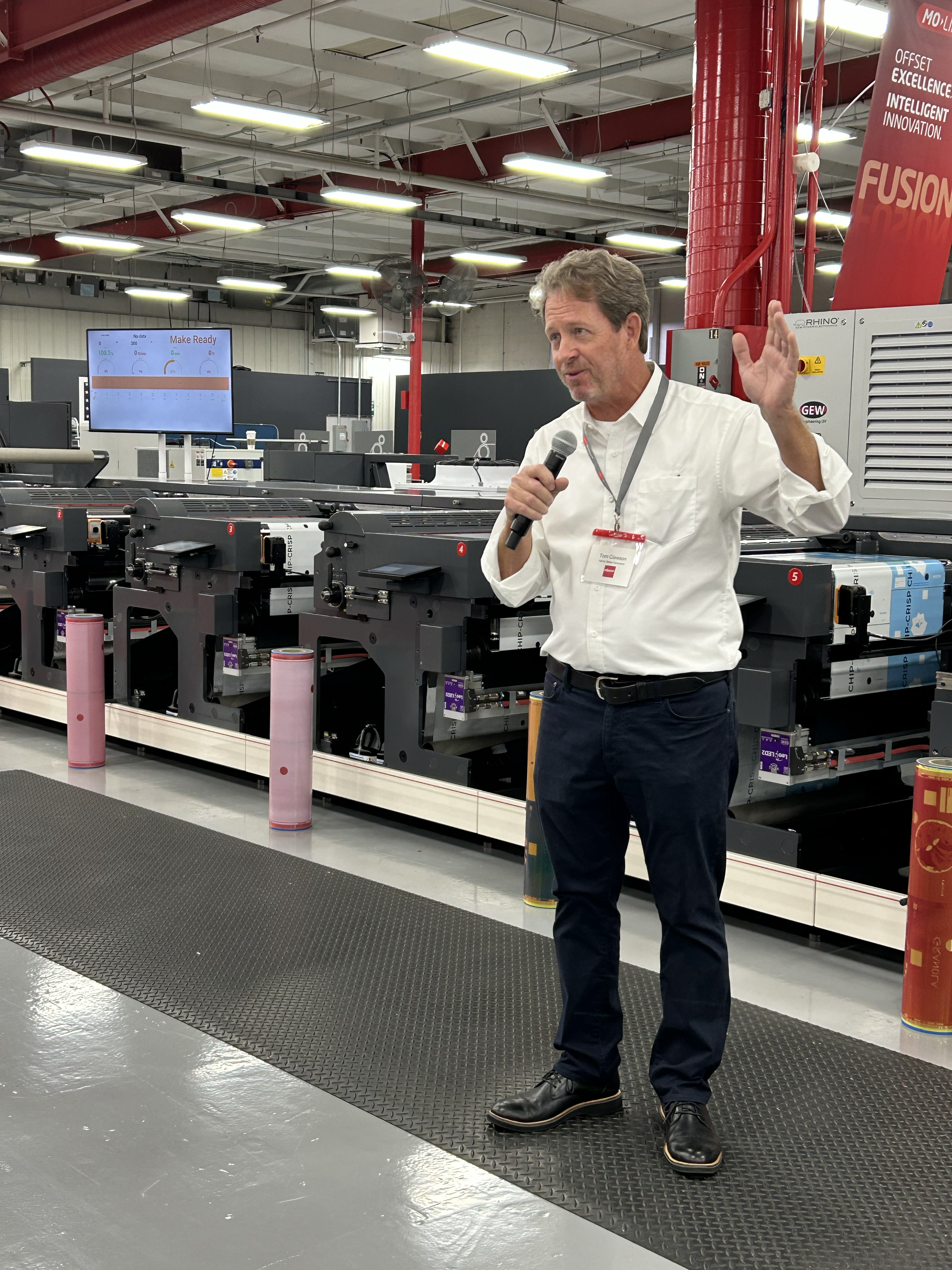
In addition to featuring education on food-safe, sustainable flexible packaging, Nilpeter’s open house in April also highlighted the company’s FA-26 flexo press.
The FA-26 is Nilpeter’s widest label press. The machine can handle a variety of materials and inks, making it suitable for flex pack, shrink sleeve, in-mold labels and pressure-sensitive labels.
Jasper Jorgensen, global sales manager at Nilpeter, notes that the FA-26 offers a high degree of web-tension control, an important consideration when handling more sustainable films, which are often less stable.
Through its ability to produce both labels and flex pack, the Nilpeter FA-26 is an example of an industry-wide trend, where segments of the packaging industry are increasingly converging. As more label converters enter the flex pack market, particularly in short-run flex pack, suppliers are providing them with technology that meets their needs.
‘The FA-26, targeting the flexible packaging market, takes all the virtues that we find in label printing, where we do everything in-line, so we can be smarter and more efficient, especially in smaller jobs,’ Jorgensen says.
Stay up to date
Subscribe to the free Label News newsletter and receive the latest content every week. We'll never share your email address.