Gift from Nilpeter to Clemson University is giving back in unexpected ways
A gift from Nilpeter to Clemson University’s graphics communications department is giving back in unexpected ways.
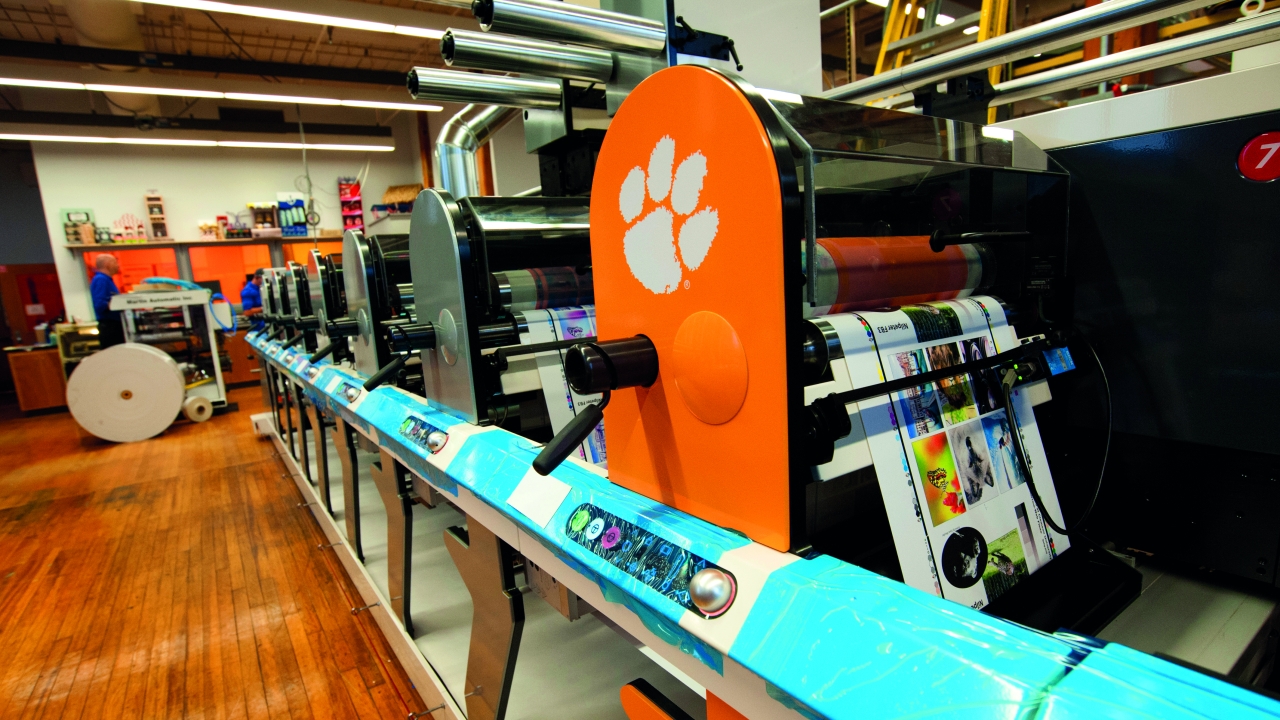
Nilpeter’s charitable foundation donated a FB-3 flexo press to the university for use in its graphics communications courses. The press not only benefits the students of Clemson who will learn on it, but students are flexing their creative muscle in a unique project with Nilpeter.
Two Clemson alumni working in the university’s Sonoco Institute – a facility that combines Clemson’s packaging science and graphics communications departments – have developed a nearly exact replica of the donated Nilpeter press in virtual reality.
Flexography in virtual reality
A highlight of Clemson’s Sonoco Institute of Packaging Design and Graphics is its eye tracking equipment used to study consumer buying behavior. (Some may remember the eye tracking equipment showcased at Labelexpo Americas in 2014). The eye tracking lab includes a model grocery store, complete with shelves lined with products. Participants wearing eye tracking glasses walk the aisles while the glasses record where their eye landed on the shelf. These studies help with shelf design, decorative decisions, material selection and more.
Building on the success of the eye tracking studies, Clemson took it a step further and created the grocery store in virtual reality. Participants put on a VR headset which transports them to a virtual grocery store where they can grab items, put them in a basket – or in the case of this reporter, throw items around the store. Clean up happens with a push of the button, and products on the shelf can be changed and customized.
Clemson alumni Christian Stith and Nate Newsome took the framework of the VR grocery store, and created a digital replica of the Nilpeter press. Nilpeter shared with the students CAD drawings and engineering specs of its FB-3. Stith and Newsome – both graduates of the university’s computer science post-graduate programs – then created the press in a virtual environment.
Like the grocery store, the surroundings of the press can be changed to recreate the facility in which the press will be housed, for example. The pair was still fine tuning the VR program during L&L’s February visit, but in the end, they want the program to be able to fully run the press in a virtual world.
Nilpeter vice president of sales and marketing Paul Teachout learned of the project in early February during a demonstration with this reporter. He was ecstatic.
‘Every department at my company could use this,’ he says. ‘It could be operator training, it could be press demonstrations, trouble shooting, engineering, sales. Really the sky’s the limit.’
Hands-on learning
Nilpeter installed the FB-3, valued at more than 900,000 USD, in May 2016, and students have had a full semester to learn on it.
‘This has been a phenomenal benefit to the program,’ says Kern Cox, a lecturer in Clemson University’s department of graphic communications. Cox teaches undergraduate-level courses in all major printing processes, electronic pre-press, package printing technologies and color management.
Cox continues: ‘This is the future for them so they can go out into the marketplace and be a valuable asset to these companies. They need to understand the capability of these presses and what they can do. I can’t say enough about this press.’
Located in the Godfrey Hall building on the university’s campus in Clemson, South Carolina, the servo-driven 13-inch, 7-color FB-3 flexo press is capable of producing labels, folding cartons and flexible film.
Teachout points to the machine’s automation and what Nilpeter calls its ‘clean hand technology’ as a driver for student engagement.
‘Automations is going to allow this next generation to be more engaged with this machine and have it be more appealing for them,’ he says.
‘We’re trying to provide that level of efficiency for the generation that wants it faster better and easier. That’s the millennial way: faster, better, easier.’
The FB-3 runs at maximum speeds of 750 ft/min, has full embellishment features, and is equipped with AVT inspection and GEW UV curing.
Graphics communications program
Students in the graphics communications programs start as freshman operating the flexographic, offset, digital and screen printing presses at Godfrey. The university also has state-of-the art plate making and finishing equipment so by the time the students make their way through the program, they understand the full life cycle of a label. The university’s school of graphic communications graduates about 90 students each year, Kern said, and its job placement rate hovers near 100 percent. Many go on to work for the myriad of companies who donate machines and materials to Clemson.
‘I tell them: “For four years you’re going to be running the press. You’re going to be cleaning and doing mechanical things, but then you’re not ever going to do that again, probably”,’ Kern says. ‘But the reason they do it is to understand how the system works, to be better trouble shooters, to be more efficient in their roles after graduation.’
Dr Chip Tonkin, director of the Sonoco Institute, adds: ‘Our students understand marketplace competitiveness and how implementing technology can keep companies strong and innovative.
‘The value of this gift extends to potential employers in that they want students who know how to utilize and implement the latest technologies to stay competitive.’
Stay up to date
Subscribe to the free Label News newsletter and receive the latest content every week. We'll never share your email address.