Mark Andy, Talkin’ Things host RFID workshop in Poland
Industry experts explore how smart labels are gaining momentum, as RFID continues to be incorporated across labeling and packaging.
RFID is shifting from an underused technology into a practical
tool, now being deployed at scale across packaging, retail
and logistics. As costs fall and regulatory pressure intensifies,
the industry is increasingly embedding smart labels into production lines to improve traceability, speed up operations and link physical products to digital data.
A recent RFID workshop by Mark Andy and Talkin’ Things in
Warsaw demonstrated how RFID can now be integrated directly into label production and move from specialist adoption to mainstream industrial use.
Talkin’ Things, based in Warsaw, Poland, is a technology
company that develops connected packaging technology using NFC and RFID chips that then enable interaction between physical products and supply chains.
During the workshop, the companies said that the adoption
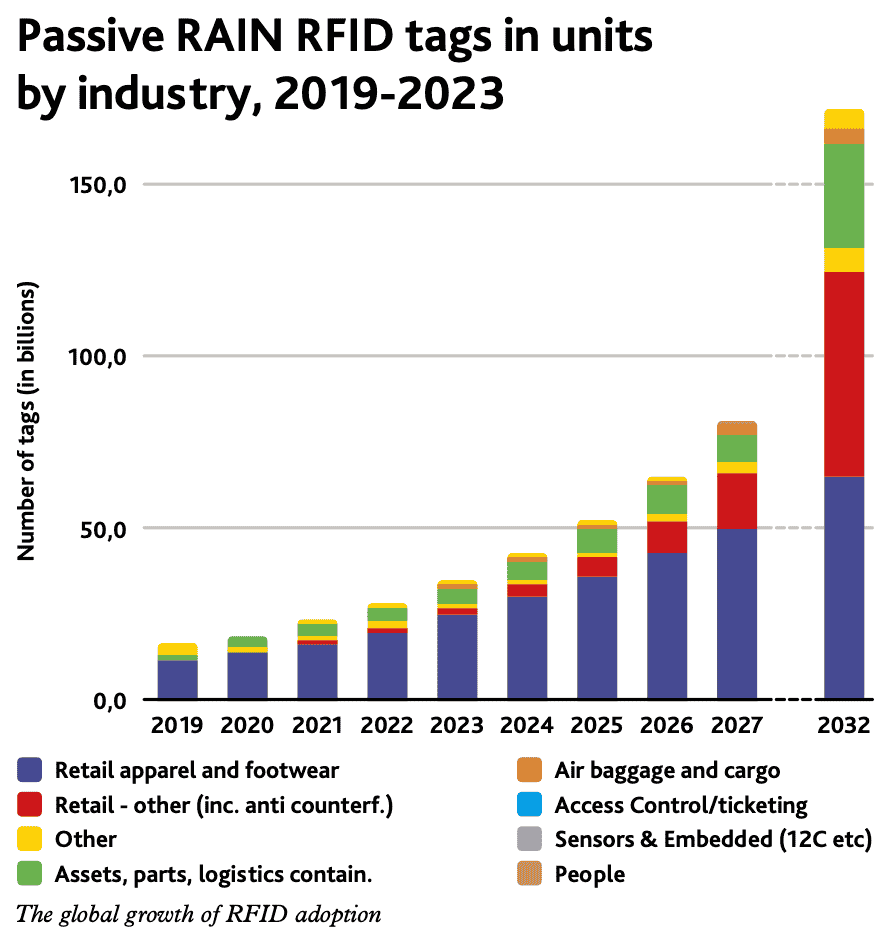
of smart labels was slow between 2019 and 2022, but in 2023, the number of tags rose to 44.8 billion from 28.1 billion. This is predicted to climb to 171.8 billion by 2032 according to the most recent statistics from the graph on the right, with the retail sector accounting for more than half.
One of the constraints for investing in RFID labels has been cost, which, as the materials and technology become cheaper, will soon be less of an issue.
The workshop wasn’t just a high-level discussion around RFID
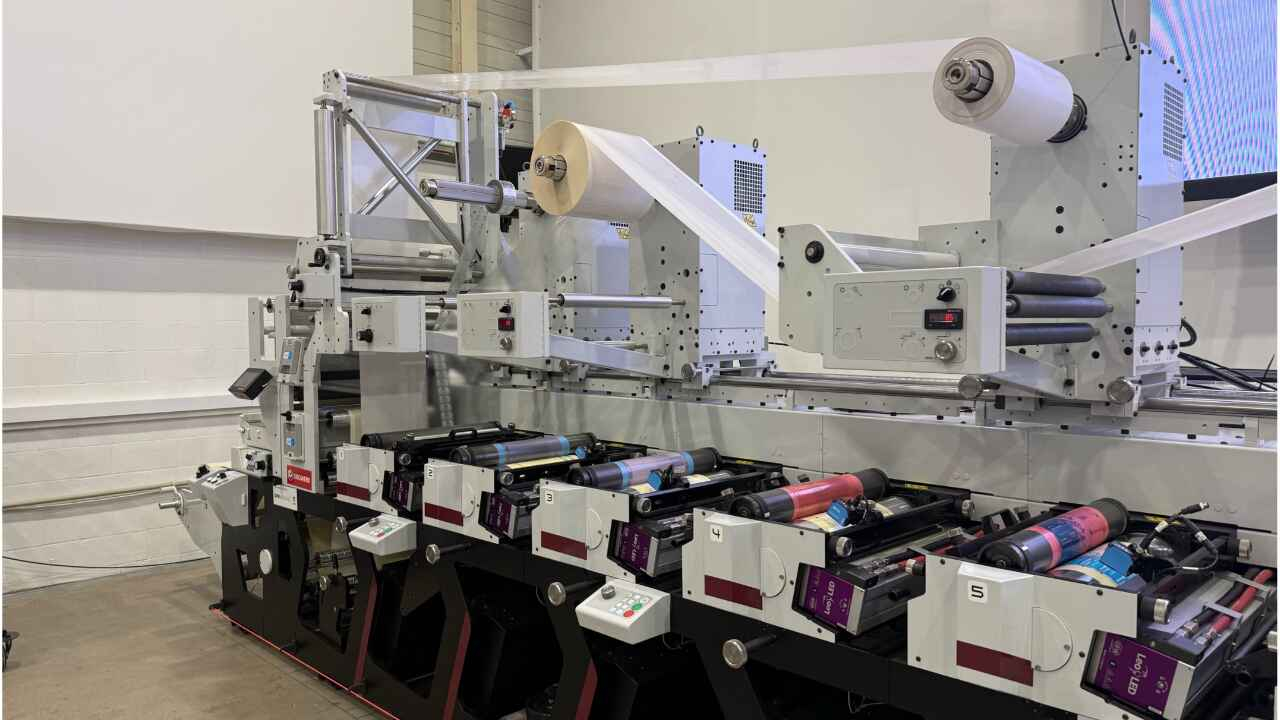
as a technology; it was centered around real-world applications. The focus of the workshop was to demonstrate how RFID can be integrated into label production environments, as shown in a live production demo on a Mark Andy Evolution Series E5 press at the Mark Andy demonstration center in Warsaw, followed by a visit to the Talkin Things RFID factory.
RFID inlays were applied in a single, streamlined workflow. This production-ready approach is becoming increasingly important as converters shift their attention from merely understanding RFID to actively exploring its implementation on the press floor.
Speaking at the RFID smart label workshop, Jacek Terski, sales and business development director at Talkin’ Things, explains how RFID is moving beyond a specialist technology and becoming a central tool for brands seeking traceability, efficiency and consumer engagement, using the graph to show how adoption has increased and how it is predicted to grow.
‘Each corporation wants to connect packaging with digital
identity,’ he says, adding, ‘RFID is currently the most practical
technology to achieve that.’
As the day progressed, it became clear that Mark Andy and
Talkin’ Things believed RFID could become one of the most
transformative developments in the labeling and packaging
industry, enabling brands to connect physical products to digital information and unlock new levels of supply chain visibility.
How RFID works
Unlike barcodes, RFID tags do not require line-of-sight to scan, allowing multiple items to be identified simultaneously.
This simultaneous identification was demonstrated during
Terski’s presentation. Bags were handed out upon entry, each fitted with an RFID label, bearing the guest’s name. Terski then walked up and down the room, and within seconds, every RFID label had been scanned and identified, proving how much time can be saved on a warehouse stock take, for example.
Terski says: ‘On one hand, you have the RFID label, which
contains a chip that stores information and an antenna that allows the tag to communicate with a reader.
‘The reader collects the data, but that’s only the beginning. You need a system to process and use that information; otherwise, the technology has no real value.’
Talkin’ Things provides software systems for its customers that
can be fully integrated into the current management systems,
which are then linked to the Talkin’ Things internal systems.
When discussing how the label performs in extreme conditions, such as extreme heat or cold, Terski notes that this is not a problem if the right components are used, including the adhesive.
“Each corporation wants to connect packaging with digital identity, and RFID is currently the most practical technology to achieve that”
However, he did say that a problem for the apparel sector is that RFID labels can lose effectiveness when close to the human body because the water in the body affects the radio frequency emitted by the microscopic chip. This problem still needs to be solved.
Regulations driving adoption
One reason RFID labels could be gaining traction in Europe is due in part to sustainability regulations. The Digital Product Passport (DPP) and the Packaging and Packaging Waste Regulation (PPWR) are forcing companies to take accountability by introducing measures to ensure transparency throughout the lifecycle of product packaging.
A key part of this will be tracking the materials used, their
composition, recyclability and carbon footprint. Terski shares that the materials used to create RFID labels are so small that they do not qualify for tracking under the regulations.
DPP will be rolled out gradually from 2026 across sectors
such as textiles, electronics and construction products, and each physical product will require a data carrier, such as a QR code, NFC chip or RFID tag.
As regulators demand more detailed sustainability reports and
lifecycle transparency, Terski believes that technologies like RFID could move from optional add-ons to essential components of the supply chain, as tracking material sustainability is not the only benefit.
Retail, the largest adopter
The technology has seen its fastest adoption in retail, particularly in clothing, where brands use RFID to improve inventory accuracy and automate stock management.
Major retailers, such as Walmart and Decathlon, are already
using RFID at scale to improve overall supply chain efficiency.
Decathlon has integrated the technology into its inventory
management and checkouts, which has resulted in an 11 percent increase in sales, holding onto inventory for 23 percent less time and reducing the time a customer spends at the checkout by two minutes on average.
However, Terski believes RFID adoption in retail is only just
beginning. Other sectors, including logistics, pharmaceuticals and food, are exploring the technology to enhance traceability and product authentication.
Terski says: ‘Retail started the adoption, but other industries are following. It’s the same technology used in contactless credit cards. With NFC-enabled RFID, a consumer can interact with a product using their phone.’
In simple terms, RFID is designed for speed and automation in industrial systems, while NFC is a short-range, consumer‑focused form of RFID, designed for controlled, one-to-one communication.
While the hardware is essential, Terski emphasizes that the
broader ecosystem around RFID, including software, data
management and system integration, is what delivers value.
‘The label generates data, but the real benefit comes from how that data is used,’ he says.
RFID in logistics
UPS is expanding its use of RFID package sensing technology across its US network. A key part of this rollout is the installation of RFID sensors across major hubs, alongside plans to introduce RFID label printing capabilities for customers between 2026 and 2027.
UPS is targeting a future where almost every package in its
network is RFID-enabled, supported by more than 100 million
USD already invested in the technology. Lower tag costs are a key enabler here, helping move RFID from specialized use cases, such as healthcare and retail, into a vast array of sectors.
RFID allows parcels to be automatically detected as they
move through the network, reducing manual scanning
processes, with UPS aiming to eliminate nearly 20 million
manual scans per day.
This could be a strong indicator that RFID is no longer an
emerging technology, but one that is increasingly being embedded into everyday logistics workflows at scale.
Inside the RFID factory
The Talkin’ Things workshop also gave attendees insight into the production capabilities of the company that operates an RFID manufacturing facility in Warsaw, Poland, through a tour of the factory. The company designs and manufactures RFID and NFC tags used across sectors, including retail and logistics.
“The label generates data, but the real benefit comes from how the data is used”
At the site, the company combines product design, prototyping and manufacturing under one roof, allowing engineers to develop and test RFID tags before moving them into production. R&D laboratories simulate the conditions labels would encounter in the real world, enabling engineers to develop the correct antenna designs and ensure tags perform reliably when embedded in various packaging types.
The production floor is equipped with bonding and converting
lines that attach microchips to antennas and transform inlays into RFID products such as labels and hang tags.
These lines can produce tens of thousands of smart labels per
hour while maintaining high-quality standards.
Quality assurance plays a central role in the process, as the chip must fit within a space of 120 microns, Terski shares. Advanced testing systems verify tag performance throughout both the design and production stages.
The company produces hundreds of millions of tags per year at the facility, highlighting how RFID manufacturing is growing to meet demand from global brands looking to digitize their products and supply chains.
Moving to necessity
As the workshop in Warsaw demonstrated, RFID is no longer
considered a niche technology. The technology is improving; chip prices are dropping, and more rules are being implemented. As a result, smart labels are becoming more common in the labeling and packaging industry.
While new skills pose as constraints in handling inlays, adhesives and testing systems, the benefits of adding RFID to labels outweigh the constraints. Brands want to see what’s happening in their supply chains, and regulators want more information on materials and sustainability, which could mean RFID labels could soon be a standard part of modern packaging.
Stay up to date
Subscribe to the free Label News newsletter and receive the latest content every week. We'll never share your email address.