Loupe Americas 2026 press technology review
Digital integration, automation, multi-materials processing and the first commercial applications of AI in flexo press control were central themes of the first show under the Loupe banner.
Much of the real innovation seen in conventional press systems at Loupe Americas 2026 was taking place ‘under the hood’, as this technology reaches a stage of development where automation, integration, substrate flexibility and uptime become key to converters’ investment decisions.
Nowhere was this integrated approach to technology demonstrated more effectively than on the Mark Andy stand.
The company demonstrated different approaches to hybrid production through its in-house-developed Digital Series HDHS 1200 press and OEM partnerships with Konica Minolta and Domino.
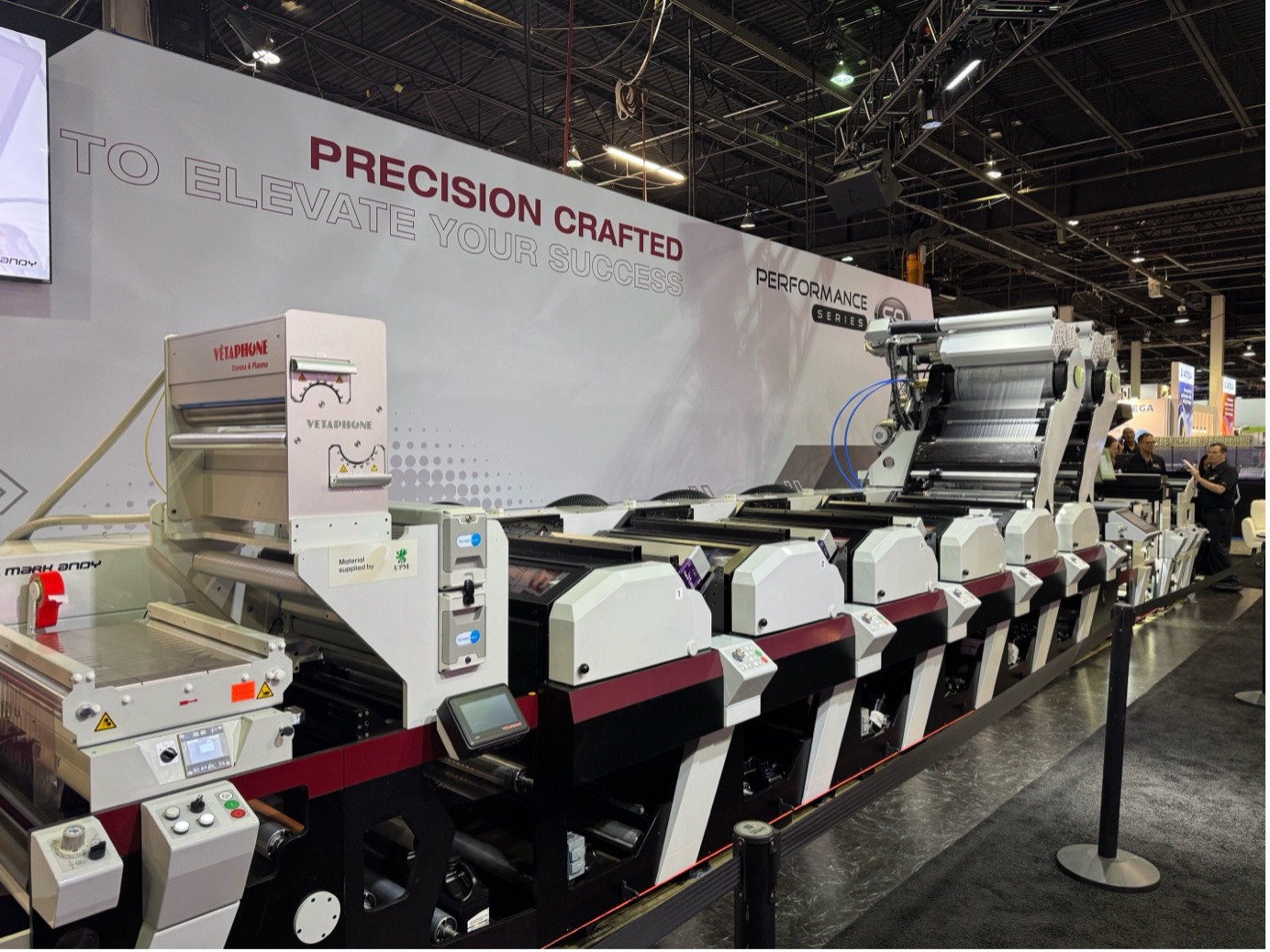
On the flexo side, a 26in Performance Series S9 was shown switching between labels, pouches and films for form-fill-seal applications. The P9 was configured with two extended delivery dryers for water-based coatings.
Mark Andy also announced a range of new partnerships showcasing the ecosystem approach the company has developed over the past few years.
The strategic distribution agreement with Sun Chemical adds inks and coatings to Mark Andy’s portfolio of flexo consumables and platemaking products and marks the launch of the Color Smart Program, a pressroom initiative designed to improve color consistency across jobs, presses, shifts and operators.
Available through Mark Andy Print Products (MAPP), the program combines on-site evaluation, press fingerprinting, calibration, product recommendations and documented standard operating procedures.
‘Color consistency depends on a range of factors, like how the plates, mounting tape, anilox rolls, doctor blades, ink and press settings work together,’ explained Mark Andy president and CEO Duane Pekar. ‘Color Smart brings those variables into one coordinated process, so converters have a clearly defined production standard that they can repeat from one job to the next. We are partnering with Sun Chemical to fingerprint the press and plates. Spot colors are pre-qualified.’
Another key Mark Andy strategic partner is AVT. Both companies will cooperate on process automation for flexo and digital print systems.
The first jointly developed product, announced at the show, is a closed-loop register control system demonstrated on both the Performance Series S9 and HD Series press on the Mark Andy stand. The technology brings clear varnish and coating layers into the register control system, addressing a long-standing quality challenge in premium label production. In hybrid workflows, it automatically registers both flexo and digital inks within a single press length.
The second launch sees AVT integrating its inspection and monitoring systems directly into the MA ProWorx platform through a new central business intelligence module. The integration gives converters a unified view of production performance across presses and sites, enabling multi-press and multi-site job comparison.
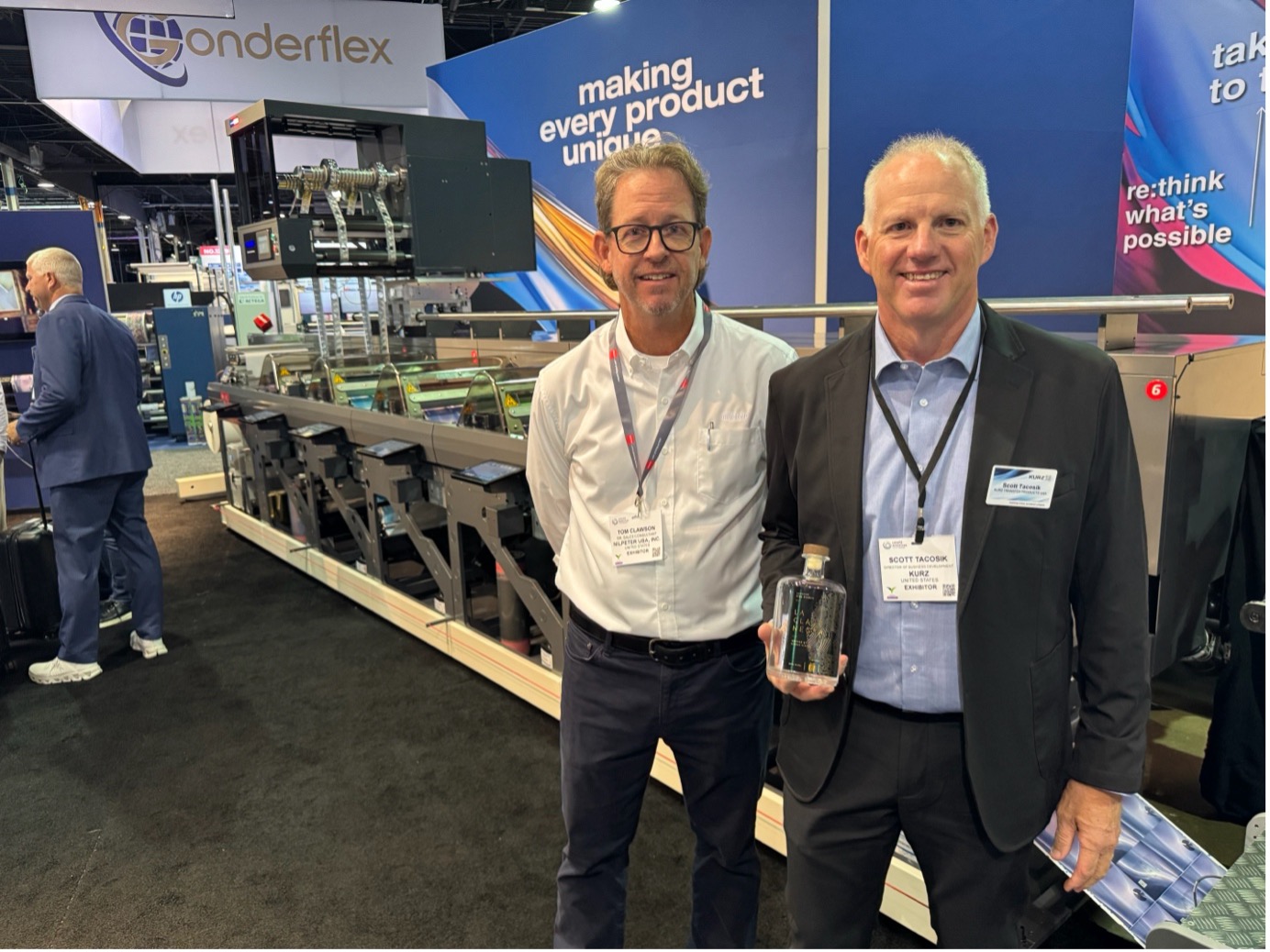
Another example of supplier cooperation was shown by Nilpeter, Kurz and a range of industry partners, demonstrating registered cold foiling followed by hot stamping in-line on a Nilpeter FA-17 press.
Kurz demonstrated a complete embellishment workflow from 3D visualization to production, with Kurz company Hinderer + Mühlich contributing the precision tooling, Pantec providing the hot foil/embossing module, and Wilson Manufacturing and RotoMetrics/Maxcess providing the finishing tooling.
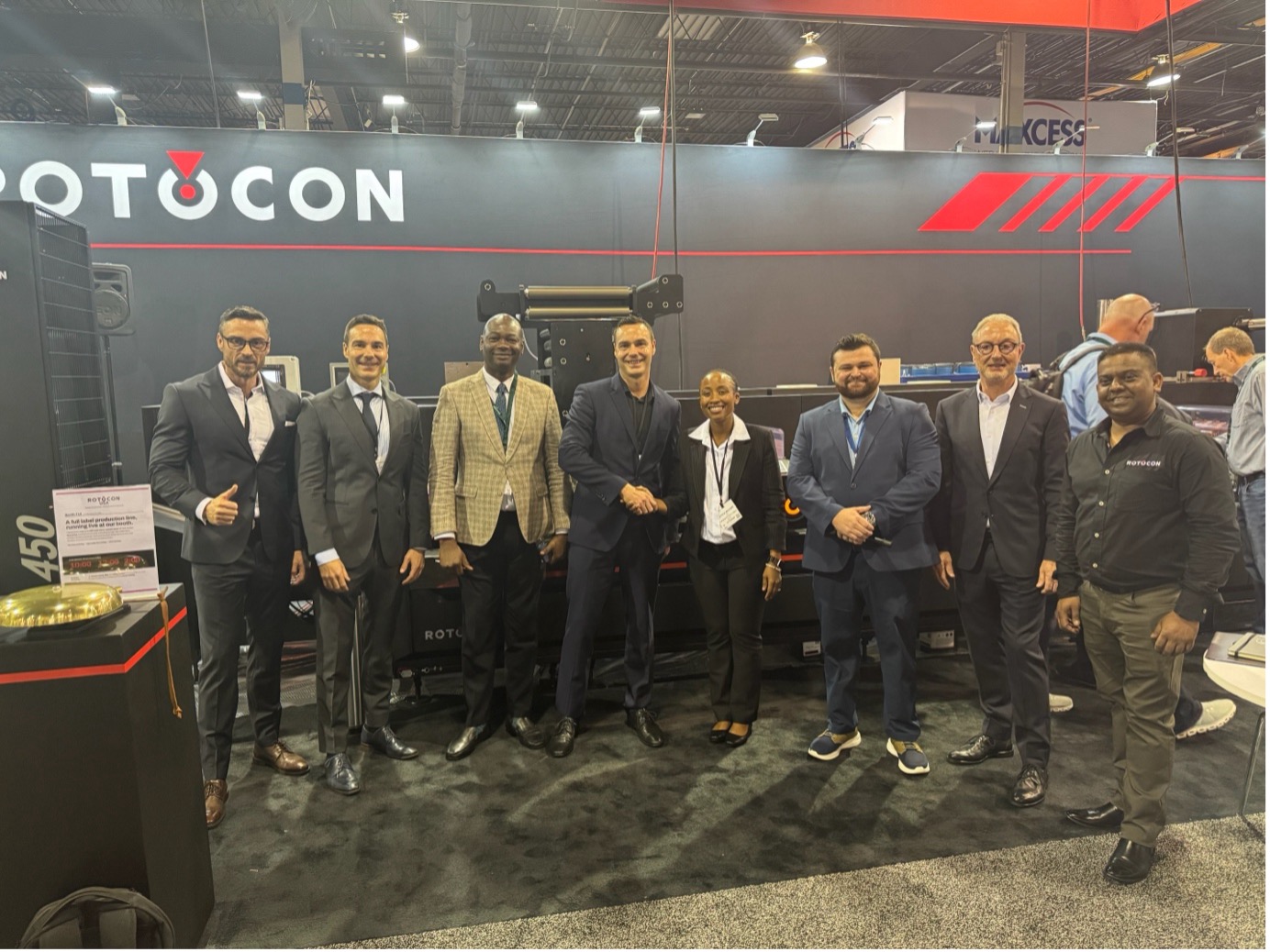
Rotocon introduced itself to the North American market with a new organizational structure and a flexo press aimed at converters seeking a more economical entry point into servo-driven flexo technology.
The company keeps costs down by outsourcing manufacturing to a global network of suppliers. Simultaneously, the presses are designed, assembled and tested at its headquarters building and demo center near Hamburg, Germany.
The press on the show floor was an 8-color, 17in (450mm)-wide RFP C-series fitted out for non-stop operation with dual unwind and a 2-spindle non-stop turret rewinder running at speeds up to 650ft/min (200m/min). This was a cylinder-based machine, with a sleeve version also available.
The company announced an order at the show for an 8-color RFP350 with three die stations, a turnbar and a de/relam unit for peel/reveal applications, plus a cold foil and sheeting conveyor for an Africa-based converter.
The company used the show to launch a dedicated North Americas operation, Rotocon USA. Spare parts, technical support and demonstration facilities will be provided by New Jersey-based Q360 Group. Q360 is also a machine broker and offers trade-in deals for new equipment.
Marco Aengenvoort, managing director Rotocon, said Rotocon USA has orders for 20 machines across its product range, including eleven taken at the show.
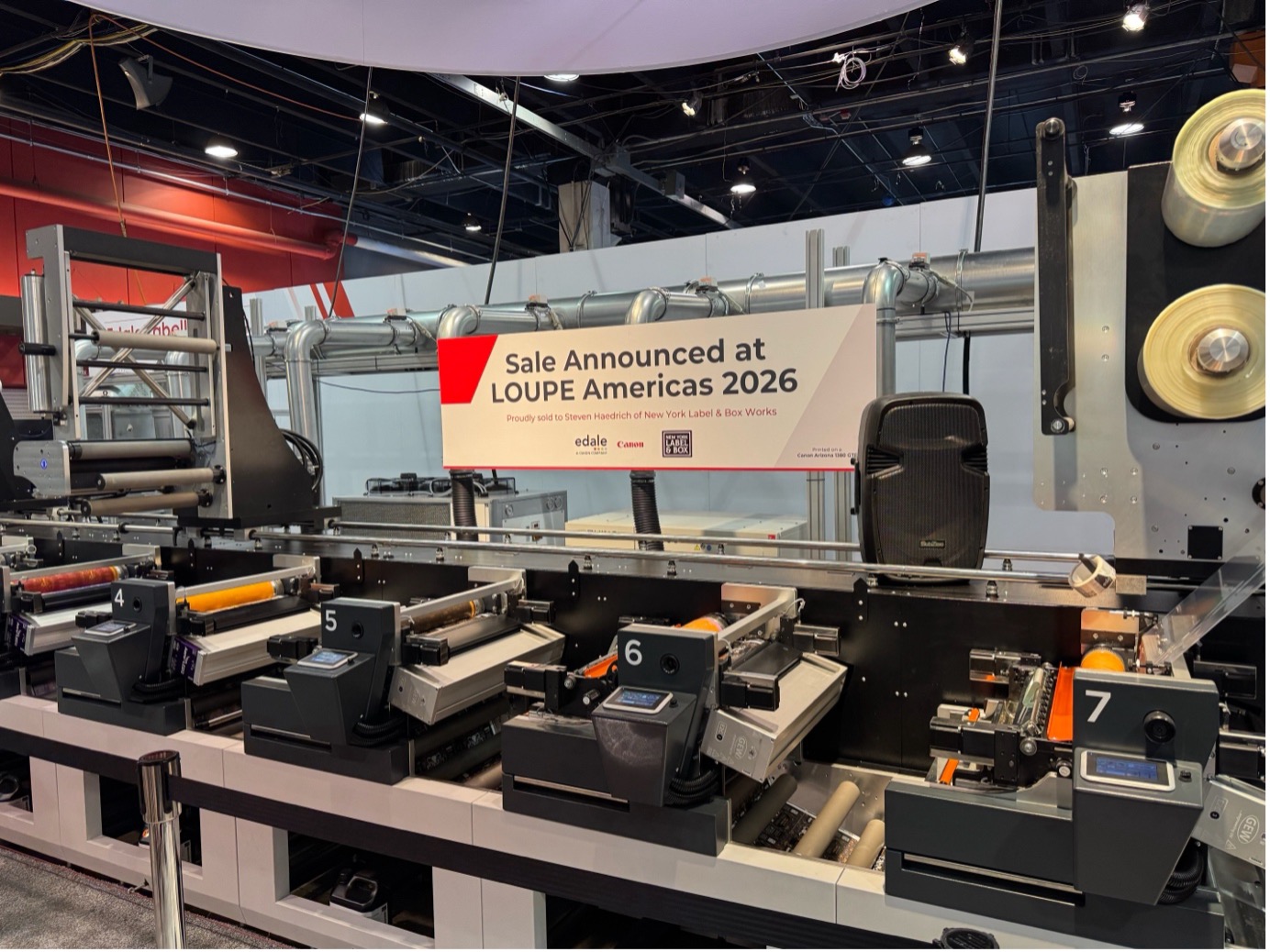
Another flexo press seen for the first time at a North American show was the Canon-Edale LabelLine FL4p, incorporating Edale’s full suite of automation features including dynamic pressure and registration setting. It was configured with GEW’s AeroLED air-cooled LED curing system (see below for how this fits into the wider Canon ecosystem).
Among other flexo equipment at the show, Hontec showed its FlexiCon 460 press printing up to 656ft/min (200m/min). The press is qualified for a range of materials from PS labels to wet glue, wraparound, shrink sleeves, flexible packaging and folding cartons. A central feature is the idler impression roller and separate chill roller to mitigate cleaning issues caused by ink residue. The quick-change roller accommodates different material thicknesses.
AI enters the arena
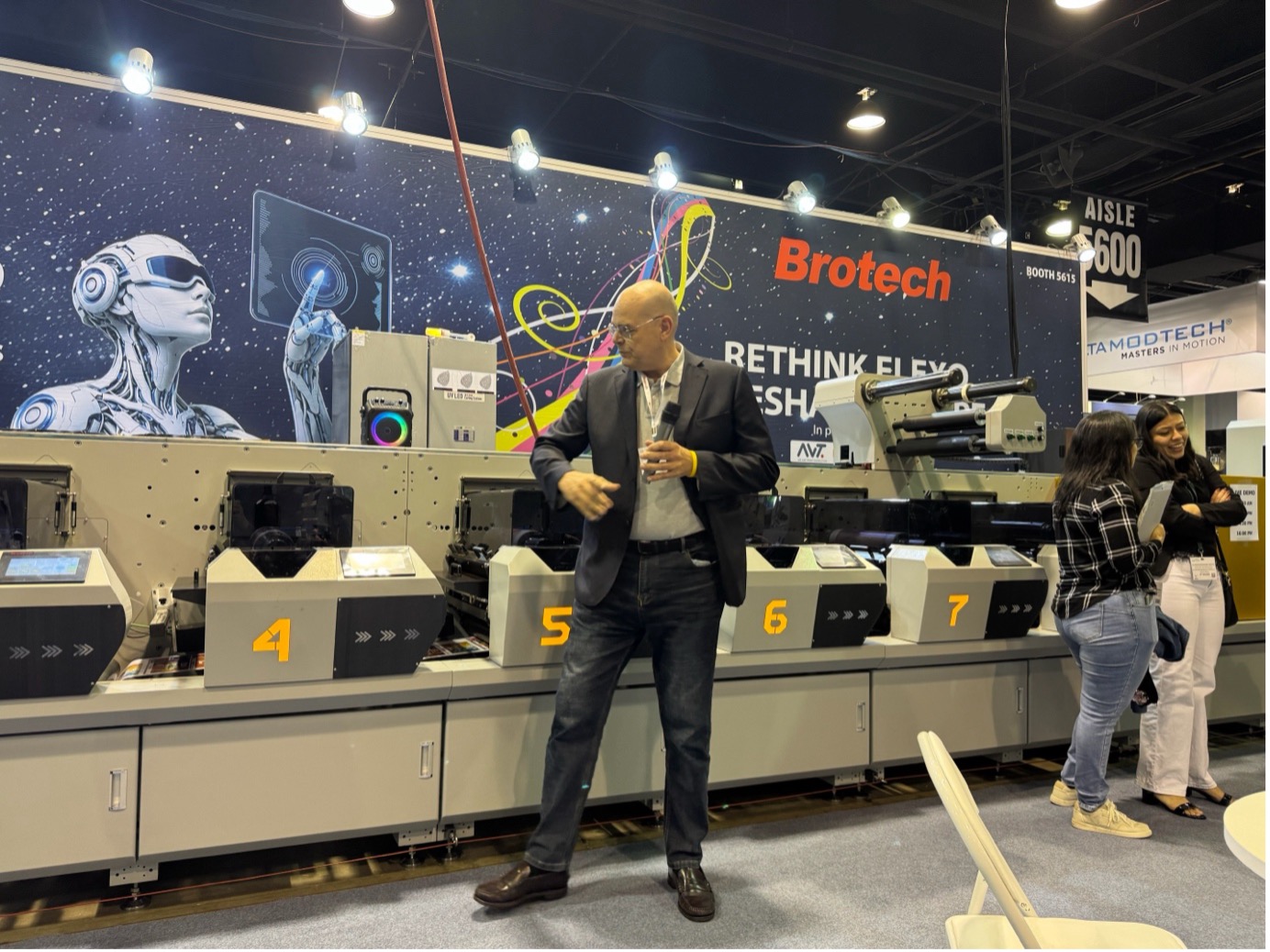
‘Under the hood’ is a good way to describe what’s happening with the Brotech FF-X530 press shown for the first time in Chicago, which uses an AI model to set up and monitor the press.
The press contains a battery of cameras and sensors that feed data to an AI model, which directs servo motors to adjust speed automatically, pressure (anilox to plate and plate to impression), UV curing power, ink temperature and viscosity. The AI model predicts future color deviations, allowing a stable print quality to be maintained without operator intervention.
Brotech has partnered with Esko, X-Rite and AVT in the development of its SmartColor AI system. The AVT SpectraLab system records Lab and deltaE values, while the X-Rite is used to feed in off-line color measurements. The press runs in 7-color fixed palette mode using Esko’s Equinox ECG platform.
‘The system learns and improves over time,’ explains Ramon Lee, Brotech CEO. ‘The feedback loop evaluates the effectiveness of the action and learns from the results.’
Lee said the press should go into production in November. The first installation is at Eshuis in the Netherlands, where final beta testing is being carried out.
Brotech is currently developing a database of inks, anilox and substrates for the AI model to learn from.
AI has already made ‘under the hood’ appearances on digital presses, mainly in analyzing inkjet head output for automated alignment and missing nozzle compensation.
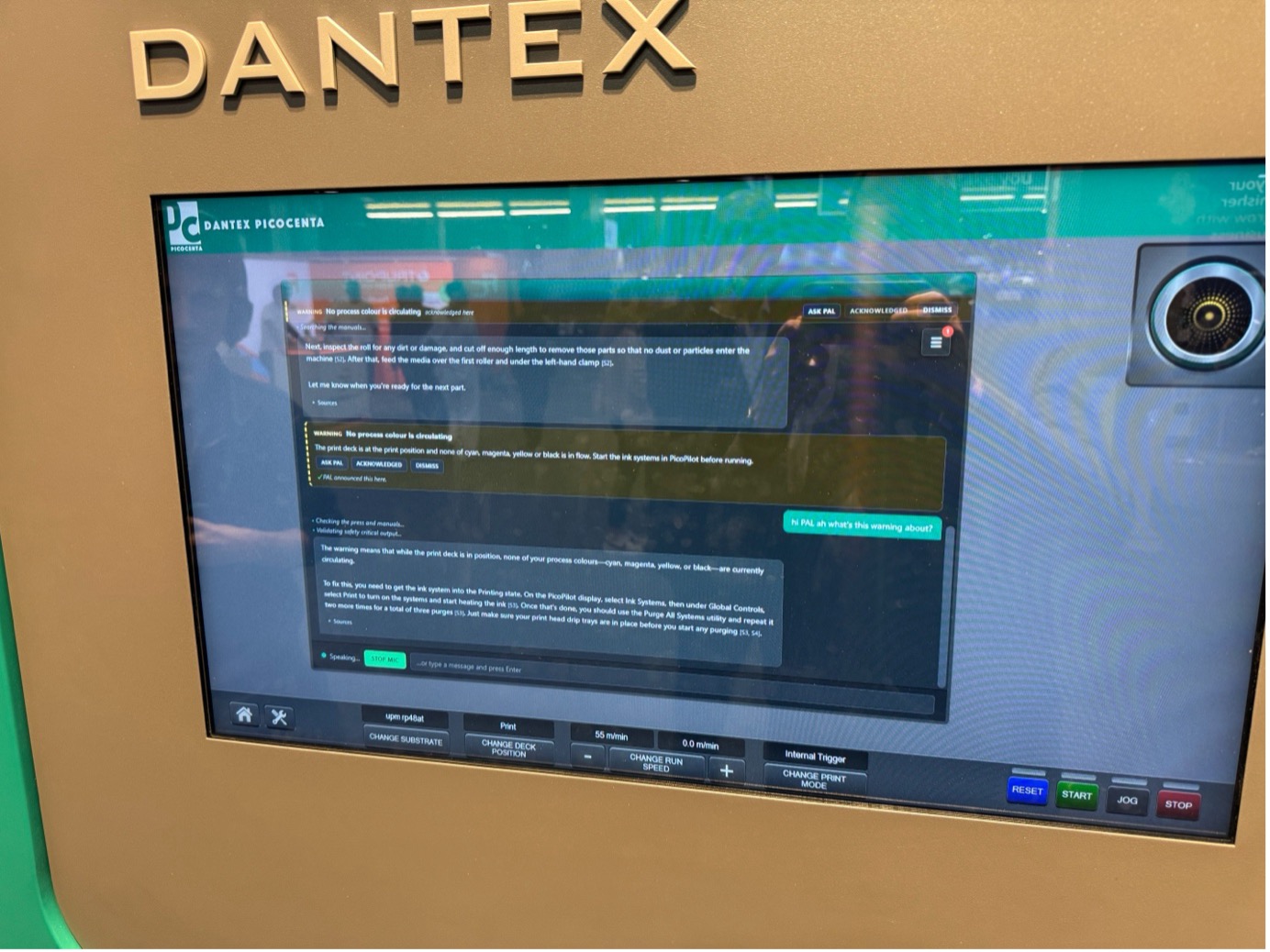
At Loupe Americas 2026, Dantex took this a stage further by previewing its AI-driven PAL (Pico Adaptive Logic) natural language press assistant. The technology is being developed by Cambridge, UK-based consultancy 42 Technology (42T).
PAL is integrated into the Dantex PicoPilot and PicoCenta interfaces, allowing the press to communicate directly with the operator via wireless headphones. The system proactively monitors the press and alerts the operator to any faults or emerging issues identified. The operator can query PAL about a range of issues including maintenance and press operation.
Going forward, 42T will make other functions ‘PAL aware’, such as job costing. The intention is not to control the press through the 2-way voice link.
It will certainly be interesting to see how far the technology has developed by its commercial launch next year on all new Pico-series presses.
Dantex also announced a strategic partnership with Ricoh at the show to offer the entire Dantex Pico lineup as part of its production print portfolio across the US and Canada. The two companies already cooperate technically; Dantex incorporated Ricoh inkjet technology into its digital label platforms many years ago.
The portfolio Ricoh will sell includes the PicoColour 254 entry-level press, available with Dantex’s integrated finishing system or the GM DC350 finishing unit, and the flagship PicoJet 1200 DRS.
Digital consolidates
Automation and integration were key themes around the digital and hybrid presses demonstrated at Loupe Americas 2026
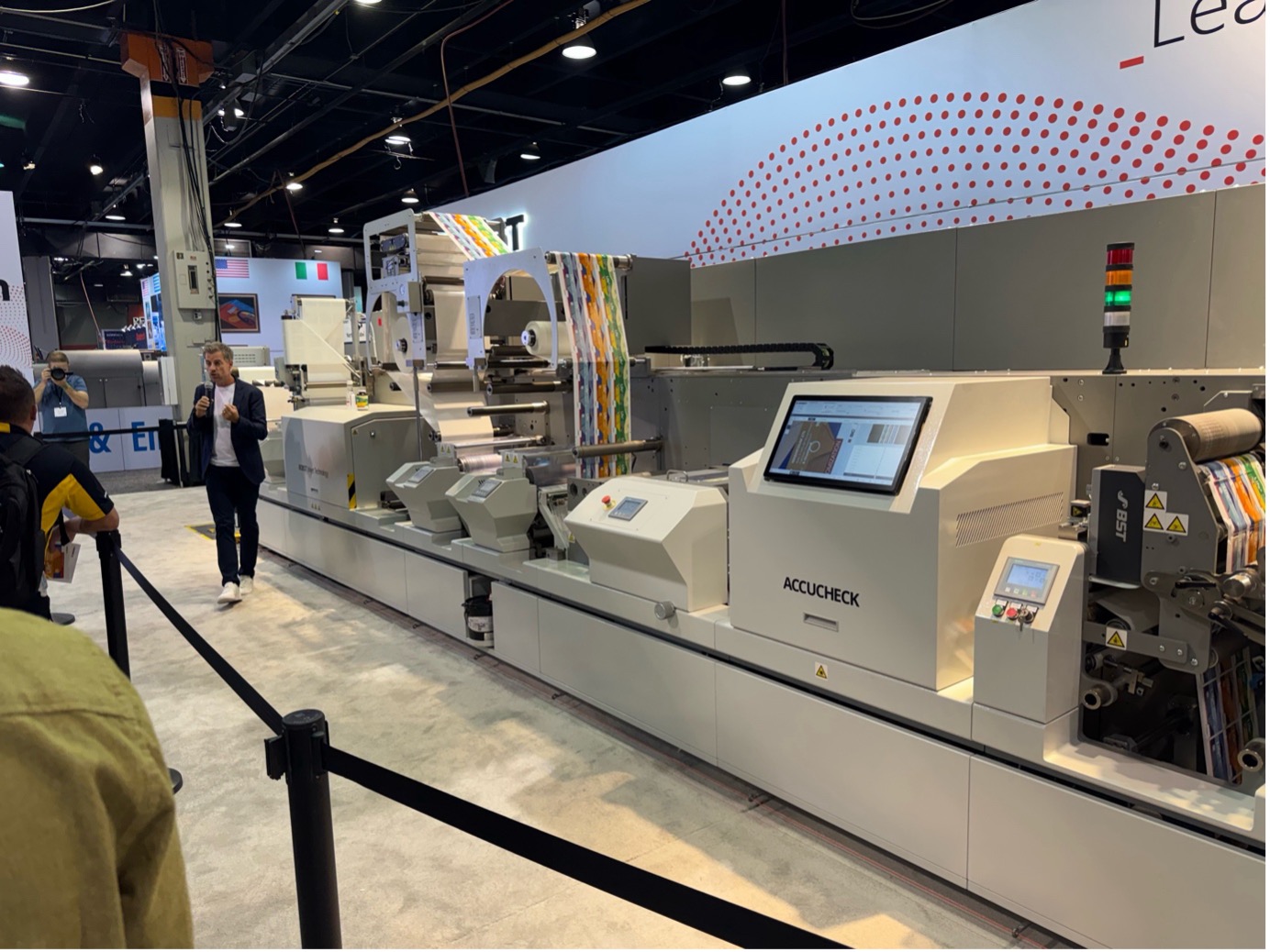
Bobst showcased its Digital Master 340 ‘all-in-one’ label press, combining UV inkjet, flexo, embellishment and die-cutting.
‘Flexo is still strong and has a dominant position in the label market. But the all-in-one, as we call it, or hybrid, is picking up more and more share, as the quality of inkjet gets better and you can shift from more flexo to hybrid,’ says John Ferreira, VP of sales, flexible packaging and labels in North America. ‘What I keep hearing from the label converters is this push to continue to differentiate. And then how do they do it? Embellishment becomes key, and that's what we’re showing here with the all-in-one Digital Master 340.’
Bobst was open about market challenges. The company’s financial reports from earlier this year have shown declining revenue, much of which is attributed to lower sales, tariff uncertainties and excess capacity in the market. Large converters continue to invest because of production contracts, Bobst says, while smaller and midsize projects are more likely to be delayed as converters wait out tariff uncertainty.
‘We’re fully committed to the label business around the world,’ says Ferreira. ‘I mean this is from Jean Pascal Bobst all the way down through every DNA of the business. Loupe was a big commitment, big investment, but we hope the impression that we're sharing here is that Bobst is serious about label, just like we are with flexible packaging.’
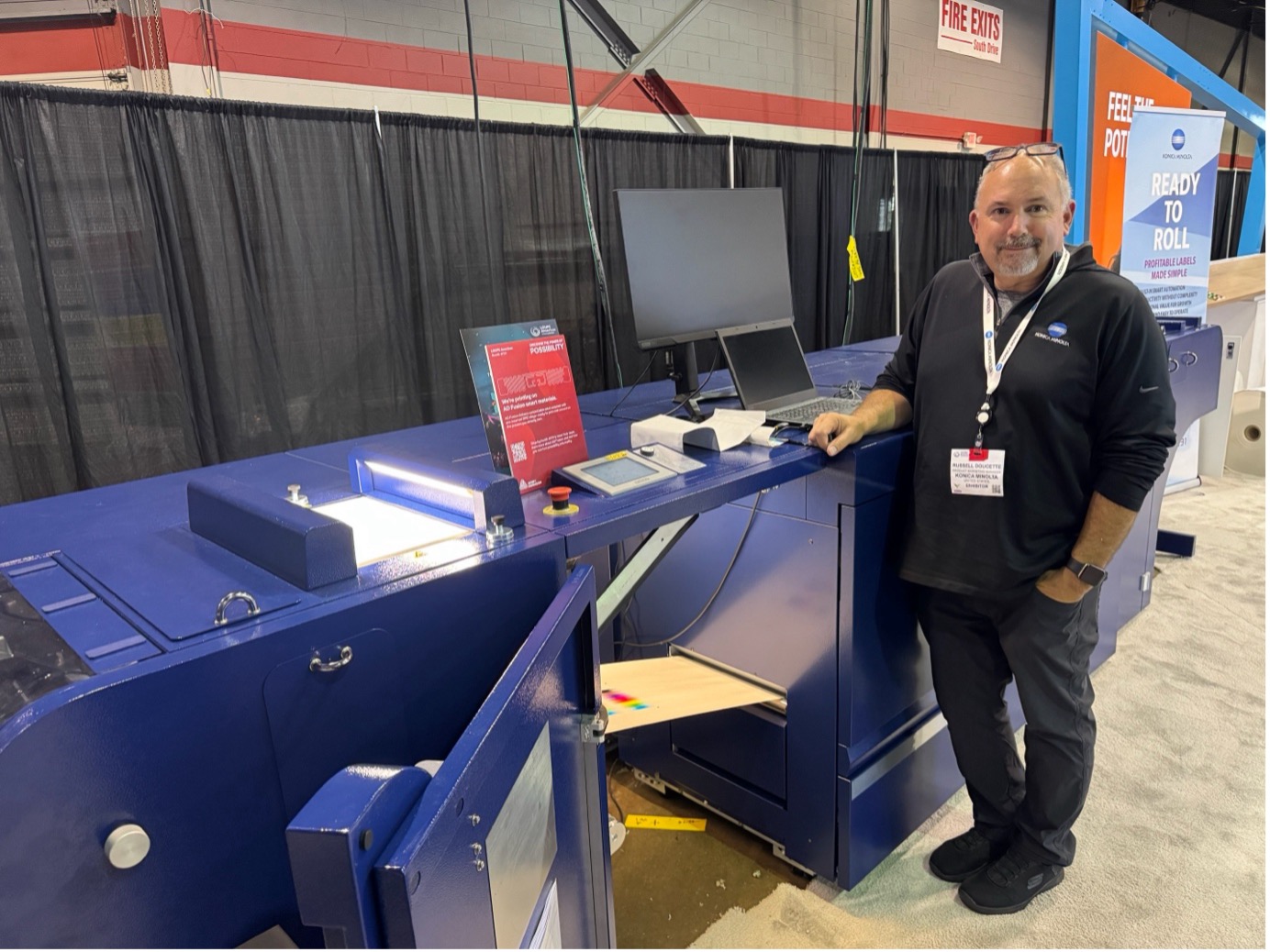
Konica Minolta used Loupe to launch its AccurioLabel 231 digital press, targeting entry- to mid-level production with greater automation and longer maintenance intervals. At the same time, Konica announced it has completed 2,000 installations of its AccurioLabel since launching it a decade ago. Its 2,000th installation went to Houston, Texas-based Biotef.
The toner-based AccurioLabel 231 runs at speeds of up to approximately 77ft/min (23m/min) at 1,200 x 2,400 DPI resolution. Konica Minolta says its key improvements are longer maintenance intervals and nearly double the engine life of its previous 230 model. Konica Minolta also added Intelligent Quality Optimizer technology that continuously monitors print performance and automatically corrects variations during longer production runs, maintaining consistent output with fewer manual adjustments.
Also on display was Konica’s AccurioLabel 400 for higher production digital label, and JetVarnish 3D Web 400 for digital embellishments, including UV varnish and hot foil.
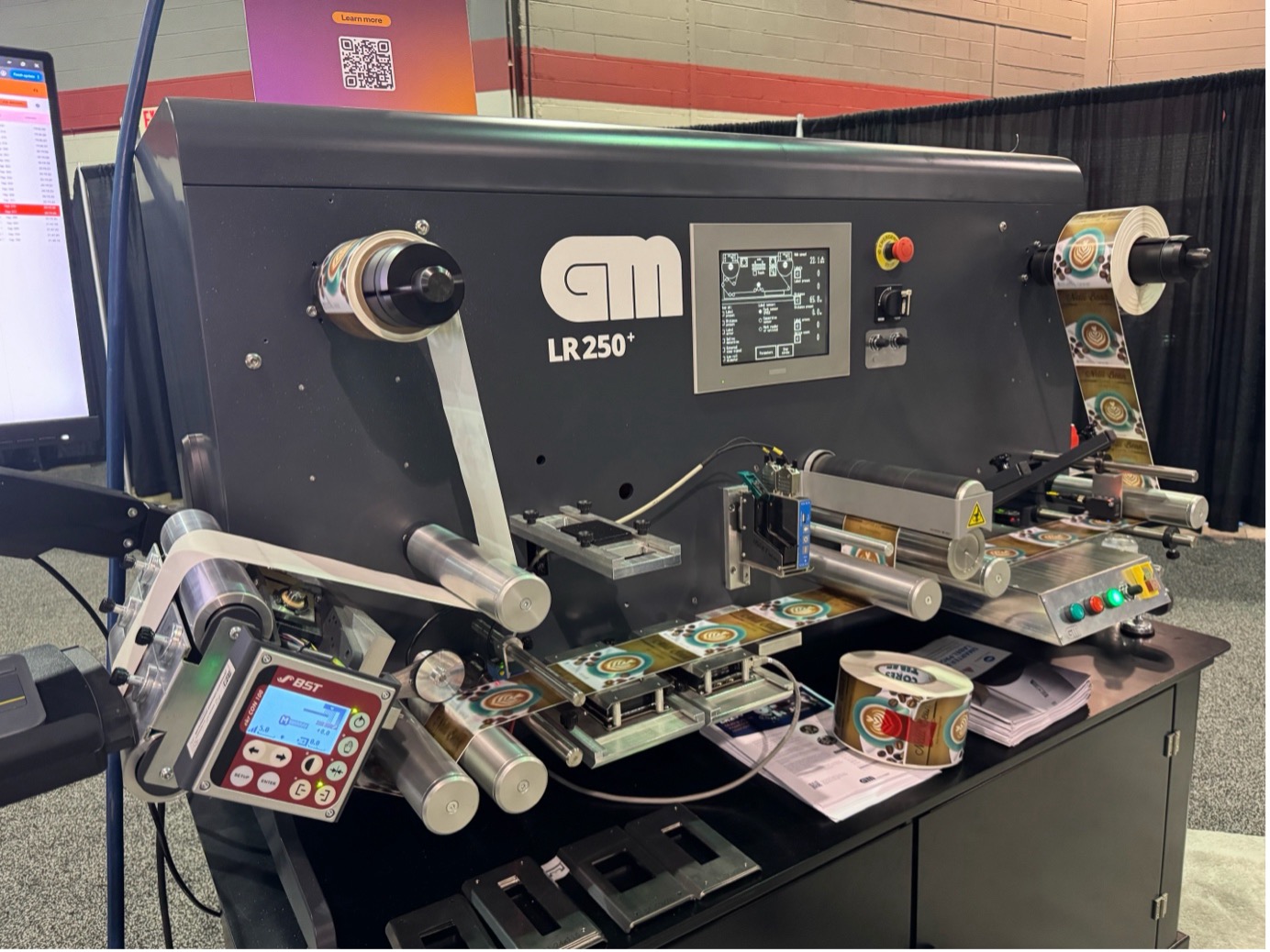
An interesting aspect of the Konica Minolta stand was a self-contained RFID workflow, marking a low-cost entry point to the technology. The AccurioLabel 231 was printing on Avery Dennison’s Fusion RFID material, followed by a compact GM finishing machine equipped with RF testing station, an essential part of the RFID QC workflow.
HP’s presence was interesting for a few reasons. With the V12, albeit with a virtual demonstration, HP showed that digital is moving up the volume curve. The HP Indigo V12 runs at speeds of 400ft/min (120m/min), rivaling flexo speeds. At the same time, the 200K showed HP moving further into adjacent packaging markets. The 200K was shown producing both labels and flexible packaging, reinforcing its message that converters can use digital technology to expand beyond traditional labels.
‘Forget about only labels,’ says Noam Zilberhshtain, vice president and general manager of HP Indigo. ‘We are talking about packaging overall, and what we see as a trend in the market. Converters are looking for ways to expand their capabilities and the range of what they produce. We see more and more label converters that are defining themselves as packaging converters.’
He continues: ‘And it makes a lot of sense. Converters’ customers want a one-stop shop that provides them all their packaging needs. They want labels, but also flexible packaging and folding cartons. We are seeing that expansion in the way converters think about not only labels but trying to find solutions that give them the ability to diversify their activities and provide end-to-end solutions for their customers.’
Meanwhile, the 6K+ proved to be the workhorse of HP’s Loupe lineup. HP demonstrated the press as part of a more automated workflow. The 6K+ was running in Enhanced Productivity Mode, which enables users to achieve up to 33 percent higher press speeds when using CMY, HP says.
At the same time, HP marked 200 sales of its 6K+ press since it launched at Labelexpo Europe last year. The 200th investment was signed at Loupe Americas by Atlanta-based converter Brightline.
Flint Group Digital Xeikon demonstrated three digital label production systems tailored to different applications, production volumes and investment levels.
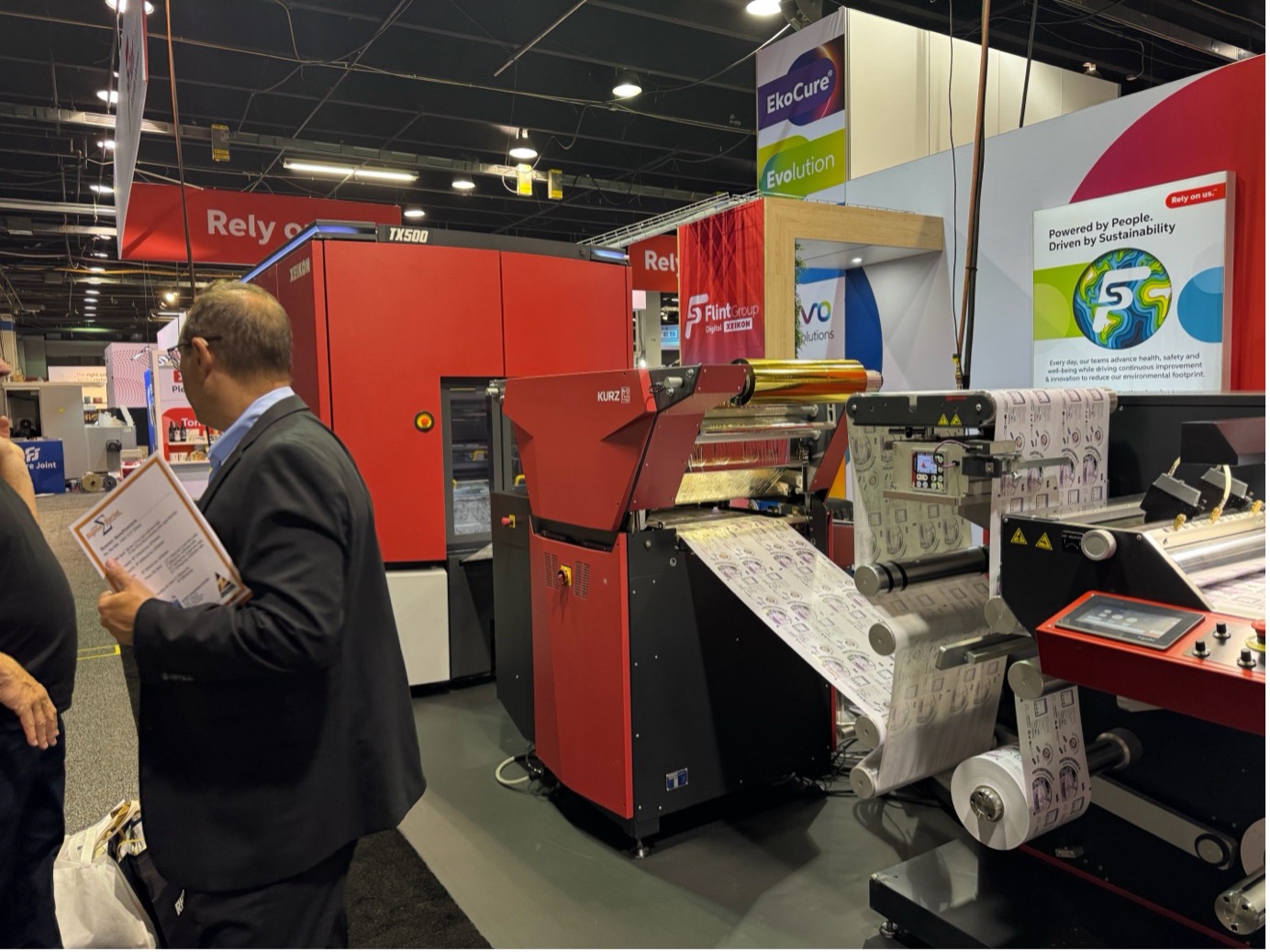
The Xeikon TX500 uses Titon dry toner, combining food safety with heat, chemical and abrasion resistance to produce highly durable print without additional varnishing or lamination. As part of the Label Trail partnership, Xeikon, Kurz and Scribos demonstrated variable metallic embellishment, with a Kurz metallization unit in-line with the TX500, as part of a brand protection program.
Xeikon also showed an Ecolyne press, designed to lower the entry barrier to digital printing. The dry-toner press offers 1,200 DPI resolution, a 330mm web width and speeds of up to 25m/min. A monthly, capacity-based commercial model helps customers enter digital production with a lower upfront investment.
On the inkjet front, Xeikon showed the PX3300HD UV inkjet press, offering 1200DPI resolution, CMYK + W and speeds of up to 70m/min. Flint Group Digital Xeikon and Xerox earlier announced a partnership under which presses based on Xeikon inkjet technology will be offered under the Xerox brand. The partnership excludes Xeikon’s toner technology.
Canon used the show to demonstrate how its recently acquired Edale flexo technology fits into its wider ecosystem. ‘Canon made the decision around four years ago to expand into labels and packaging and we are very serious about this market,’ said Dan Lacey, strategic business development manager at Canon.
‘We are currently bringing support to the North American market for Edale technology. By the end of the year, we will have full-service support in the US and Canada.’ James Boughton, formerly managing director of Edale, is spearheading this program.
A hybrid press based on the Edale platform is under development, though no details were given as to configuration at this stage.
There was no sign of the LabelStream LS2000 water-based label press, with Canon saying it would be available ‘very soon’.
Canon used an ‘unboxing experience’ to demonstrate how their analog and digital package printing systems fit together. The outer carton was produced live on a Colorado M-series wide format (1.2m) UV Gel inkjet printer; a shipping label was produced on Canon’s LX-D400 and LG-P800 4in/8in desktop label printers; the inner carton was printed in a single pass on an Edale CartonLine press and finished with a label printed on the Edale LabelLine press on the stand. Promotional poster and corrugated display case were printed on an Arizona large format printer, and proofs for the whole pack were produced on Canon’s own imagePrograf GP-2600S.
‘We are showing how new business streams are available to label printers based on short runs with color matching between substrates,’ said Lacey.
Durst launched its Tau G3 platform in North America. The press on display was a Tau G3 Peak model, printing at 1,200 DPI native resolution at speeds up to 328 ft/min (100m/min).
This press also features Durst’s Automatic Register Control (ARC), an intelligent color-to-color registration system, and Material Edge Protection (MEP), which prevents accidental contact with print heads. Both technologies reduce the manual intervention necessary during press maintenance, setup and run.
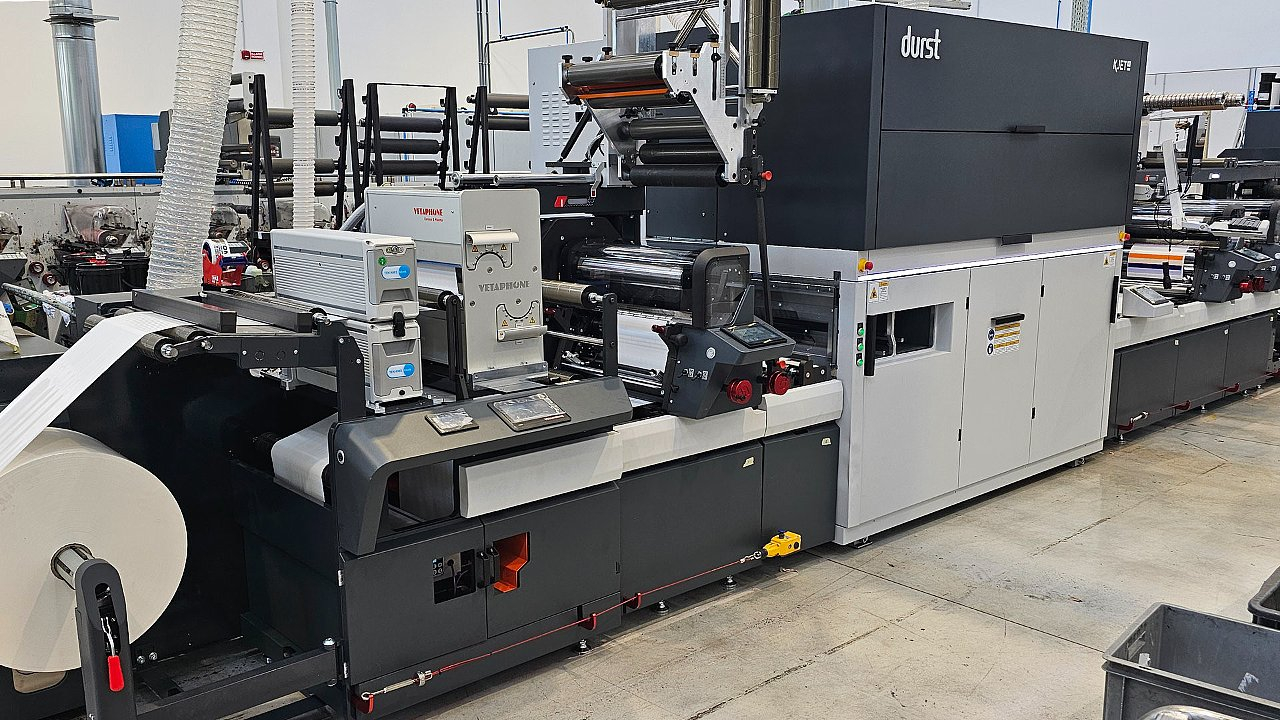
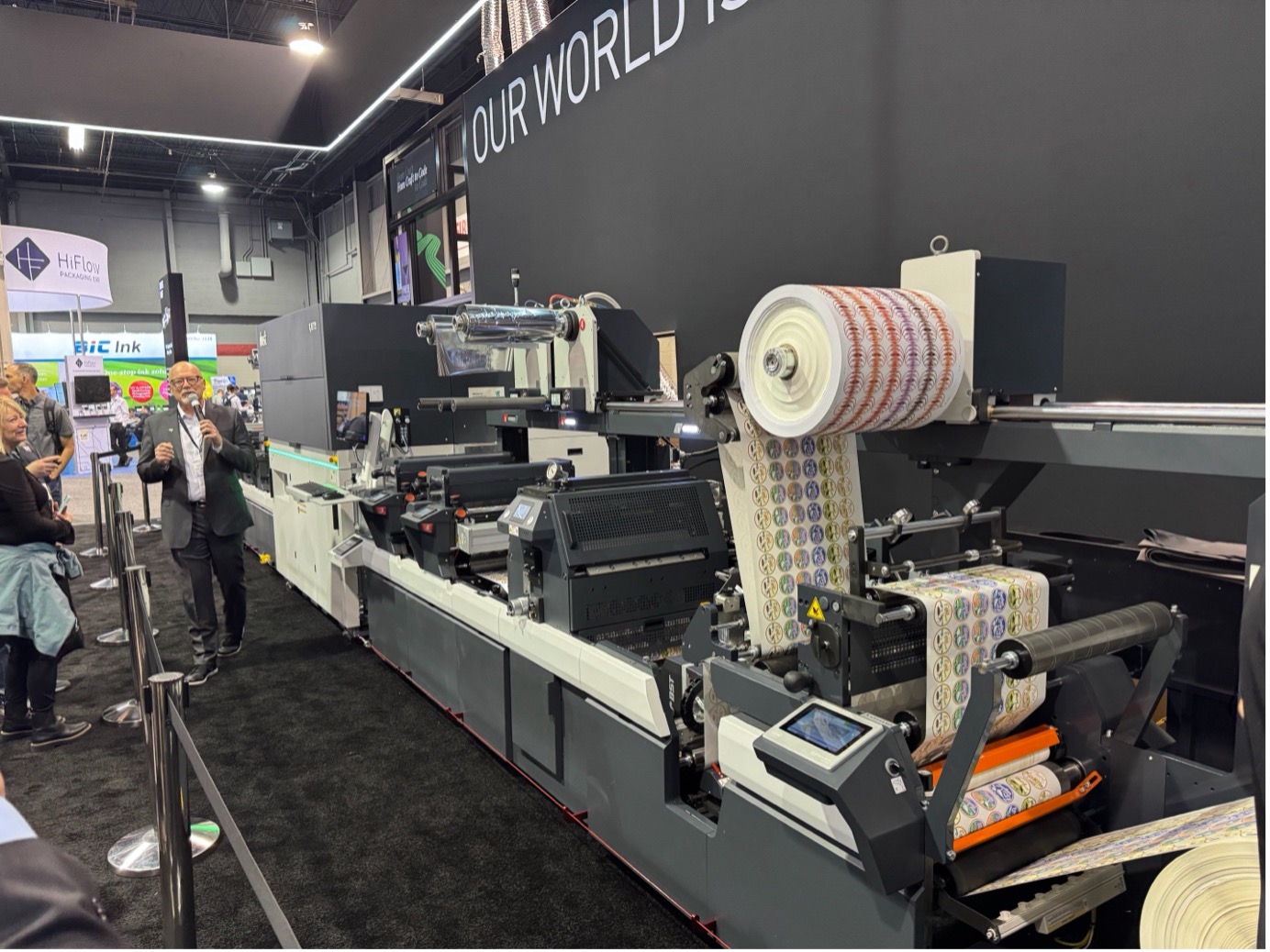
Also on stand was Durst’s KJet hybrid press, built on the modular Omet KFlex platform combined with Durst’s 1,200 DPI Tau RSCi inkjet technology. The KJet at Loupe Americas was fitted with plate cylinders, but sleeves are also available along with full or semi-rotary die-cutting.
Naturally, the announcement made at the show that Durst has acquired MPS raised questions about the future relationship with Omet.
But Thomas Macina, sales director for labels and flexible packaging at Durst, insisted the working relationship with Omet remains central to Durst’s hybrid strategy for the foreseeable future (for an excellent analysis, see the article by L&L European Editor Will Drysdale).
Epson launched its L-5034 water-based digital press in North America, building on the success of the L-4733 series (which remains in production). The L-5034 prints almost three times the speed of the L-4733 at 44ft/min (13.5m/min) at 1,200 DPI resolution, made possible by a hybrid drying system that combines hot air with reverse-side heating of the web.
A digital water-based White was announced at the recent Japan Label Forum in Tokyo.
Also on the Epson stand was an L-6534 UV inkjet press printing at up to 50m/min including a digital varnish station and high-opacity white, along with the company’s on-demand printer series.
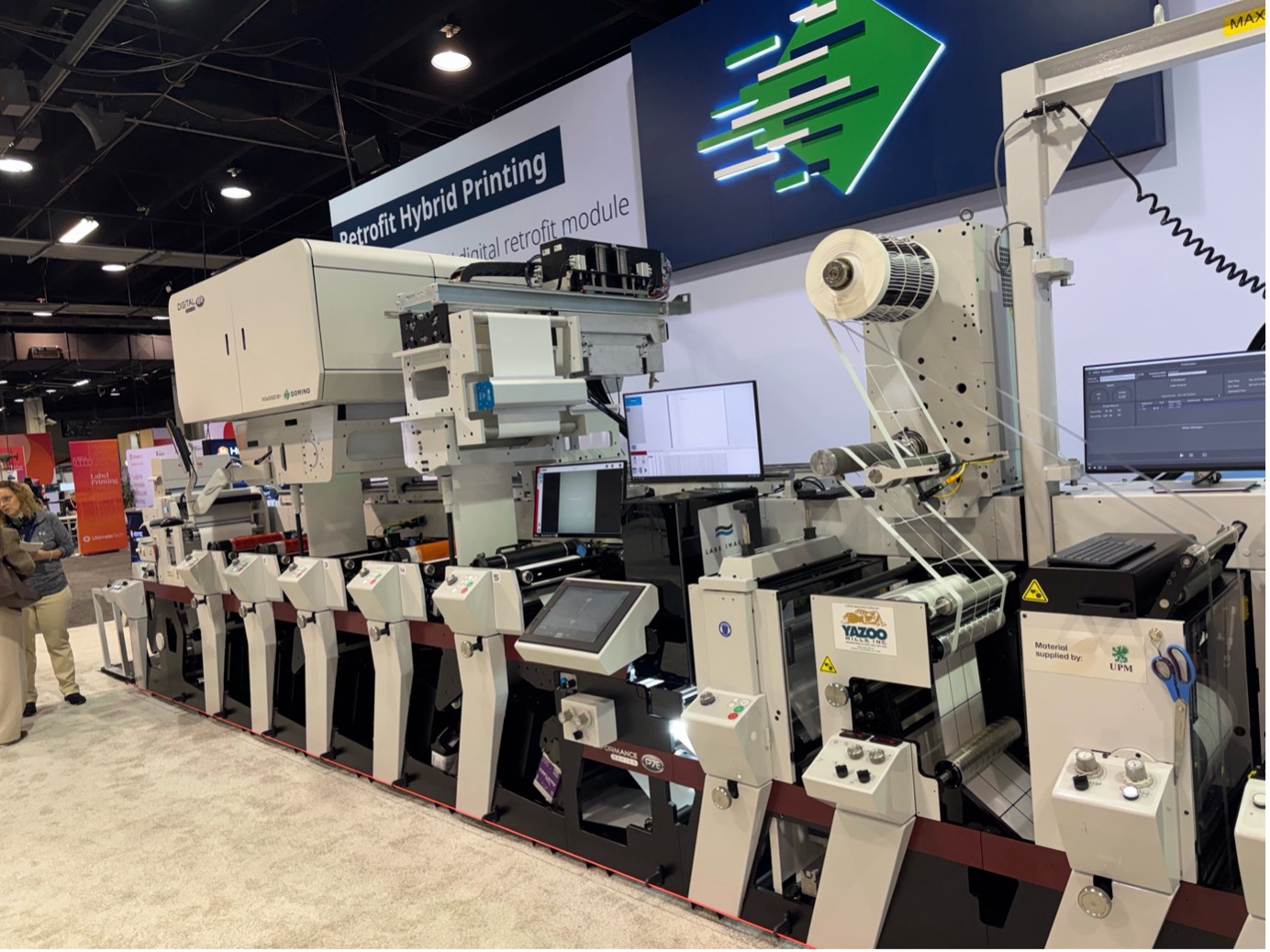
Domino focused on hybrid printing through a partnership with Mark Andy, demonstrating an N610i-R digital integration unit and a dual-bar K600i inkjet printer fitted to a Performance Series P7 press.
The 13in (330mm)-wide N610i-R module can be fitted to any flexo press using a rail mount. It reads an i-mark printed on the first flexo station to synchronize web speed. The integration module prints at speeds up to 246ft/min (75m/min) at 600DPI in CMYK+W.
Also installed on the P7 press was Domino’s dual-bar mono K600i unit, printing UPCs and barcodes. Running without the N610i-R module, the K600i runs up to 496ft/min with full LED-UV curing. To achieve this speed, Domino partnered with SST Inc., which has developed its own patented As-LED curing technology.
Domino focused heavily on educating visitors on the upcoming Sunrise 2027 GS1 code, the global initiative to move the linear barcode to a QR code format by next year.
Additional information such as serial numbers, date and lot codes, promotional information and other variable information will be included in the UPC QR code without taking up additional real estate on the label. This will make every label variable and unique, as it will have its own identifier or number.
Domino also reported good sales for its entry-level LED-curing N410 digital press launched at Labelexpo Europe last year. The press is specified with CMYK+W at 164ft/min (50m/min) at 600DPI resolution. Domino reported a high level of interest from Mexican and Latin American converters in particular.
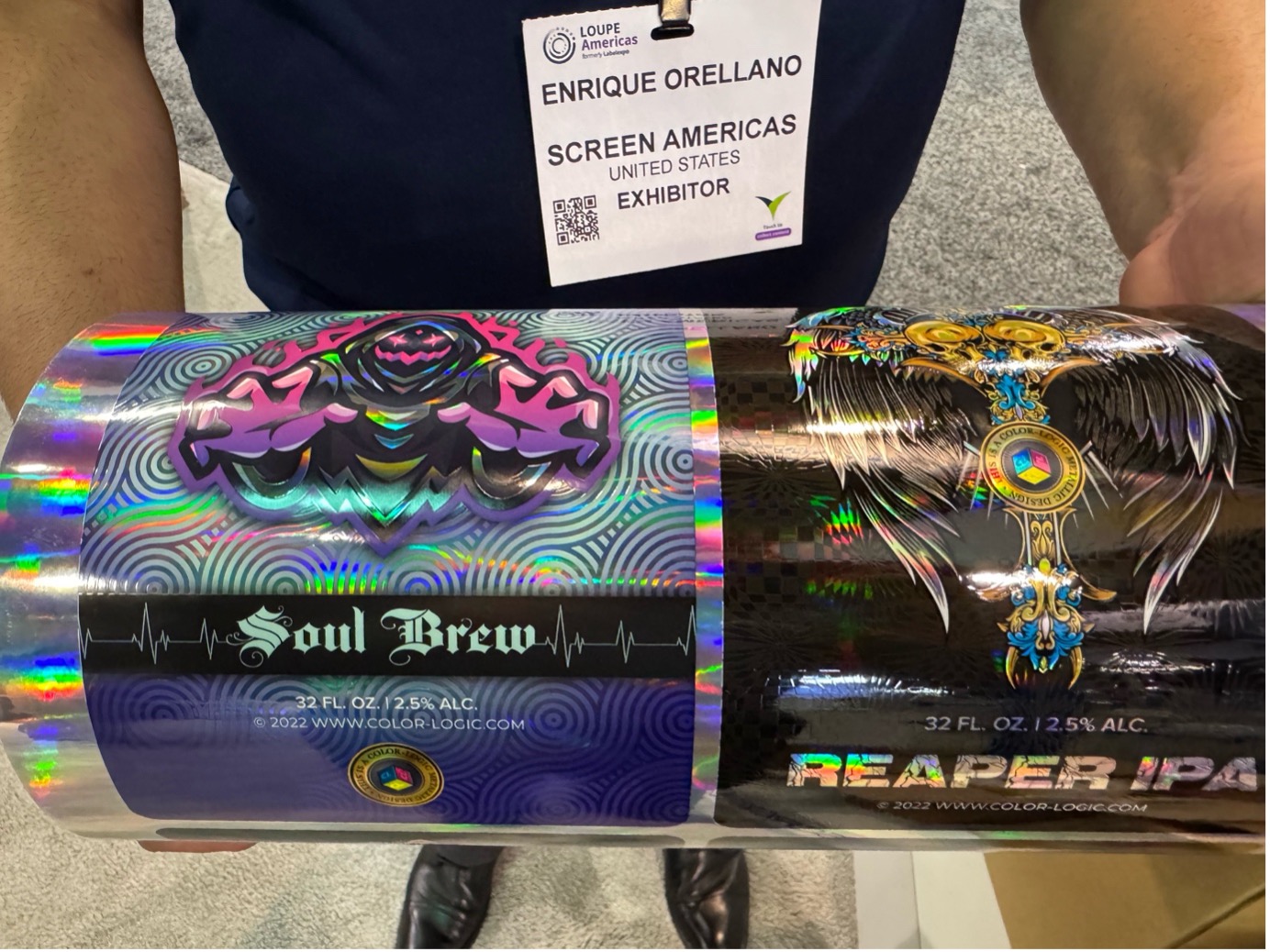
Screen exhibited its Truepress Label 350UV SAI S inkjet press. Supporting up to seven colors — CMYK, white, orange and blue — and speeds of up to 196ft/min (60m/min), Screen says this is the first UV inkjet label press to comply with Idealliance's CRPC7 expanded color gamut printing specification. Printed rolls were finished and die-cut on a GM DC350Mini.
In collaboration with Color-Logic, Screen demonstrated a wide range of metallic colors and decorative effects produced in a single pass on metallic substrates.
The company additionally partnered with Denmark-based LabelHub to showcase an online proofing and approval workflow.
Colordyne Technologies announced a strategic partnership with inkjet technology specialist DJM to expand its industrial inkjet retrofit products across North America. DJM’s Eureka technology uses HP’s latest TIJ4.0-HD printheads with a native resolution of 1,200 DPI and a print width of 4.25in with patented micro-recirculation technology.
It was also announced that Xaar has appointed Colordyne as North American distributor for the Xaar Versatex printbar. The collaboration combines Xaar’s printbar with Colordyne’s inkjet integration, application development, and converter support expertise. Designed for turnkey in-line integration, Versatex adds digital embellishment and functional printing to existing presses and converting equipment. Available in varnish, white and variable-data black configurations, it supports spot varnish, high-build gloss, textures, cold foil, braille and personalization.
Digital news in brief
Flora showed its hybrid Orca330 Ultra platform, launched at Labelexpo Asia last year. The press was configured as a 5-color UV inkjet press (CMYK+W) with a flexo coating unit. It is optionally available in up to eight colors and can be configured with flexo or digital varnish, lamination and hot stamping. The press operates at 600 x 1,200 DPI resolution on 3pl ink droplets and can print on a wide range of materials from coated paper to flexible packaging. The company reported significant interest from Mexico and Latin American converters
Zonten demonstrated its digital label print and converting equipment, showing a standalone ZTD roll-to-roll press and the ZTD Combo hybrid version with flexo, cold foil and lamination unit. The ZTD-RP7350R is available with CMYK+OV+W and runs at between 98-196ft/min (30-60m/min0 depending on print resolution, to a maximum 1,200 x 500 DPI.
AnyTron focused on its compact Any-Jet II Plus label press that combines high-resolution CMYK inkjet printing and laser finishing in a single pass. The 1,600 × 1,600 DPI digital engine is based on Memjet pigmented water-based technology and includes the company’s AIMS workflow automation software.
ArrowJet demonstrated its range of ArrowJet printers and finishing systems, including the ArrowJet Aqua 330R II, which uses Memjet DuroCore water-based inkjet technology to achieve production speeds up to 144ft/min (43m/min).
Dilli showcased its flagship 13in (330mm) digital label press, the Neo Picasso Plus, designed to print on both labels and flexible packaging materials. The press incorporates Dilli Vision, Dilli's proprietary in-line inspection technology.
Hanglory showcased two machines: the LabStar 330mini, an integrated, all-in-one digital label production system with a maximum print speed of 164ft/min (50 m/min), and the Hanlabel Ultra digital embellishment press, delivering 3D UV varnish and gold foiling at a maximum speed of 239ft/min (73m/min).
Digital Inkjet Solutions Group exhibited its integration technologies alongside newly appointed American agent, Print Label Pack (PLP). PLP was showcasing the Go HUB platform, an ‘OEM-friendly hybrid integration system’ designed to add advanced digital printing and embellishment capabilities to existing production lines.
Direct to shape
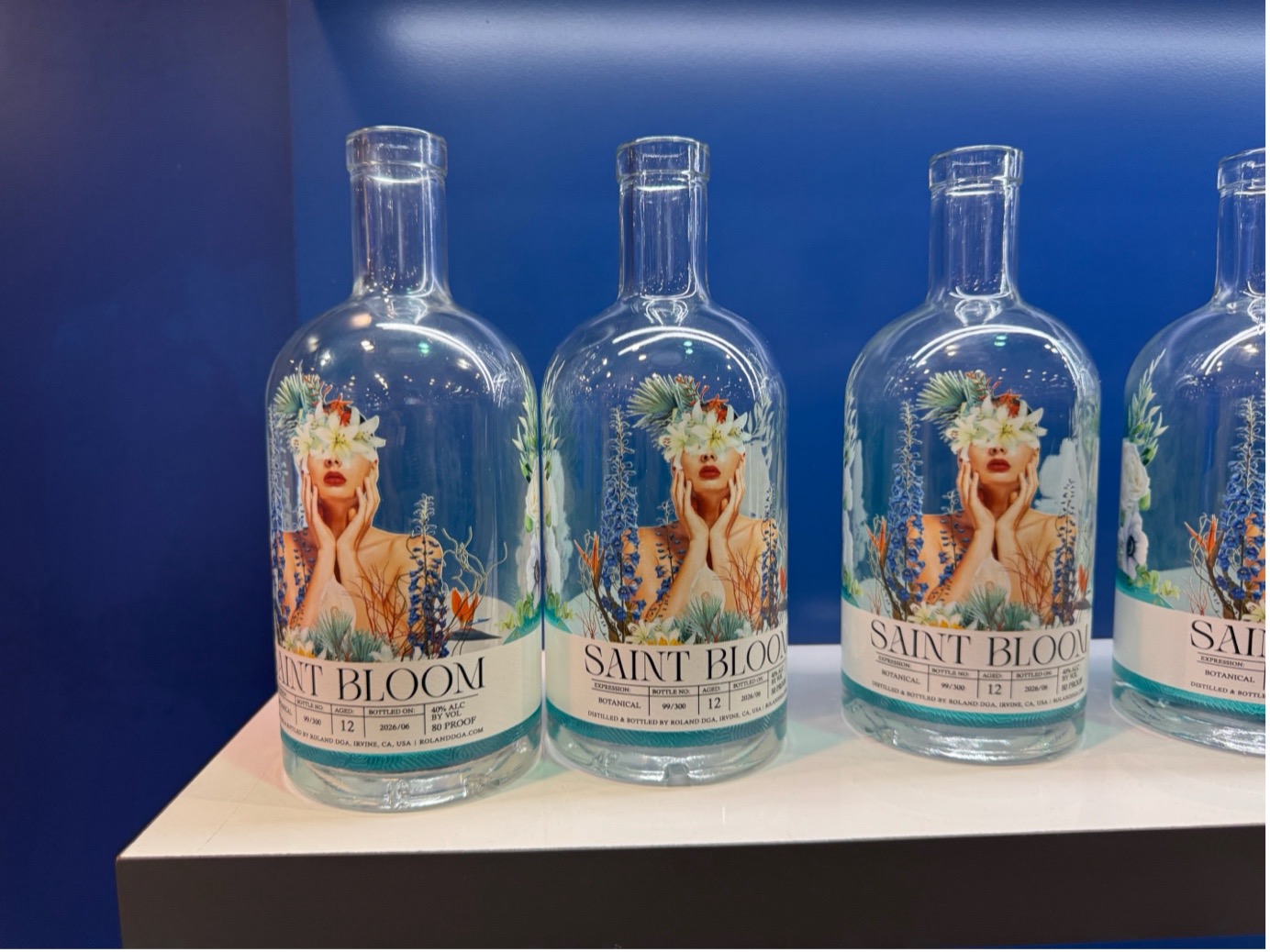
Roland DGA was the only company to demonstrate direct-to-shape printing at Loupe Americas 2026. The company showed an LSINC PeriOne machine capable of decorating 4-5 containers a minute. Typical applications include prototypes, personalized and special-edition product runs.
The machine has a single rotary axis and can image onto cylindrical or tapered cans and bottles. The printer uses a JetINX inkjet engine imaging at 1,247 x 1,200 DPI, printing CMYK, White, varnish and primer. Multiple rotations can be used to build embossing-type varnish effects.
Roland DGA also previewed its RC-300 UV inkjet rotary printer, engineered to use Roland DG’s durable Hard UV ink.
Flexpack digital embellishment
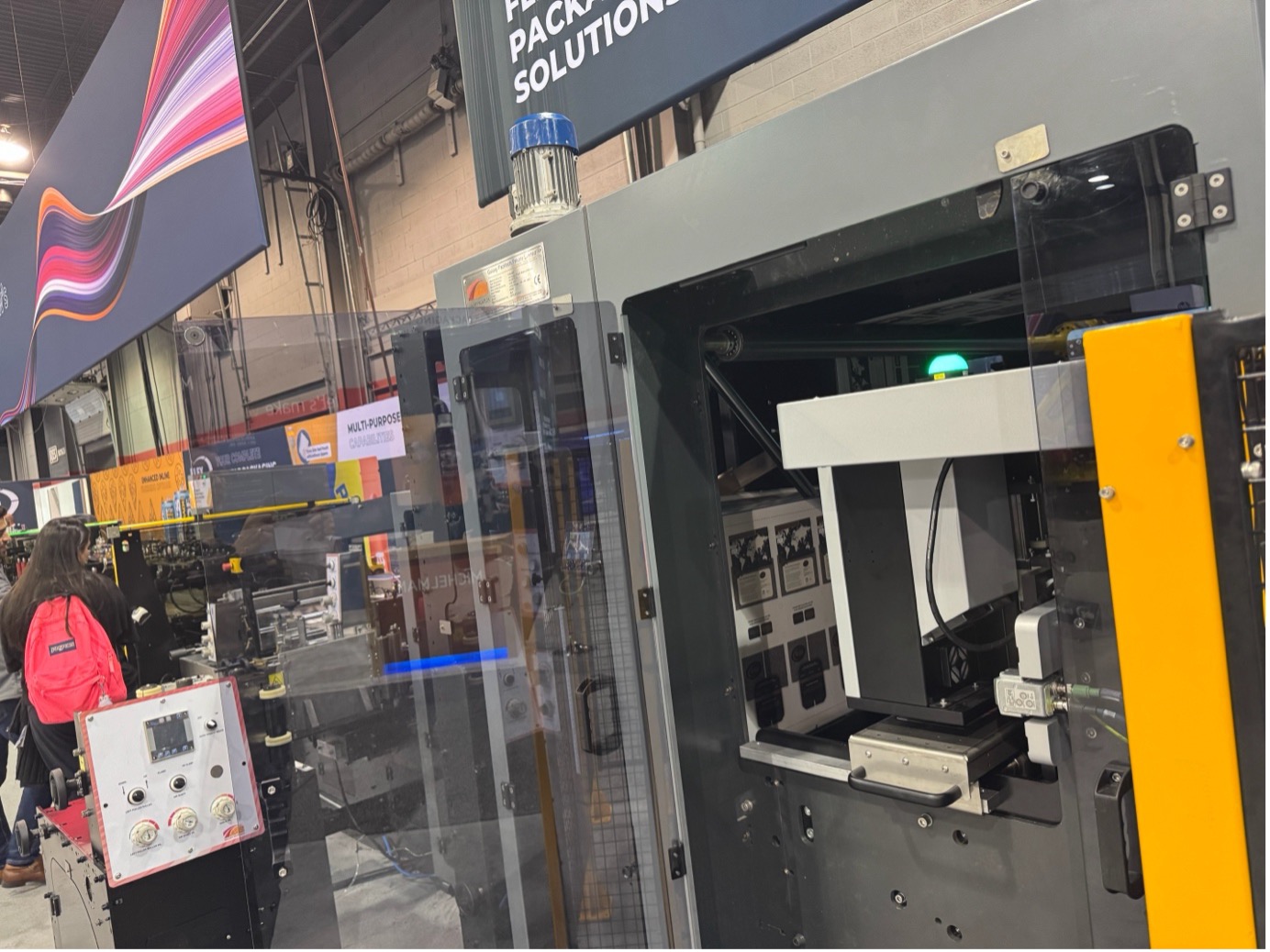
We saw inkjet modules embellishing flexible packaging at different stages of production. At the ABG stand, the company launched its Pouch Jet embellishment system, mounted in-line on a Galaxy pouch-making machine. The inkjet module is built into a separate station at the end of the pouch-making line on motorized carriage mounts, allowing the inkjet heads to move to any part of the web.
As part of the HP flexible packaging ecosystem, JetFX demonstrated a digital embellishment unit mounted on the Gonderflex mid-web laminator launched at the show. The laminator was operating on pouches printed on the HP Indigo 200K.
Stay up to date
Subscribe to the free Label News newsletter and receive the latest content every week. We'll never share your email address.