Sandon Global, Hamilton-Schades push anilox tolerance
The collaboration focuses on challenging assumptions around anilox tolerance and its influence on color control in process printing.
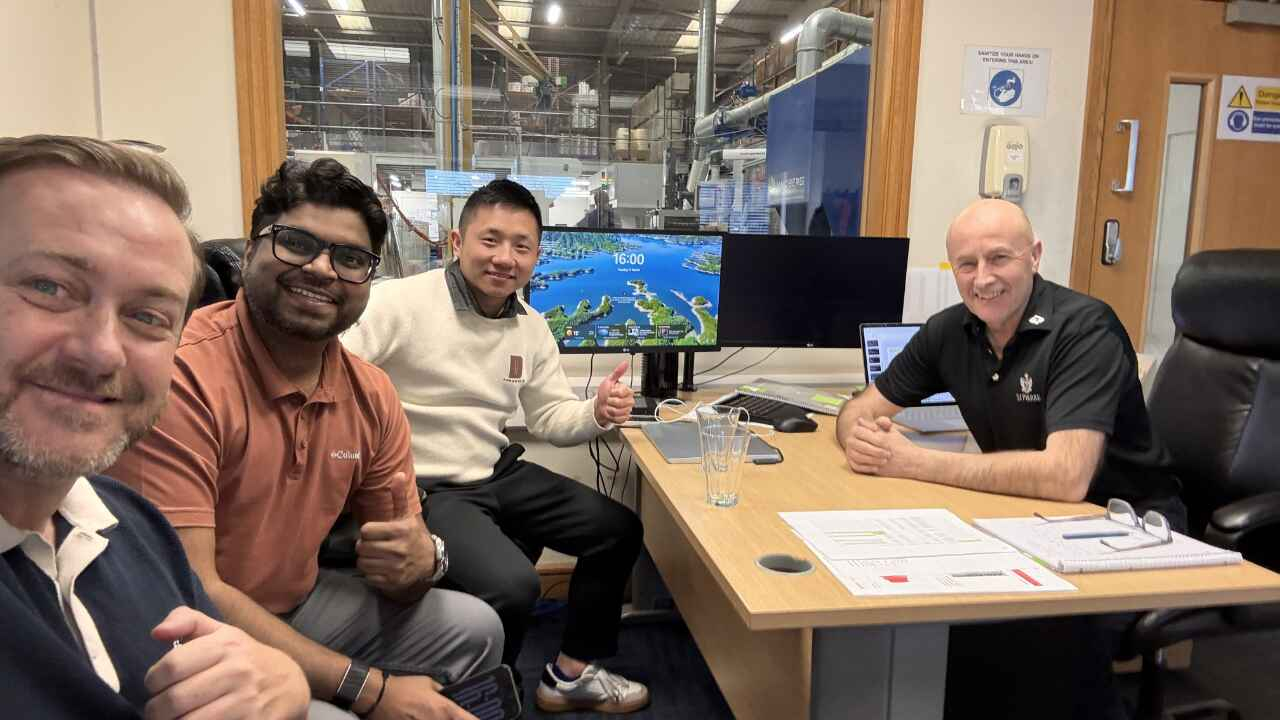
Left to right: Paul Mitchell, regional sales manager, UK & Ireland, Dr Siddharth Lokachari, research and technical manager, plasma coatings division, Dr Menghui Zhu, research development technical manager, laser processing division, Sandon Global with Paul Larkin, technical director, Hamilton-Schades Labels
British anilox manufacturer Sandon Global has completed a 15-month technical collaboration with Hamilton-Schades Labels, part of the Schades Group, achieving anilox tolerances beyond established flexographic industry standards to improve print accuracy, color consistency and long-term repeatability.
The project set out to determine whether tighter control of anilox volume consistency could be achieved and sustained in a production environment. The objective was to improve color stability and repeatability on press, while also reducing makeready time, minimizing waste and improving overall process predictability.
Led by flexo industry veteran Paul Larkin, technical director at Hamilton-Schades Labels, the collaboration focused on challenging established assumptions around anilox tolerances and their direct influence on color control in process printing.
A structured program of measurement and validation underpinned the work, including the assessment of 106 anilox rolls in operation at the company. Each engraving was inspected and quantified to establish baseline volume consistency and identify variation across the installed inventory.
The project aim for Sandon was to provide an anilox that gave even greater accuracy than current industry standards. The challenge was to establish the optimal combination of volume and line count to ensure consistent reproduction across repeat jobs, new press installations and replacement rolls, achieving the highest possible print quality standards. Testing included optical density, color balance and print performance across paper and film substrates, with Sandon Global’s Fluid UV cell structure used for all process inks throughout the program.
Larkin said: 'Flexographic printing depends on control across every stage of the process. All component parts must perform consistently over time. While line count remains part of the specification, it is the anilox volume that determines the ink film and therefore color accuracy.
'Achieving and maintaining these tolerances contributes to taking Hamilton’s quality and performance of label manufacturing to new heights.'
Laser processing and engraving were central to achieving the required level of control. The project was delivered by Sandon Global’s technical and R&D teams, led by Dr Menghui Zhu, research and development technical manager and head of the laser processing division. His expertise in laser engineering and process control was applied alongside Sandon Global’s advanced engraving technology.
Key laser parameters were tightly controlled and fixed to achieve target volumes without altering cell structure, supporting more consistent ink release on press.
Dr Siddharth Lokachari, research and technical manager of Sandon Global’s plasma coatings division, ensured coating performance supported durability and consistency across the anilox specification.
Jake Roberts, sales director at Sandon Global, said: 'Paul’s approach to measurement and control aligns closely with how we work at Sandon Global. This project demonstrates the value of applying that discipline consistently across both the flexo printing process and anilox manufacture.
'Our capability is strengthened by combining production experience with scientific understanding. Having in-house expertise such as Menghui’s academic background in laser processing, alongside Sid's coatings knowledge, enables us to connect detailed research with practical application in a production environment. That link is important in achieving consistent engraving performance and reliable results on the press.'
Larkin added: 'The results achieved have been quite remarkable and we have reached tighter tolerances than previously achieved. This project reflects the value of measurement and control in building a system that delivers repeatable, high-quality results.
'It also brings us closer to a digital level of tolerance, which is important as we continue to develop expanded color gamut printing. Tolerances are critical in this area, as even small deviations can affect color accuracy.'
With more than five decades in the label industry, Larkin has long advocated a measurement-led approach to improving productivity and quality. The project reflects that philosophy, focusing on consistency through detailed understanding and control of process variables.
He continued: 'Improvement at this level requires time, investment and a willingness to examine every stage of the process. Working with a partner prepared to commit to that approach has been essential in achieving these results.'
For Hamilton-Schades Labels, improved anilox consistency supports more stable color reproduction, fewer press adjustments and greater confidence in repeat jobs and new installations, strengthening capability for expanded color-gamut workflows.
The collaboration demonstrates that tighter anilox tolerances can be achieved and maintained in production, providing a more stable foundation for color control, reduced waste and improved operational efficiency in modern label printing.
Stay up to date
Subscribe to the free Label News newsletter and receive the latest content every week. We'll never share your email address.