Five generations in print at DWS Printing & Packaging
New York-based DWS Printing & Packaging has been in business for 161 years. With a legacy in offset and flexo printing, it looks toward the future.
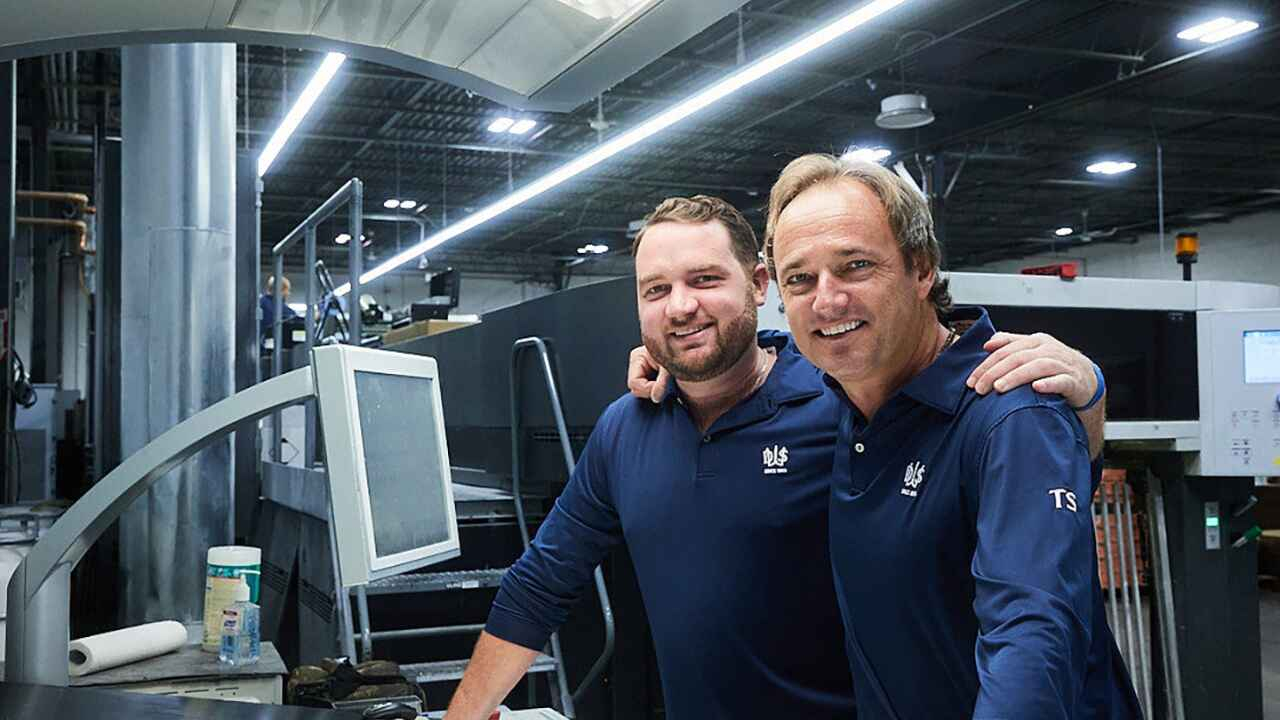
TJ and Andy Staib at DWS Printing & Packaging
It could be said that the modern trajectory of DWS Printing &
Packaging was changed by a horseradish sauce company.
Of course, for a 161-year-old printing business, there were many twists and turns before a fateful condiment company
changed its direction. And there certainly were peaks and valleys after, but for this story, it all begins with horseradish.
It was 2008, and brothers Andy and Tom Staib were running DWS, a successful cut-and-stack label business on New York’s Long Island, catering to food and beverage brands.
One of its top customers, the aforementioned horseradish company, changed its packaging format from glue-applied cut-and-stack labels to a pressure-sensitive format. DWS was an
offset label printer with no flexo assets at the time.
So, the Staib brothers had a choice. Turn to flexographic printing or lose one of its biggest customers. Together with the deep expertise of its COO, John Gulino, DWS bought its first flexo press, a Nilpeter FB, which is still considered the workhorse of the facility, printing some of the company’s
longest flexo runs.
‘We noticed a lot of beverage brands were also going from cut-and-stack labels to pressure-sensitive labels or even shrink sleeve,’ Gulino says. ‘We saw that evolution and said if it’s going to happen to one account, it could happen to any one of them. We need to be able to change with our customers.’
‘You have to keep in mind that we knew nothing about flexo when we started looking at it,’ Gulino recalls, comically. ‘I was literally looking at the plate, saying: “why is it rubber?” We had no experience, except that we were losing a customer from our cut-and-stack side that we wanted to keep, and it was enough work to spend the money in the press to learn about it.’
Eighteen years after that first flexo purchase, pressure-sensitive labels make up half of the company’s jobs.
A defining moment
Another turning point for the company came in 2020, when Tom Staib passed away all of a sudden, a loss that profoundly
altered the organization.
Anyone who knew Tom knew he was just as passionate about the family business as he was about his own family. He was equally as enthusiastic about music as an avowed ‘Deadhead’ and drummer.
“It’s important for us to be as efficient as we can be so we can compete against anyone”
Tom’s presence is woven into the fabric of the facility. From the Grateful Dead stained glass hanging in the front window, to the rock concert photos that line the walls of the hallway to the office he once shared with his brother, Andy. Tom’s son, TJ, was then three years with the company when his father passed, assumed the role of president.
Tom was a well-respected and engaging figure in the label industry. He frequently attended TLMI events and other industry conferences, often called upon to speak on panels and happy to swap stories of successes and setbacks with fellow label converters. Tom was not afraid to take a leap of faith on new equipment if it meant moving the company in the right direction.
‘The move into flexo opened up a whole new area and marketplace to compete in,’ says Andy Staib, owner and CEO.
DWS was an early adopter of in-house platemaking and ink mixing, as well as expanded color gamut printing. In 2017, it was the first converter to purchase a new MPS EF Symjet hybrid press with Domino, which helped the company better serve the craft beer and beverage markets.
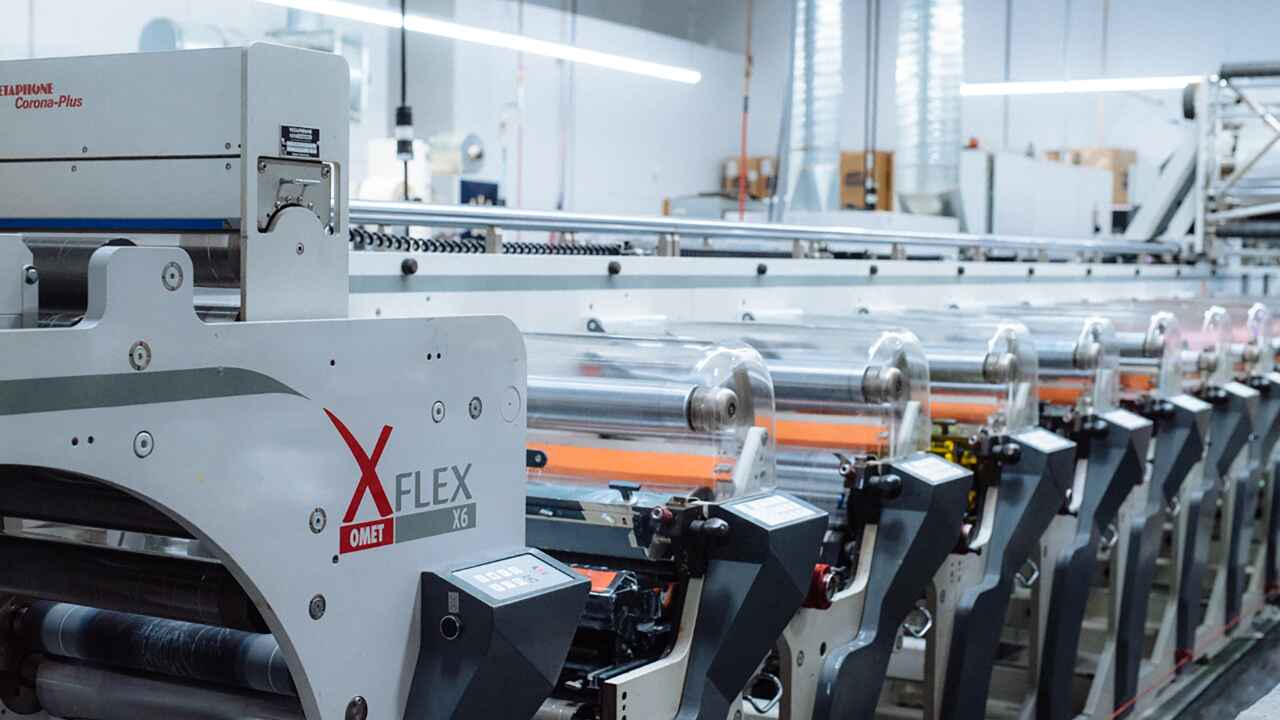
Rounding out its PS label assets is an Omet XFlex X-6 in-line flexo press that helped the company expand into shrink sleeves and further into roll-fed labels; and an HP digital press for its short-run shrink sleeves and PSL work. DWS runs a Heidlberg XL 106 press for its cut and stack labels.
‘Flexo changed the course and the direction of our business,’ Gulino says. ‘The Heidelberg gave us the capacity, the quality and the speed that we needed to keep competing in the market we were in. The Nilpeter gave us the speed, quality and capacity to get into completely different markets.
‘If we didn’t get into flexo, we wouldn’t be doing shrink sleeves or printing on films. I think without our first flexo equipment, we wouldn’t get the hybrid press, or the Omet press, or the HP. You probably wouldn’t have seen 15-plus people that we’ve employed to work on this equipment.’
History
DWS stands for David Weil’s Sons, a company that started as a lithographic printer in 1865 in New York City. Charles Staib, the great-great-grandfather to Andy, Tom and sister, Kathy, joined the company in 1888 and worked with the Weil family for more than 50 years, later becoming principal.
“We need to automate as much as possible, if not more, to remain competitive. We automate wherever we can”
Tom joined DWS Printing in 1987, at a time when the company’s growth was fueled by large beverage customers like Coca-Cola, Yoohoo and Snapple. Andy joined later in 1991, the pair assuming the roles of president and vice president in 1996. Kathy joined in 2013 after spending more than 25 years outside the company in print advertising sales. Kathy has since retired.
‘Back when I joined the company, it was really Tom and me. Tom inherited my uncle’s shoes, which was the administrative, due diligence and procurement side. You know, all the stuff I didn’t really care for and wasn’t very good at,’ Andy says, laughing. ‘I inherited my dad’s role, which was sales, which I really enjoy. Tom and I really had that balance.’
Today, TJ sits at the desk his father once occupied, while Andy and Andy’s daughter, Hope Staib, are across the large room. Tom, Andy, Kathy, TJ and Hope formed the fourth and fifth generations of this proud and enduring family business.
TJ oversees operations, planning and R&D. A graduate of Villanova (like his father), TJ went to work for Heidelberg in
Germany after graduation, before signing on at DWS in 2017.
Hope is the newest Staib to join the family business, taking over many of Kathy’s accounts and leading new sales and
marketing initiatives.
‘I think I’m bringing a young, fresh energy to it,’ Hope says.
And like any good Gen Zer, she takes a digital-first approach to finding new business, often using Instagram, LinkedIn or even Slack channels to scout for new leads.
‘I think I am trying to embrace the digital age, but I also know how important face-to-face meetings are,’ she says.
Markets
DWS continues to serve food and beverage brands, including craft beer, while expanding into pet care and cannabis markets. Much of its growth is driven by the digital side of the business.
‘The cannabis industry has really come in strong for us and leads to a lot of growth on our digital machines,’ Andy says. ‘They have all the different strains, different percentages of THC and CBD, and it’s always changing, so these customers can’t order a lot, because if the strain changes, then those labels are no good. They need quick-to-market, short-run, high-quality. It’s perfect for digital.
‘But for us, our bread and butter are still our longer runs,’ Gulino adds.
Looking forward
While DWS’s history provides a strong foundation, the company is firmly focused on where it’s headed. They strive to be responsive, agile and ever evolving.
Longevity like that at DWS is increasingly rare in the North American label landscape, giving the company its competitive edge. Customers choose DWS for its adaptability and ability to move quickly to solve their problems, which they say is ‘just as valuable as the label itself.’
That mentality also reshaped production operations, with a stronger focus on efficiency at every stage.
Gulino says: ‘We compete against the big guys, and we have a lot of the same technology, but on a much smaller scale, and under one roof. So, it’s important for us to be as efficient as we can be so we can compete with anyone.
‘Being out on almost the furthest part of the East Coast, in a very expensive area, can make it very difficult. So, we need
to automate as much as possible, if not more, to remain competitive. We automate wherever we can.’
That automation at DWS starts the minute a job comes through the door.
Company leaders quickly recognized during the Covid-19 pandemic that the bottlenecks had shifted from the production floor to the front end of the business. A surge in orders during
that time meant that moving jobs through estimating, pre-press and the art department began to slow down overall production.
‘As we were increasing efficiencies in the pressroom, we were able to push out more work. It gave the sales team more tools to go out and sell more, but those files and all have to be entered into our systems, and estimates need to go out, or the
artwork needs to be automated, and that’s constantly evolving,’ Gulino explains.
‘Right now, our biggest focus is automating on the front end: how are we going to get the work into the art department fast? Because you still have to write up a job ticket, you still have to estimate it and enter it into our MIS system. How can you automate all that? For us, it’s very tricky because we’re dealing with a very wide range of clients, but we’ve come a long way.’
Honoring the past
While the company’s legacy speaks to resilience and continuity, the Staibs are open-minded about the future.
‘We get solicited all the time, and you know we never say never. But this has been in our family for 161-plus years; there’s a lot of weight to that.’
That enduring legacy feels especially poignant in light of Tom’s passing.
In a tribute video produced by Domino, Tom’s own words echo what generations built before him: ‘I think our forefathers
would be proud’.
Stay up to date
Subscribe to the free Label News newsletter and receive the latest content every week. We'll never share your email address.