Gallus completes ‘digital-first’ strategic transformation
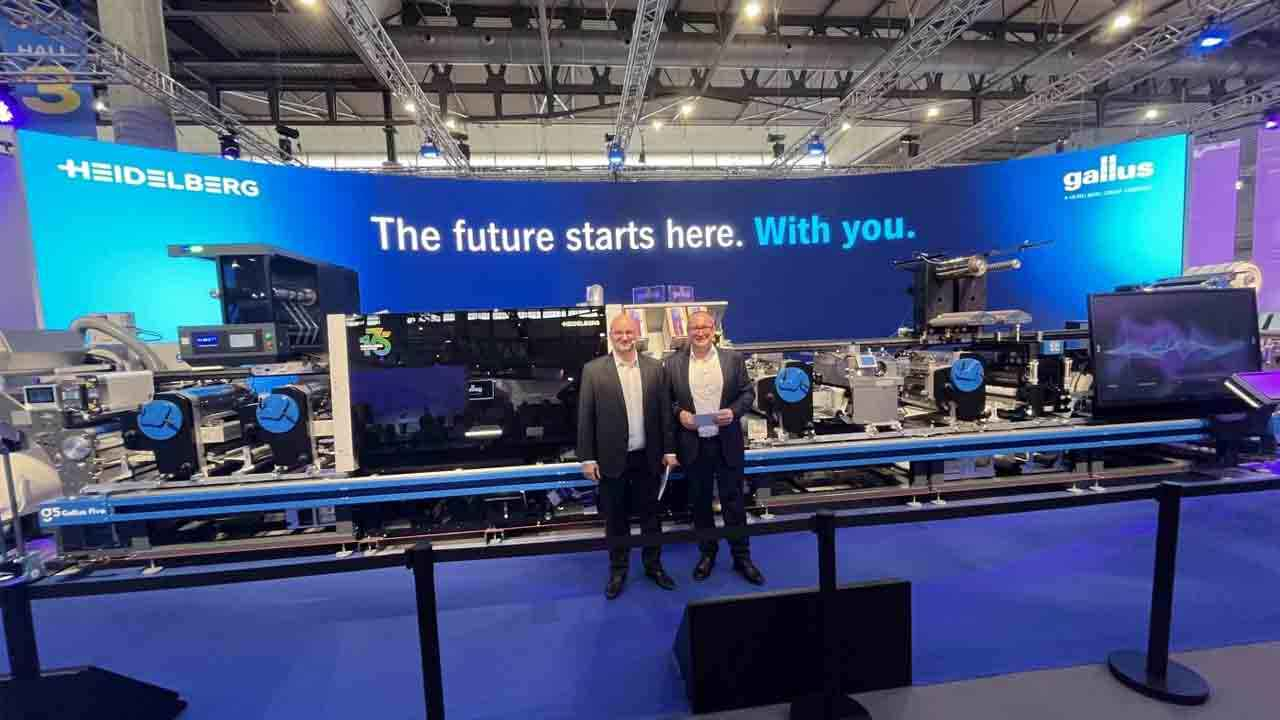
With the launch of the Gallus Five at Labelexpo Europe 2025, Gallus completed its transition to a ‘digital first’ strategy.
The launch of the Gallus One digital press in 2022 marked a major strategic shift toward digital from a company best known for its high-end conventional presses.
The Gallus One was not Gallus’ first venture into digital, of course. The Gallus Labelfire hybrid press, built on the Gallus ECS flexo press platform, was launched in 2015. But the Labelfire was very much subsidiary to Gallus’ conventional flexo and offset press programs.
The development of the Gallus One marked the start of the company’s move to a true ‘digital first’ strategy, a change conceptualized and driven by Dario Urbinati, CEO of Gallus Group. Urbinati became CEO in December 2022 at a defining moment for Gallus, with a renewed focus on strengthening the company’s role within the Heidelberg Group.
‘When I returned, we had to figure out how to move forward,’ recalls Urbinati.
'The first thing that needed to change was the internal culture. ‘Gallus was very hierarchical. Today, it is a flatter structure. I do not feel like an “outside” CEO with a closed-off office. In the early days, I moved my desk to different departments to engage with our employees.’
A key priority for Urbinati was strengthening strategic alignment within the Heidelberg Group, fostering even closer collaboration and a shared momentum. Gallus benefited from extensive support across Heidelberg, particularly in digital technologies, as the group advanced its broader digital transformation strategy.
“At a high level, I no longer want to talk about machines, but about modules, about different building blocks which can be combined”
Urbinati put together a VIP sounding board, including both large and small customers, and asked what was important to them. ‘This gave us the baseline for thinking about what technologies we needed to develop.’
Inkjet first
Urbinati saw inkjet as the ‘technology of the future’, with the greatest potential for development.
‘By 2021, inkjet had reached a comparable point to flexo on the technology S curve in terms of productivity, print quality and speed. Since then, digital has surpassed flexo in terms of makeready, “coolness” and TCO for short-to-medium, high mix-production – whilst flexo, however remains the most cost-effective choice for many long, repeatable runs.’
Urbinati points out that 80 percent of label jobs are under 10,000 linear meters, benefiting the TCO case for inkjet technology.
‘Having made the decision for inkjet, I had to reset the company, and this was at the center of the development of our new product range. We needed to become a primarily digital company. The most important thing was to explain to our employees and stakeholders why we are doing this, and to formulate it into a strategy. It has changed the whole culture of the company. People now understand the new direction and why it’s necessary, and their part within it. This alone creates its own energy.’
System to Compose
Urbinati sees inkjet as one module in a wider hybrid ecosystem, which the company calls System to Compose.
‘Digital does not solve every problem, and not everything can be, or should be, digital. There will always be a place for flexo, where there are certain color gamut requirements or where certain substrates are specified. But for most applications, a hybrid configuration between flexo and inkjet provides the most flexibility and lowest TCO.’
The System to Compose is built around the Gallus Labelmaster platform. The Gallus One was the first digital building block and was designed in compatible widths of 340mm and 430mm (13in and 17in).
The Gallus One is a 7-color UV inkjet engine (CMYK+OVW), imaging at 1,200 DPI native resolution and printing at speeds up to 70m/min (229ft/min). The Gallus One can be combined with any module from the Gallus Labelmaster range, either specified from new or retrofittable in the field.
At Labelexpo Europe 2025, Gallus extended the modular System to Compose ecosystem with the Gallus Five, designed for higher-volume workflows and with a new energy-efficient LED-UV curing system.
Once again, this is built on the Gallus Labelmaster platform, allowing ‘almost limitless’ combinations of digital and conventional modules.
The Gallus Five is available in 340 and 430mm (13in and 17in) widths and uses the same 1,200 DPI imaging system as the Gallus One, but increases speed to 100m/min (328ft/min) using Heidelberg’s Saphira UV05 LED-UV ink set. The 6-color configuration (CMYK+OV) covers around 95 percent of the Pantone Plus V4 color library.
Gallus’ new SDC Pro semi-rotary die-cutter was also launched at Labelexpo Europe 2025. It is fully compatible with System to Compose and operates at 100m/min.
The Gallus Five press at Labelexpo Europe was configured with two flexo units ahead of the digital print unit (DPU), followed by a flexo unit with cold foil, screen printing, a further flexo unit and the RDC Quick die-cutting module.
Modular future
‘At a high level, I no longer want to talk about machines, but about modules, about different building blocks which can be combined,’ explains Urbinati. ‘When we asked customers about their use models, they said “we want to be able to change modules as our business changes”.’
Urbinati says most printing machines today are like ‘small factories within a factory’, with boundaries defined by software, operator training and tooling across different machines. These ‘museums of different brands’ are complex and expensive to manage, difficult to automate and with little effective redundancy.
‘With System to Compose, the printer tells us which printing and converting blocks they require, all with the same operating platform. If you have a digital press, you can add a compatible flexo station and go straight into production with the same operator. This is a different way to think. You then have redundancy within the plant, with the ability to move jobs between presses.
‘We have seen customers with existing Gallus Labelmaster flexo presses retrofitting digital, and customers who started with a Gallus One press adding Labelmaster flexo modules. In some cases, customers have used the System to Compose to build off-line processing units for standalone digital presses.’
The longest hybrid press sold by Gallus so far is 34m (111ft) long, built for special applications.
The future
In conclusion, it appears Urbinati’s vision of company transformation has been a success, with around 60 percent of Gallus’ turnover now coming from inkjet-led System to Compose modular press sales, both from existing and new customers.
Urbinati says Labelexpo Europe 2025 was by far Gallus’ best show to date, despite issues with the air conditioning in Hall 3. The company sold a substantial number of Gallus Five presses directly off the stand.
“Digital does not solve every problem, and not everything can be, or should be, digital. And there will always be a place for flexo”
Looking to the future, Urbinati believes there are several ways the supplier side of the industry can further reduce complexity for the label converter. For example, cutting down on the bewildering range of substrates label converters have to manage and standardizing the exchange of production data.
‘There is a lot of scope for the labels industry to agree on standardization measures for the seamless two-way exchange of production data. As an industry, we need to sit down together and discuss standards for data exchange and open networks, so everybody uses those standards. For example, we have Bluetooth, which works as a standardized way to transfer data across multiple brands and tools. Maybe we can create a way forward for the printing industry by applying the same mindset? We also need to discuss how to transfer data in a safe and secure way to fight against cyber attacks.’
Aligned with Heidelberg’s Prinect workflow system, Gallus also supports other industry-standard MIS and workflow platforms, ensuring broad compatibility across the market.
‘Integration should be straightforward. Our aim is to make Gallus presses easy to adopt within any professional workflow environment.’
Inkjet vs offset
One of Gallus’ most successful legacy presses was the intermittent offset Gallus TCS 250, which found a niche particularly in the short-run, high-quality wine, food and spirits sectors.
UV Inkjet has found it difficult to replace offset because of the inherent glossiness of its inks in a market that values matte design themes.
Urbinati believes that Gallus’ MatteJet technology now enables UV inkjet to compete directly in these kinds of offset applications. MatteJet changes the optical appearance of the inkjet dot, reducing direct reflections to give the appearance of a matte finish.
‘The purpose of MatteJet is to bring inkjet closer to offset in terms of print quality and perception, and we are very, very close with this module.
Gallus’ MatteJet technology is currently available only as a System to Compose module for the Gallus One.
This story has updated since it first appeared in print, including some changes to Gallus’ machine lineup.
Stay up to date
Subscribe to the free Label News newsletter and receive the latest content every week. We'll never share your email address.