Europe: Optimism amid recovery
The top five European markets are gradually recovering from over-ordering during the pandemic; however, some are recovering much faster than others.
Europe's label industry enters 2026 with optimism as the sector continues to recover after 2023, when labelstock demand fell by more than a quarter across the continent. According to the latest analyses from Finat, the industry recovered minimally in 2024 and continued to do so in early 2025. Growth remains uneven across major markets.
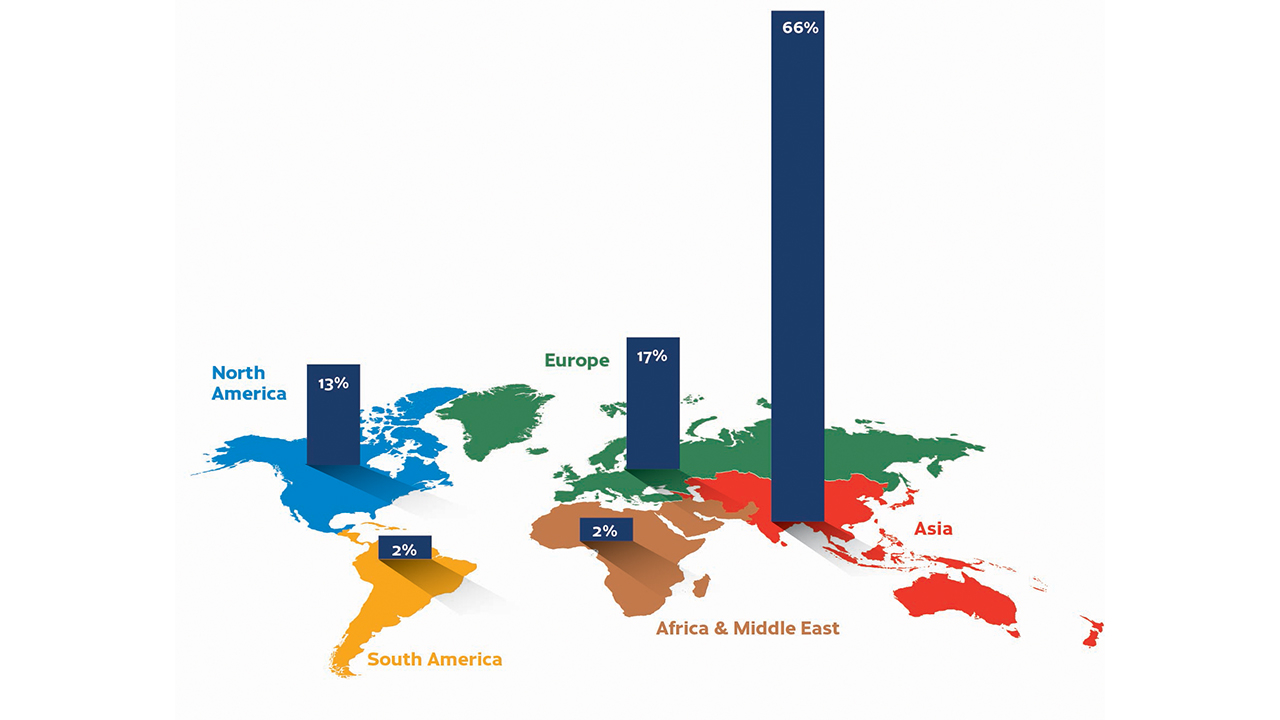
The five largest European markets, the UK, Germany, France, Italy and Spain, account for approximately 60 percent of total European label consumption, up from roughly 50 percent in 2021; however, each region is recovering from 2023 at its own pace.
For converters, suppliers and major fast-moving consumer goods (FMCG) brands, the question isn’t whether volumes will return, but which markets will come out on top in 2026.
Finat's latest overview describes the industry as still working through the impact of the correction after mass over-ordering during the pandemic.
In 2023, European labelstock volumes fell by approximately 25 to 26 percent year-on-year, marking one of the steepest drops on record. The recovery in 2024 was primarily attributed to the unwinding of extreme destocking, particularly in Western Europe, rather than by organic demand growth, according to Finat.
Finat also noted that while overall demand strengthened in the first half of 2024, volumes in many markets remained below their 2021 peaks. Some countries are now stabilizing, others are still lagging, and Spain has exceeded expectations.
Country-level outlook for 2026
UK
The UK remains the fourth-largest label market in Europe, but it has been one of the slower regions to recover. According to Finat's regional analysis, UK label consumption remains below 2021 levels, reflecting weaker household spending and the long tail of e-commerce normalization.
For 2026, the UK is expected to see modest value growth. Much of the growth opportunity lies in higher-value work: digital print, premium decoration and logistics labels.
Converters will continue shifting toward recyclable and mono-material laminates and adhesives as UK brands adjust to tightening sustainability rules and evolving European requirements, despite regulatory divergence. Lead times and input costs are expected to stabilize but remain sensitive to raw material volatility.
Germany
Germany is historically Europe's largest label consumer but faces a slower outlook heading into 2026. Finat highlights weak industrial production, energy price pressures and cost-conscious customer behavior as issues.
Volumes remain below their 2021 peak, and the recovery is slower than in southern Europe or France. For converters, margin pressure is likely to remain a theme, particularly for those that depend on industrial and technical applications rather than FMCG and beverage categories.
However, Germany remains a large market for high-performance filmic labels, liner and adhesive innovation and advanced converting technologies.
France
France is showing a more balanced recovery in Western Europe. Finat describes it as mixed but stable, supported by resilient food and retail segments. Growth in 2026 is expected to remain in the low single digits, with sustainability requirements acting as a catalyst for product mix evolution.
French retailers are tightening recyclability and labeling requirements ahead of European PPWR timelines.
Converters serving France are prioritizing compliance support, substrate substitution consulting and lifecycle documentation as brand owners adjust packaging portfolios ahead of stricter 2027–2030 sustainability rules.
Italy
Italy is positioned for healthier growth in 2026. Finat notes that Italian demand patterns mirror France but benefit from strong, label-intensive premium categories, especially wine, olive oil and specialty foods.
Italy is also becoming a proving ground for recyclable premium label formats, as exporters face multi-market compliance requirements. Converters that can balance premium aesthetics with circularity will gain a competitive advantage.
Spain
Finat highlights Spain as having 'recovered quite well,' reaching or surpassing 2021 levels ahead of its peers.
The growth is mostly from domestic consumption, fewer industrial constrictions compared with Germany, and more balanced inventory patterns.
Converters in the Spanish market are increasing capacity in filmic, PP and digital label formats, anticipating sustained expansion in personal care, household and food categories.
PPWR
However, Finat states that continued regulatory pressure will be a ‘defining force’ across all markets through 2026.
Converters are being pushed to shift to mono-material or recyclable constructions and provide recyclability evidence for label-pack combinations while reducing the use of problematic components such as certain adhesives, laminates and inks, while compliance costs are also expected to rise.
Finat identifies digital and hybrid label printing as a growing value driver across all significant markets. As SKU proliferation, shorter runs and variable-data requirements intensify, digital adoption should continue expanding through 2026.
Inkjet is gaining traction as platforms improve in speed, opacity and substrate compatibility.
The 2023 shock exposed vulnerabilities in Europe's raw-material supply chains. While 2024-25 stabilized conditions, the medium-term trend is toward tighter supplier–converter partnerships and consolidation among mid-size converters as capital requirements rise.
Across the board, sustainability, digitalization and supply-chain resilience will shape profitability.
As Europe's label market heads into 2026, the industry should feel more optimism than in the past two years; however, growth across the board is expected to be moderate, according to Finat.
Stay up to date
Subscribe to the free Label News newsletter and receive the latest content every week. We'll never share your email address.