China transformed
Labelexpo Asia 2025 saw innovative technology launches and revealed the opportunities and challenges facing converters and suppliers.
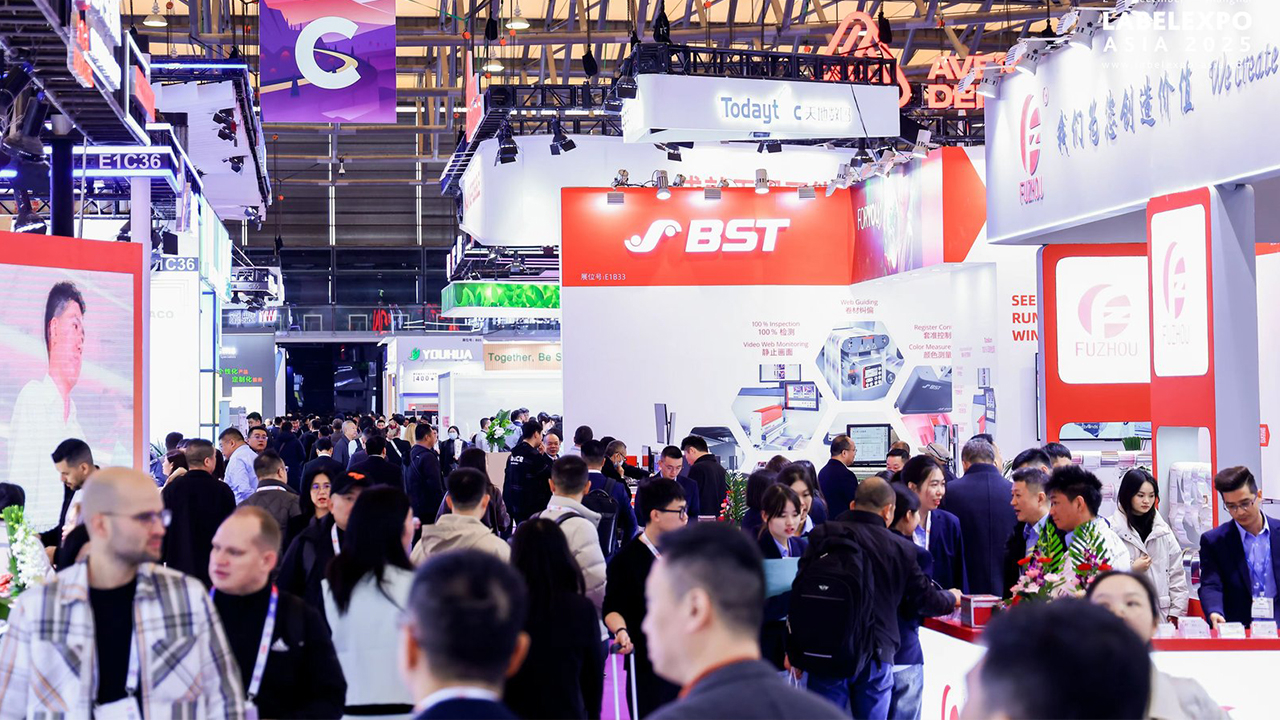
Labelexpo Asia 2025 in Shanghai demonstrated just how far the Chinese labels industry has come in the 22 years since the show’s launch.
The exhibition attracted over 30,000 visitors, not just from across China, but globally from as far afield as the Middle East and Latin America. The show was 14 percent bigger than 2023, and the momentum will carry to 2027, when it becomes Loupe Asia.
Labelexpo Asia 2025 revealed a swathe of innovative technologies, particularly focused on AI-driven automation across print, inspection and workflow. We saw real innovation from companies like Brotech, working with universities at its Shenzhen base to develop AI models to control flexo presses; Spande, with its automated flexo and hybrid presses and pushing toward new models in in-line folding carton production; and Luster, developing AI-driven inspection workflows.
Increasingly, these companies are cooperating not only with the University network across Eastern China but also with Western suppliers.
Most servo-driven presses use German-sourced drives, while Brotech, for example, is working closely with AVT and Spande is working with Pantec to develop new applications like hot stamping on shrink sleeves. Spande’s hybrid press partner, General Inkjet Printing, is Agfa’s Chinese agency.
High-end equipment
This writer predicted two decades ago that although Chinese label converters might start with cheap local machines like those we saw at the first Labelexpo Asia, they would develop their flexo skill base and graduate to more robust machines backed by high levels of service and technical support. This, in turn, would support innovation and differentiation among Chinese press manufacturers. And so, it has proved. Today, the Chinese flexo press manufacturing industry has displaced Western suppliers from the mid-range market and is now starting to sell these machines globally.
Although we no longer see Western flexo presses at Labelexpo Asia, there is a real and growing demand at the top end of China’s label converter market for customized, complex press systems.
The increased confidence and skill level of Chinese converters is already providing a growing market for Western suppliers of high-end digital presses like HP Indigo and Durst, with Xeikon looking to become a bigger player in China with the launch of its lease-model Ecolyne press at the show.
Remarkable change
Summing up the two-decade transformation of China’s label industry is the winner of the 2025 China Label Industry Awards, Dagang Li. When this writer first met Li 15 years ago, he was Avery Dennison’s first Chinese country manager, having worked first at a state-owned corporation, and then for Boston Consulting in its pioneering study of the potential of China’s PS market. Li’s mission was to raise the quality of China’s PS supply chain so he could source from within the country, which he succeeded in doing in a remarkably short space of time. Li went on to run CCL’s China operations, in the process building a local management team.
Today, Chinese label converters are at the cutting edge of innovation, as Labels & Labeling readers who follow China editor Yolanda Wang’s excellent articles will know.
In particular, there has been an embrace of social media channels and AI-driven marketing tools to reach a new customer base, with a strong focus on automated web-to-print factories.
Challenges ahead
At the same time, the Chinese label industry faces its own significant challenges.
On the converter side, we see fierce price-driven competition that has eroded profit margins. We also see the cost of skilled labor continuing to rise.
China now sits in the middle of the global labor cost scale with a wage rate almost double that of ASEAN countries and five times that of Mexico and India. Shanghai and Shenzhen have become expensive global cities.
Trump tariffs have meanwhile impacted Chinese converters whose business model is based on e-commerce sales to the US.
“The increased confidence and skill level of Chinese converters is already providing a growing market for Western suppliers of high-end digital presses”
The urgency of these adverse currents has forced Chinese converters to invest in advanced automation systems and to enter new value-added label and adjacent packaging markets.
Equipment manufacturers have been hit by the same adverse currents. The rising cost of skilled labor has hit manufacturers and is just one element of an overall rise in material and production costs.
The impact of US tariffs is being felt in two ways: by Chinese manufacturers that supply components and subcomponents to US manufacturers, and by the increased cost to end users of exported machinery and materials. In response, Chinese manufacturers have adjusted their strategies to remain competitive, focusing on innovation, cost control and diversification into alternative global markets.
As Labelexpo transitions to Loupe, we await with interest the latest developments in this fascinating and fast-moving market.
Click here to read the full review of Labelexpo Asia 2025 by our China editor, Yolanda Wang.
Stay up to date
Subscribe to the free Label News newsletter and receive the latest content every week. We'll never share your email address.