FTA Forum InfoFlex highlights workforce development
Through several education sessions and a focus on students, this year’s Forum InfoFlex focused on one of the most significant issues facing the flexo.
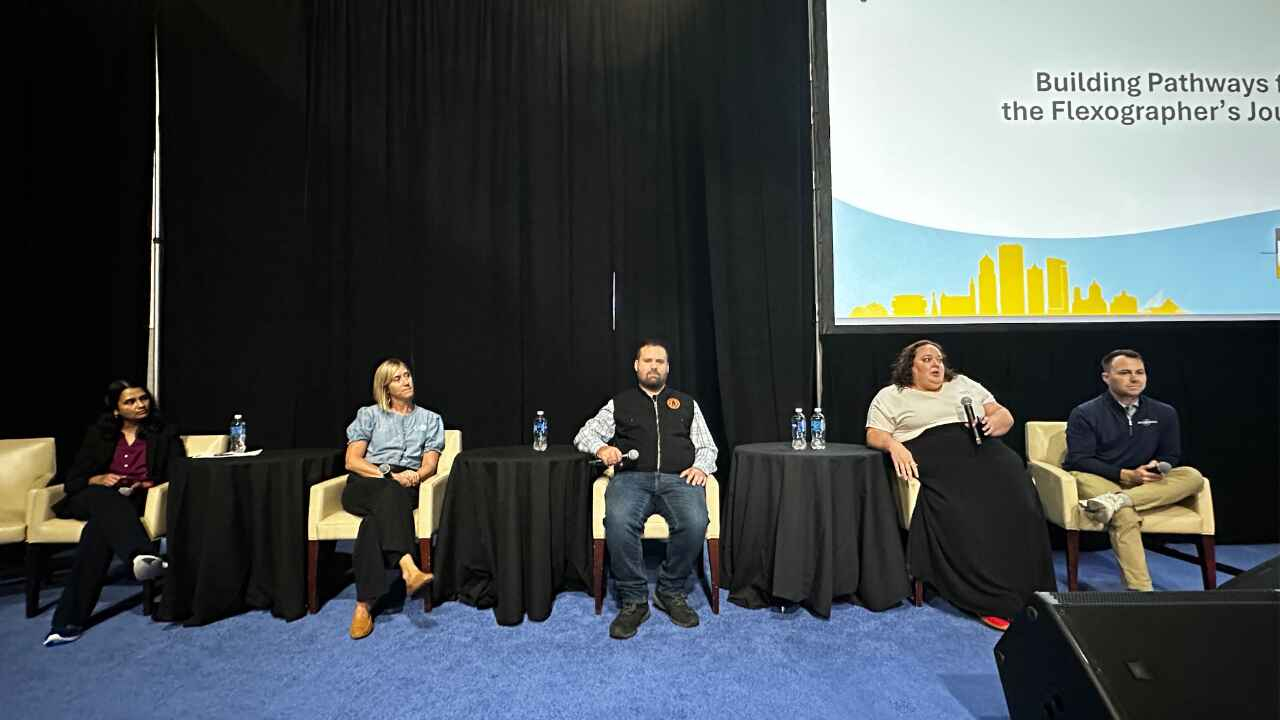
‘Building Pathways for the Flexographer’s Journey’ panel. L-R: Siddhi Pendse, Carrie Aaron, James Dye, Becky Bunch and Brent Zurcher
FTA has organized its 2026 FTA Forum InfoFlex at the Baird Center in Milwaukee, Wisconsin, from April 26-29, drawing about 1,100 attendees. FTA president Nathan Ridnouer and Phoenix Challenge Foundation chair Bettylyn Krafft presented the graduating students during the opening talk, in an NFL draft-inspired gag. Workforce development was a theme throughout the forum.
‘Every pressroom has a story: someone's first day, someone's mentor, someone learning the craft, someone building a career,’ Ridnouer said on stage after introducing the students. ‘And our responsibility today is to make sure that story continues, because the future of flexography is standing right here.’
The students each shared either where they were going to work after graduation or what they were interested in (if they didn’t yet have a job).
Throughout the Forum InfoFlex, speakers noted the challenge of hiring and developing employees. The event also featured a significant student presence, including a student-led session highlighting this year’s Phoenix Challenge Foundation-winning project.
Other Forum education sessions covered automation and AI, sustainability and more. A keynote session on the first day of the program featured two representatives from The Coca-Cola Company discussing their Packaging at Pace program, which has significantly reduced the time-to-market for its packaging campaigns. Also, Michael Apperson, the former CEO of Resource Label Group, moderated a panel with Inland Packaging's Mark Glendenning, Steinhauser's Tara Halpin and Flexo-Graphics' Tim McDonough about taking a customer-centric approach.
Unlike last year, this year’s Forum InfoFlex held education sessions on the showfloor, providing an opportunity for attendees to move more easily between the Forum and the InfoFlex segments of the event.
Alongside the education sessions, the InfoFlex showfloor saw suppliers exhibiting their technology. It also featured Women of Flexo and Lift stations, where attendees could color or play games and connect with each other.
Knowledge crisis
The biggest challenge facing flexo is hiring, Ridnouer said during his opening talk, noting that the flexo industry needs 5,000-7,000 new operators each year.
Rory Marsoun, director of global flexo print excellence at Esko, and the first keynote speaker at the Forum InfoFlex, highlighted the ‘knowledge crisis’ as one of three forces – alongside the ‘compliance era’ and the ‘digital reality’ – shaping the next decade of packaging. Marsoun said that 95 percent of converters in the packaging space struggle to find skilled operators and technicians. When experienced staff leave, they take knowledge and intuition with them, he noted.
Marsoun said that AI and automation can help alleviate the challenge. For example, AI can assist with knowledge capture and training. However, workforce development remains key.
‘Educating people, hiring people who are hungry to learn and spending the time to develop – that's going to become critical,’ Marsoun said.
He added that it’s advantageous for converters to develop their own experts and not simply rely on supplier knowledge.
‘We're always going to need people to solve problems, because if there's one thing that we can all bet on, it’s that there's always going to be some problem on the press or in that process that a real person is going to have to look at and solve,’ Marsoun said. ‘That’s not going to go away.’
Workforce development
Also, during the first day of programming, Hank Welter and Maria Burkle of ProAmpac spoke about leadership development and ProAmpac’s rotational program in a session called ‘Adapting Leadership for the Evolving Flexo Workplace’.
Burkle, now a printing department manager at ProAmpac who oversees three presses, shared her personal journey of going through the company’s rotational program, during which she served in different roles at multiple facilities. She was also given the opportunity early in her career to start up a new wide-web machine.
She has now been at ProAmpac for about seven years, during which time she has developed leadership skills as well as more technical skills.
‘A lot of my growth I attribute to my mentors and coaches,’ Burkle said. ‘Usually people think it’s just one, but I was lucky to have several.’
During an education session entitled ‘Building Pathways for the Flexographer’s Journey’, Carrie Aaron, general manager at Maryland-based converter Hub Labels, spoke about the company’s state-approved apprenticeship program. This is a structured, 18-month apprenticeship with set salary adjustments. Maryland also supports youth apprenticeships.
Aaron highlighted one of the company’s employees, who started working for Hub Labels while in high school. Upon graduating from high school, he worked for Hub Labels part-time while attending community college. He finished his degree and decided to stay at Hub Labels. The converter promoted him and put him through the state apprenticeship program. He is now a press operator.
Aaron also encouraged companies to support their employees’ curiosity and, when possible, develop their knowledge beyond their standard day-to-day tasks.
‘If any of you are in a position where you can allow people to participate in something that's outside of their daily job duties, that's creating an environment where they can grow,’ she said. ‘If they come to you and they're curious about something, feed their curiosity, and they will naturally grow, and their career will naturally grow.'
Throughout the Forum InfoFlex, multiple speakers also mentioned the benefits of knowing Spanish and presenting training material in Spanish.
‘Workforce is one of the topics we cannot get away from,’ Ridnouer told L&L. ‘No one can get away from it. It’s making sure you’re able to find that next workforce for your organization, or that next employee, that next career-seeker.’
Stay up to date
Subscribe to the free Label News newsletter and receive the latest content every week. We'll never share your email address.