Material prices loom over talks at TLMI event
Material prices, the war in the Middle East and tariffs drove speaker sessions and conversations at the TLMI Converter Leadership Meeting.
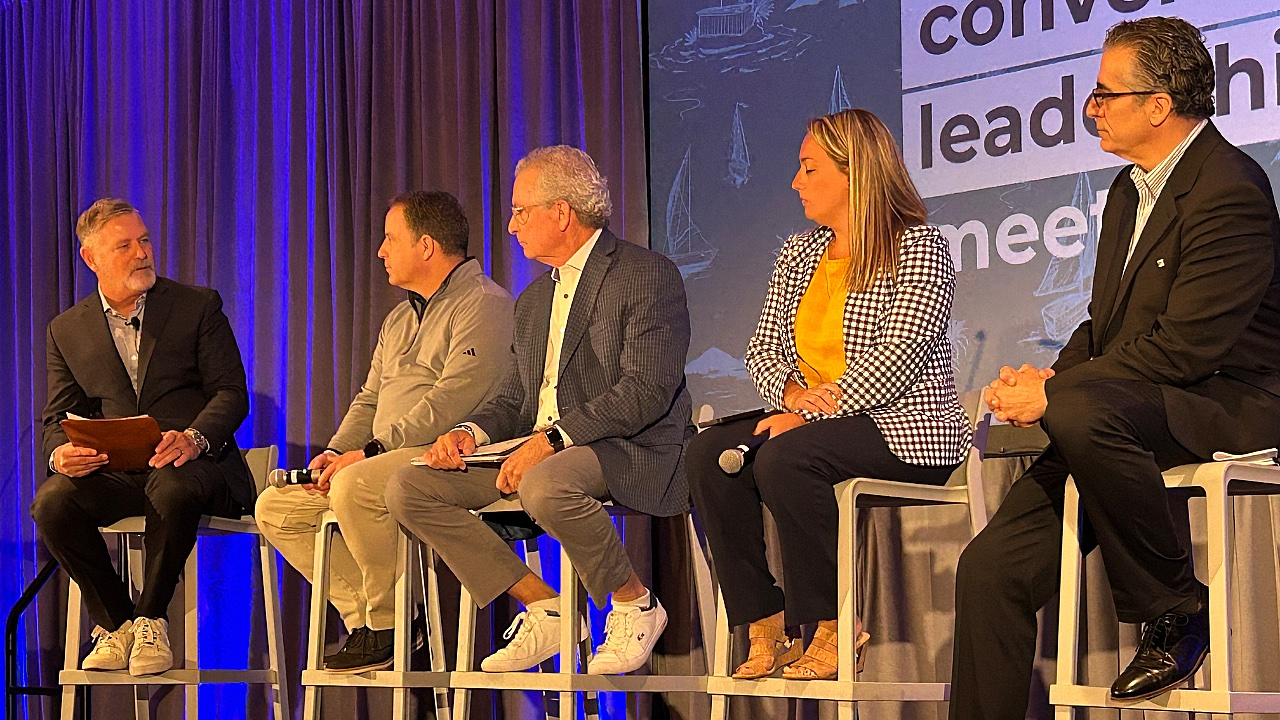
L-R: Corey Reardon moderates a panel with Barry Wendell, Kent Wolford, Abby Monnot and Frank Grecco
Conversations at the TLMI Converter Leadership Meeting repeatedly turned to recent news about double-digit material price increases now weighing on converters.
This year’s TLMI Converter Leadership Meeting took place at the Opal Sands Resort in Clearwater Beach, Florida, from April 12-14. There, speakers addressed geopolitics – such as the war in the Middle East and tariffs – and their impact on the label market. During the speaker presentations and more casually between sessions, speakers and attendees also discussed the recent price hikes for materials.
It fit well into the theme of the meeting, which TLMI board chair Mark Glendenning highlighted during his opening speech: the next chapter of converter leadership, a strategic shift and a higher level of conversation.
Glendenning noted the challenges facing the industry: more demanding customers, faster timelines and a greater expectation for sustainability, all against the background of an increasingly complex global landscape.
‘The old playbook still matters, but it’s no longer enough,’ Glendenning says.
Speakers at the meeting included Corey Reardon, president and CEO of Alexander Watson Associates, who provided an overview of trends shaping the industry, reviewing growth rates across regions and segments. Reardon also moderated a supplier panel – made up of Durst’s Barry Wendell, Konica Minolta’s Kent Wolford, Avery Dennison’s Abby Monnot, and Gallus’ Frank Grecco – that addressed strategies to remain competitive, growing end-use markets and more.
Economist Alex Chausovsky of 3DM Consulting gave a presentation with his brother, Eugene Chausovsky of New Lines Institute, on geopolitics and its impact on global markets. Alex Chausovsky also moderated a supplier panel with HP’s Raffael Kraus, UPM Adhesive Materials’ Brinder Gill, Flexcon’s Catherine Heckman; Bobst’s Patrick Graber, and Mark Andy's Duane Pekar.
Other speakers included Green Group Consulting managing director John Caturano, who spoke about environmental regulations, and Imagine AI Live chief AI officer Steve Metcalf, who provided an update on the latest developments in AI technology and led an AI workshop.
TLMI also named the winners of the 2025 Eugene Singer Excellence in Business Management Awards. These awards recognize the top performers of the TLMI Management Ratio Study. The recognized winners were Trend Printing/International Label, for the small company category; Steinhauser, for the mid-range company category; MakeStickers, for the medium company category; and Online Label Group, for the large company category.
Material price increases
Shortly before the Converter Leadership Meeting, several material suppliers issued notices about double-digit price increases. Converters are now navigating how to implement these new prices.
During Reardon’s panel, he was asked about material price increases and linked them to the war in the Middle East, which has driven up prices.
‘The good news/bad news is that the whole industry is impacted by the same global events that are causing a ripple effect back to supply and cost,’ Reardon explains.
Reardon also said that these recent price increases are the highest that he’s seen in his career.
‘I’ve never seen double-digital price increases being executed at the same time ever in my history,’ Reardon says. ‘I’ve seen 5 percent, 6 percent, 7 percent historically, but never at this level. But it’s not because someone’s pulling it out of their ear. It’s for real reasons.’
During Reardon’s presentation, he discussed the impact of the Middle East war on the label industry and noted that the industry has faced frequent disruptions since 2020. He characterized the current supply availability and resulting inflation as the latest.
‘We have supply side availability and cost inflation around anything related to energy, anything related to petrol, chemical products including films, as well as anything related to the commodities that are inputs to our industry, whether it's pulp paper, whether it's chemicals, silicones, whether it's adhesives,’ Reardon says. ‘All these general commodity products are linked to or are impacted by what's happening in the Middle East, whether it's by supply and shortage of supply due to what's happening, or whether it's by transportation issues and being able to get product.’
According to Reardon, these supply challenges may prompt companies to adjust their supply chains to be more regional. Brands may also simplify the materials in their products to reduce supply issues.
Eugene and Alex Chausovsky examined the impact of the Middle East war on inflation during their presentation. They noted that consumers have already started to feel the impact of gas prices at the pump. Other commodities expected to be impacted include food due to rising fertilizer prices, electronics and aluminum.
Alex Chausovsky predicted that inflation by the end of the year would likely be around 3 or 4 percent, but the war could push it higher, such as into the 5-6 percent range. ‘The key element is how long does the war last,’ he says.
A complex world
Throughout the TLMI event, speakers highlighted the impact of a complex world on the label market.
‘We were hopeful that 2026 was going to be a little more predictable, had a little more characteristics of a market that you can plan better [for] and understand what market drivers and demand drivers are going to be,' Reardon says. But that hasn't been the case, he says.
Tariffs have not gone away and continue to cause uncertainty in the market, Reardon says. Sustainability, driven by both legislation and consumer demand, is spurring innovation and collaboration, while specific regulations such as the PPWR also create uncertainty.
Meanwhile, RFID and smart labeling are experiencing growth that’s much stronger than the overall label industry, Reardon notes.
Eugene Chausovsky characterized the world as multipolar, with the US and China as the two true global powers, and many other countries exerting influence regionally or through specific mechanisms, such as military or economic means. Over the past few years, the world has also seen deglobalization through tariffs and trade policies, as well as geopolitical conflicts that impact supply chains.
Alex Chausovsky highlighted practical advice to navigate this complex landscape: make data-driven decisions, build relationships and seek productivity and efficiency.
‘Whether that’s through AI adoption or more automation in your environment, any of the things that you can do to do more with less will help you buffer some of these headwinds that we’re facing right now,’ Alex Chausovsky concludes.
Stay up to date
Subscribe to the free Label News newsletter and receive the latest content every week. We'll never share your email address.