Platinum Packaging turns crisis into opportunity
Kenya-based converter Platinum Packaging re-enters the market with a growth-focused strategy following a fire.

Platinum Packaging, a Kenyan flexible packaging converter, planned growth in the narrow-web adhesive market, but those plans are on hold after a devastating fire caused significant losses and marked a critical turning point for the company.
By mid-2022, the company was on a strong growth trajectory, with revenues up around 26 percent, when disaster struck.
An electrical spark caused a fire that ignited one of the machines, and the flames quickly spread to the ceiling. Once the roof insulation caught fire, the blaze swept through the rest of the factory, damaging most of the company’s machinery beyond
repair. This loss was compounded by the fact that the company had recently diversified its technical capabilities. Platinum Packaging was a gravure and digital company, and the team had invested in a used Nilpeter narrow web flexo press to enter the self-adhesive market only months prior. The flexo press was also lost in the fire.
The company attempted to partner with other manufacturers to continue servicing its customers with flexible packaging. But the team was unable to find one that could take on additional tonnage and ensure quality. Platinum Packaging also considered securing supply chains from Egypt and India, but also found it unviable.
The only answer was total reconstruction from the ground up.
Reconstruction
Platinum Packaging benefited from the fact that its facility had been built only six years prior, meaning the architectural plans were already in place. The company was able to rebuild quickly.
To maintain continuity for its flexible packaging customers, the company purchased a second-hand Miraflex machine from Windmöller & Hölscher, along with a laminator and a slitting machine, from a local factory that was no longer profitable.
Platinum Packaging began operating from its premises almost immediately. However, it required a significant technical transition, as the company had to move from gravure to CI flexo.
While the team couldn’t move all of its jobs to its newly acquired secondhand flexo equipment, it was successfully able to service its top clients.
While sourcing new machinery from Italy to replace the lost equipment, the leadership began to rethink its entire business model.
We believe that we can differentiate in self-adhesive labels by applying the same oneECG workflow used elsewhere in the business
‘We questioned whether to return as the previous plant or as a versatile plant with a completely different value proposition,’ says Hasit Patel, CEO of Platinum Packaging. ‘Even as the market leader, the company struggled with inefficient job cycles. In more mature markets, a gravure line might change jobs two or three times a day; however, Platinum was changing jobs maybe six or seven times a day to accommodate customers who would twist our arm to go below minimum order quantities.’
The team decided to build a more versatile operation better suited to the demands of the Kenyan market. When developing the new production line, the team opted for a fresh approach.
‘Why don’t we go narrow web flexo, wide web flexo, and then one gravure line,’ Patel explains of his thinking at the time. ‘Standardizing on a oneECG format would allow the business to change on the fly while strengthening competitive position.’
‘This setup enables MOQs [minimum order quantities] as low as 100kg. Around 30 percent of capacity is dedicated to short runs, while approximately 35 percent is focused on longer runs produced on wide web flexo,’ he adds. The short runs are produced on the narrow web flexo, mid runs on the wide web flexo and the long runs on the gravure machine.
Introducing ECG to a market unfamiliar with the technology proved challenging. ‘There was only one label company that attempted this and not successfully,’ Patel says. To overcome this, the company built an in-house pre-press department. ‘That’s something we never saw outsourced, and it helped protect the workflow and make it a barrier to entry.’
The plant is now equipped with two Bobst M6 flexo presses, a Windmöller & Hölscher wide web flexo press, a Bobst gravure line, and Nordmeccanica lamination systems, including combi and simplex configurations.
The site also operates Comexi equipment and pouching lines sourced from India, largely replicating the setup before the fire. The plant is now equipped to produce a full range of flexible packaging and pouch formats.
Patel adds that the fire revealed who the company’s true partners were. ‘While some suppliers attempted to exploit the situation with inflated pricing, others stepped forward to help. We had competitors who opened their plants to us and offered to take on outsourced work,’ he says.
The company accepted support from at least two competitors and continues to value those relationships today. Despite being out of the flexible packaging market for around 18 months, recovery was swift.
Short runs and lower MOQs
The plant reopened in April 2024 and is currently operating at about 50 percent of its pre-fire capacity. With competitors increasing capacity during this time, re-entering the market has been challenging, Patel admits.
However, the company continues to win new business through its broader value proposition. The company introduced low MOQs and short-run printing.
The company is encouraging customers to shift their ordering behavior as well.
‘We’re trying to get the market aligned to ordering based on consumption rather than MOQs because we can provide all sizes of MOQs,’ Patel notes. ‘Around 80 percent of SKUs are slow-moving, while 20 percent are fast-moving. By helping customers reduce inventory and overproduction, we don’t have to stock as much, they don’t have to stock as much, and it becomes a win-win.’
He says the turning point came during discussions with Bobst, when Platinum Packaging adopted a strategy of creating lower MOQs for flexible packaging from narrow-web machines, with pricing and margins adapted to support orders as low as 100kg. The analysis showed that short runs offered a faster route back to volume and stronger margins. ‘If we had come back exactly as we were before the fire, we would have been forced into aggressive pricing just to re-enter the market,’ he explains.
While longer runs remain price‑competitive, Platinum’s advantage lies in short-run flexible packaging, where competitors struggle to match the company’s capabilities. Although some have reduced MOQs, Patel notes that it is tough for them to stay lucrative given higher setup waste and ink changes on gravure machines. With a single ECG workflow, the company avoids ink changes and enables rapid job changeovers.
The new factory has been developed to serve new entrepreneurs operating from their homes, whom Patel refers to as ‘homepreneurs’.
‘They would never be able to afford MOQs of even 250kg, making runs of 50–100kg a more viable option. These businesses typically operate with just one or two SKUs and were largely underserved by the packaging industry in the past, relying instead on standardized polythene bags. As a result, many were unable to access supermarket listings,’ he says.
We are now working to shift this mindset by encouraging customers to order based on actual consumption rather than stockpiling
‘By offering high-quality, low-MOQ packaging, we are enabling these homepreneurs to improve product preservation, compete on shelf, and scale their businesses more quickly.’
The ‘Sprint Pamoja’ initiative was designed to simplify the offering for ‘homepreneurs’, minimizing the need for hands-on involvement from business owners.
‘They’re busy running their businesses, which is why the process has been structured to be as frictionless as possible. Customers can place orders via a messaging platform, pay digitally and benefit from very short turnaround times, enabled by in-house production,’ he adds.
The company also uses AI-assisted tools to kick-start design, allowing it to deliver end-to-end service, from artwork and payment to final delivery by rider.
Patel adds that the long-term goal is to act as a packaging advisor and a one-stop shop for ‘homepreneurs’ and enable them to get their products onto shelves and scale more quickly.
Coming back stronger
The new machines were installed, and production began in April 2024 with output initially at around 100 tons and gradually increasing to approximately 250 tons.
Looking ahead, the company is targeting 300–400 tons by the second quarter of 2026. About 25 percent of volumes are expected to come from B2C customers, with the remainder from B2B customers.
Platinum Packaging currently produces shrink sleeves and flexible packaging on narrow web but plans to expand into self-adhesive labels and in-mold labeling (IML) with further investment in slitting and die-cutting equipment. While the self-adhesive market is relatively mature, Patel notes that IML is experiencing strong growth. The company is actively seeking strategic partners as it expands beyond flexible packaging into self-adhesive labels, IML and beer labels.
These expansions would allow the plant to serve multiple industries, unlike most competitors that operate in only one or two segments. He notes that, despite local IML capability, significant volumes are still imported from Turkey and the Far East into the region. ‘We believe that we can differentiate in self-adhesive labels by applying the same oneECG workflow used elsewhere in the business. This would allow shorter runs than competitors who are still using spot colors,’ he says.
Smaller runs also allow the company to tailor packaging for different consumer demographics, such as using wrappers for the same product to target children, adults or the elderly.
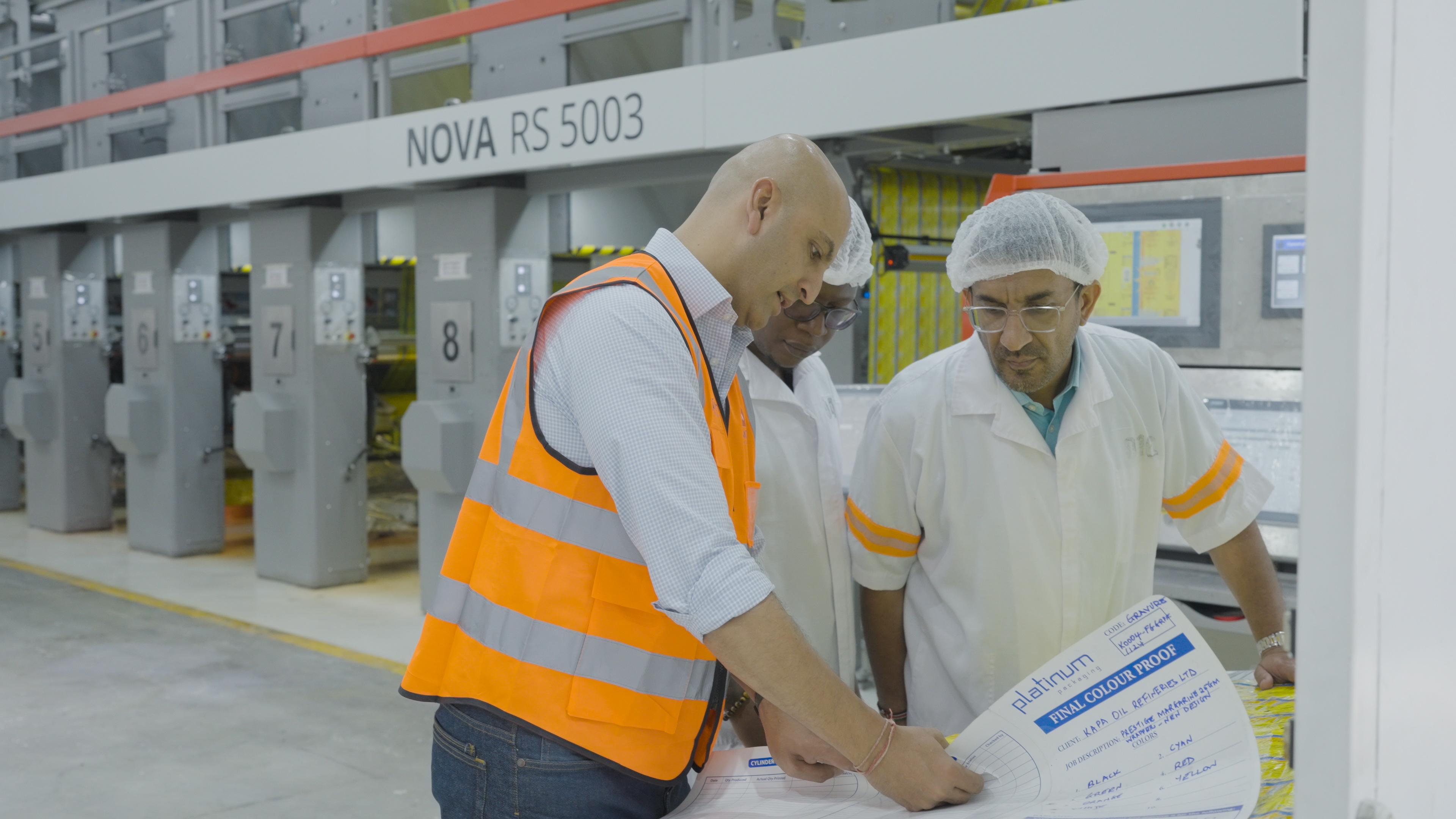
Patel adds that this approach is helping the market rethink packaging as a marketing tool. ‘Short-run printing is increasingly being used for seasonal, promotional, or one-off campaigns such as Easter or Christmas packaging, encouraging even B2B customers to engage consumers in more targeted and flexible ways.’
The company has earlier focused on exports across Africa. Kenya is a more mature market, where smaller runs are better understood, unlike many African markets, where large order volumes are still prominent due to weak logistics and supply chains, with customers often holding 160 to 180 days of inventory.
‘We are now working to shift this mindset by encouraging customers to order based on actual consumption rather than stockpiling. Changing ordering behavior across Africa will take longer than it has in Kenya and require greater education,’ he says.
Customer visits to the plant play a significant role in building this confidence. To support markets where in-person visits are less feasible, the company is exploring a virtual shop-floor experience to demonstrate its capabilities and to understand oneECG and how it could reduce MOQ. The company is also investing in customer and technical training to support this shift. In Kenya, this is relatively easier, as customers can visit the factory to see the differences firsthand, helping both customers and technical teams better understand the new operating model.
Stay up to date
Subscribe to the free Label News newsletter and receive the latest content every week. We'll never share your email address.