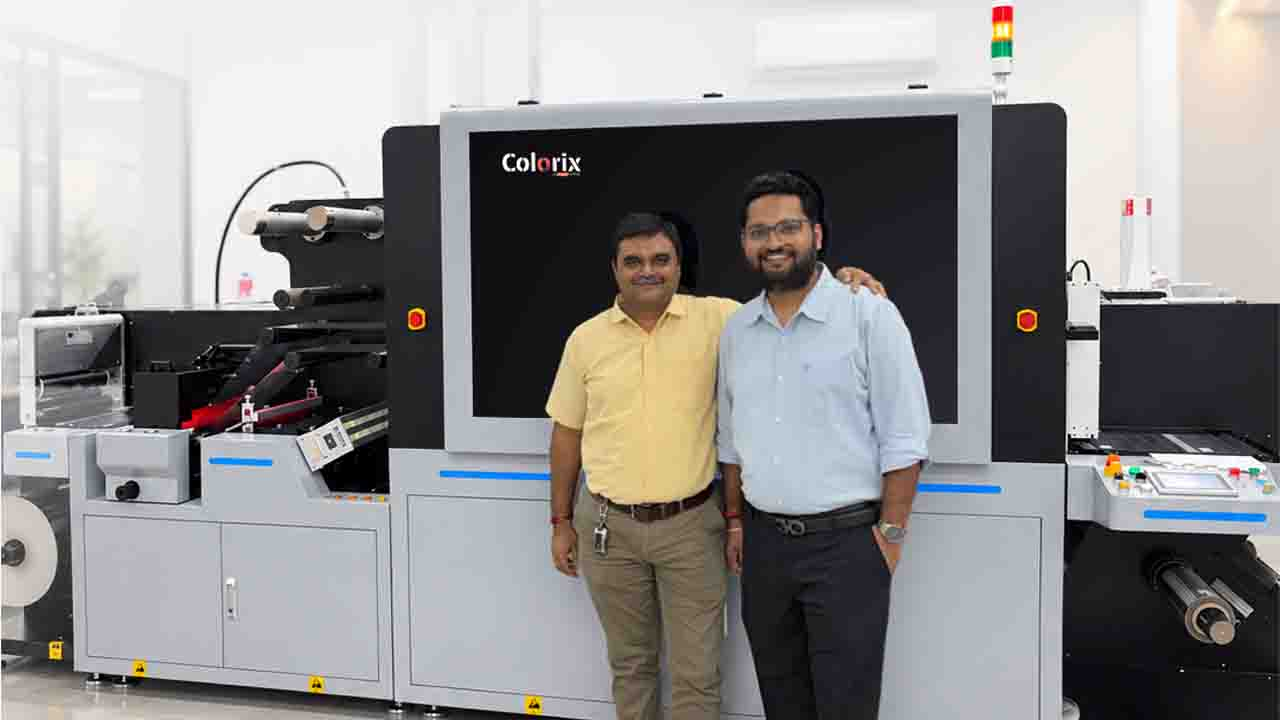
Dulari Printpack’s strategic leap into labeling
Ludhiana-based Dulari Printpack bolsters its digital production capabilities and targets the region’s nutraceutical and direct‑to‑consumer sectors.
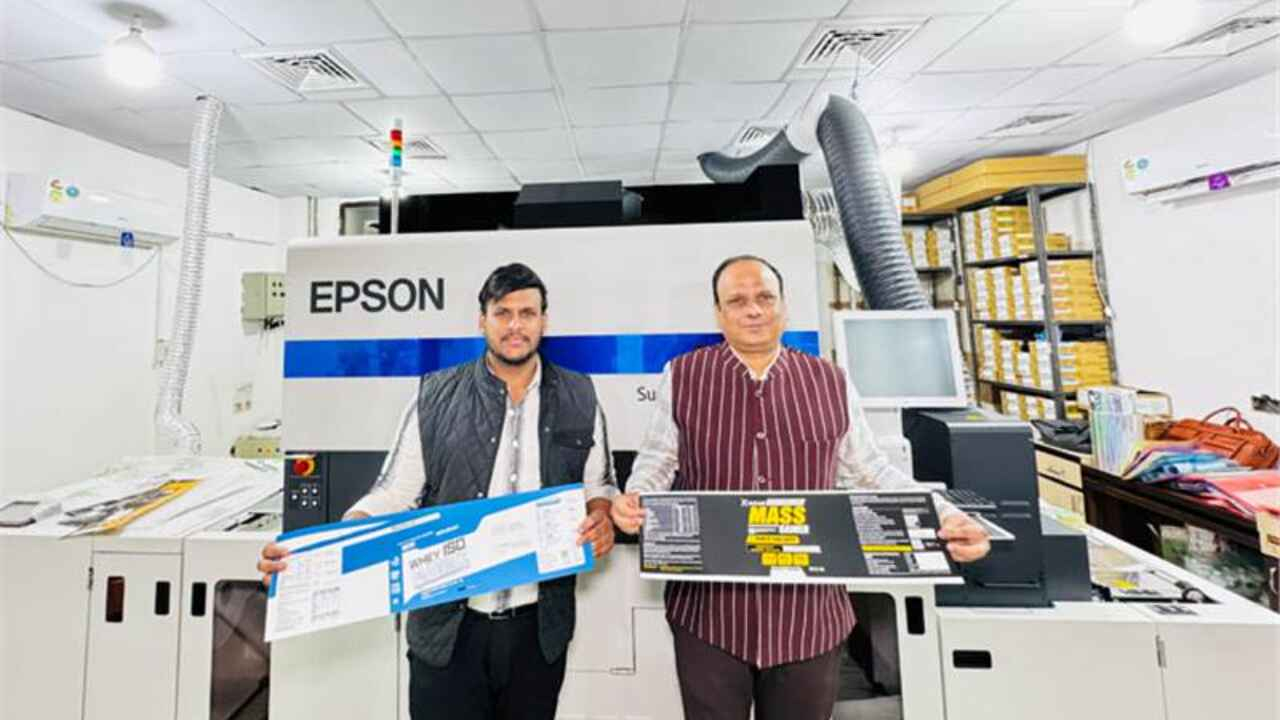
L-R: Harshit and Rahul Goyal with Epson SurePress L-6534VW UV digital label press
The industrial pulse of Ludhiana, often referred to as the
‘Manchester of India’, is beating at a new, digitized rhythm.
In the center of this transition stands Dulari Printpack.
Long recognized as a leader in North Indian photo albums and commercial digital printing, the company has recently made a high-stakes entry into the label segment by installing the Epson SurePress L-6534VW UV digital label press, alongside a Vorey VD330 digital die-cutter, both integrated with a Luxarjet UV inkjet varnish and foil system, purchased through Kridwinn Innovations. With these installations, Dulari is not just adding capacity; it is signaling a new era for the Ludhiana label landscape.
From Miller Ganj to digital dominance
The story of Dulari Printpack is one of consistent, calculated
evolution. Founded in 1998 by brothers Aman and Rahul Goyal as Dulari Digital Photo Service, the company began its journey in the analog era, operating Japanese chemical-process photo machines. In the late 90s, the wedding photography market in Punjab was commoditized, yet the Goyals identified a niche for premium quality that others overlooked.
By 2010, the company had pivoted toward the digital revolution. It was an early adopter of high-end digital presses, including the Konica Minolta bizhub 70hc and later the HP Indigo 5600. Its investment in the MGI JetVarnish 3D with iFoil further cemented its reputation as ‘embellishment experts’ capable of turning standard prints into tactile, luxury experiences.
Today, the group is transitioning into its second generation of
leadership. Harshit Goyal, son of Rahul Goyal, has taken the helm of the label division, bringing a fresh, data-driven perspective to the family business.
‘We realized that the traditional photo market was reaching
a plateau,’ says Harshit Goyal. ‘Our analysis showed a massive surge in the startup ecosystem in Punjab and nearby Haryana. These brands, ranging from organic honey producers to high-end nutraceutical manufacturers, needed premium labels, but in quantities that traditional flexo printers couldn’t economically handle. We saw an opportunity to become their technology partner, not just their printer.’
The technology choice
For a company rooted in high-fidelity color and luxury finishing, choosing a label press was critical. After evaluating various digital technologies, Dulari opted for the Epson SurePress L-6534VW.
“In today’s competitive environment, printing alone is no longer sufficient. Post-print enhancements play a decisive role in creating differentiation”
The press is a workhorse designed for high productivity
environments, featuring Epson’s proprietary PrecisionCore
technology. Unlike many entry-level digital systems, the
L-6534VW is built for industrial-scale reliability and offers a
productivity mode that reaches speeds of up to 50 m/min. It has a resolution of 600 x 1200 DPI. The machine supports standard self-adhesive label substrates, BOPP, PET and metallic foils (80 to 320 microns thickness). The drum platen system securely holds the substrate to the drum during printing, ensuring precise color-to-color registration.
‘The primary reason for selecting the Epson L-6534VW was its versatility and ink performance,’ explains Harshit Goyal. ‘We deal with a lot of transparent and metallic substrates. The high-opacity white ink of the Epson allows us to print vibrant colors on clear films in a single pass, which is a game-changer for cosmetic and beverage brands.’
Talking about the strategic importance of this installation,
Prabagaran S, senior general manager, Epson India, shares: ‘The Indian label market is at an inflection point. Converters are moving away from the “quantity over quality” mindset. The L-6534VW is specifically engineered to bridge the gap between short-run digital flexibility and long-run industrial stability. By integrating our PrecisionCore technology, Dulari can offer their clients consistent color across different batches, a critical requirement for pharmaceutical and nutraceutical brands.’
The finishing touch
In the label industry, a beautiful print is only half the battle.
Precision finishing and value-added embellishments are where the margins lie. Dulari’s installation includes a comprehensive finishing suite provided by Kridwinn Innovations.
The Vorey VD330 digital die-cutter offers a knife-cutting system that eliminates the need for expensive physical dies, making it suitable for the high-SKU, low-volume orders that define the D2C market. When coupled with the Luxarjet 330mm UV inkjet varnish and foil system, Dulari can add 3D effects, spot UV and digital foiling.
The combined workflow allows Dulari to handle complex
embellishment jobs with consistent quality, improved efficiency
and faster turnaround times.
The investment supports Dulari’s strategic expansion into the
rapidly growing digital label segment, complementing its established expertise in photo albums and commercial digital printing.
“The Indian label market is at an inflection point. Converters are moving away from the ‘quantity over quality’ mindset”
With brand owners increasingly seeking differentiation through superior shelf appeal, finishing and embellishment have emerged as key value drivers in label production. In response to this market shift, Dulari Printpack has installed these machines to move beyond conventional label printing and cater to premium and value-added label requirements across diverse industry segments.
‘In today’s competitive environment, printing alone is no
longer sufficient,’ says Rahul Goyal, director of Dulari Printpack. ‘Post-print enhancements play a decisive role in creating differentiation. The Kridwinn systems enable us to produce labels that invite consumers to touch and feel the product. It’s about creating an emotional connection on the shelf.’
He further comments: ‘The newly installed systems are helping elevate both the visual appeal and perceived value of Dulari’s label offerings.’
The post-press machines from Kridwinn have enabled Dulari
to produce high-impact, value-added labels in roll form. These
capabilities are particularly relevant for the sectors where short runs, multiple SKUs and premium presentation are critical.
Dinesh Thakur, director of sales and marketing at Kridwinn
Innovations adds: ‘Our association with Dulari Printpack is built on a shared vision of innovation. Their focus on the startup ecosystem in Punjab matches the design intent of our Luxarjet systems, providing premium, high-impact finishing for brands that are scaling fast.’
Scaling the vision
Since the installation approximately three months ago, Dulari’s
label division has been operating at high capacity. The Epson
SurePress runs between 10 to 12 hours a day, producing roughly 2,000 running meters of labels daily.
But the Goyals are not stopping there. With plans to introduce
a second shift, they aim to scale production to 5,000 meters per day shortly. Their team of nearly 70 staff members is now being cross-trained to handle the intricacies of digital label workflow, from AI-driven pre-press design to high-precision finishing.
‘We don’t just see ourselves as a printing press,’ Harshit Goyal concludes. ‘We are a solution provider for the entrepreneurs of Punjab and beyond. Whether it’s a metallic honey label or a textured pharmaceutical sticker, we want to be the reason a brand stands out. The Epson and Vorey installation is the foundation of that promise.’
The company’s footprint is also extending across Maharashtra
and North India, supported by a robust infrastructure and a
philosophy of ‘meticulous preparation.’ With plans to integrate
more automation and explore sustainable substrates, the Goyals are already looking at the next phase of expansion.
‘In today’s competitive environment, you cannot compete on
price alone,’ concludes Rahul Goyal. ‘By integrating digital printing with advanced finishing, we are equipped to deliver labels that enhance brand identity. We are moving from being a service provider to being a technology partner for our clients.’
As the Epson press hums in the background, churning out
high-impact labels for the next generation of Indian brands, it
is clear that Dulari Printpack has successfully navigated its most important transition yet. In the heart of Ludhiana, the future of label printing is no longer a prospect; it is a digital reality.
Ludhiana’s label evolution
Ludhiana is witnessing a tectonic shift in its industrial identity.
While the city remains a global hub for hosiery and bicycle
parts, it has recently emerged as a primary destination for the
nutraceutical, agrochemical and food processing industries.
This diversification is the engine driving the local labeling
boom. The rise of the ‘Start-up Punjab’ initiative and the
growth of e-commerce have decentralized brand ownership
and birthed a new class of entrepreneurs who require agility.
‘The “new Ludhiana” is different. The city is currently
experiencing a boom in the nutraceuticals, wellness and
agrochemical sectors. These industries require labels that
are not only durable – resistant to chemicals and oils – but
also highly informative to comply with stringent government
regulations,’ shares Harshit Goyal.
India’s nutrition industry is projected to double from 30.37
billion USD in 2024 to 60 billion USD by 2030. Ludhiana is
becoming a hub for these ‘clean label’ brands.
A wellness startup in Ludhiana can now sell to a customer
in Mumbai or New York. This global reach demands a global
standard of packaging. Digital label printing is the only
technology that can provide this level of sophistication for a
brand launching its first 500 units.
Kamal Mohan Chopra, former chairman of the World Print
and Communication Forum, aptly notes: ‘The printing industry
would have been dead without the packaging boom. In India, there has been a year-on-year growth of about 15 percent
in packaging.’ Diving deeper, he talks about the dual engines
of growth: digital disruption and eco-innovation, bolstered
by e-commerce’s insatiable appetite for custom labels
and brochures.
Geography is another advantage that makes Ludhiana a
preferred hub for label printing. The city serves as a primary
logistics gateway for North India, with many manufacturers
from neighboring states flocking to Ludhiana for its advanced
conversion capabilities.
While Dulari is the ‘new guard’ of digital labels, the market
is built on the shoulders of legacy regional players like Krishna
Halftone, Nayyar Labels, Sangam Labels, Pacific Labels, Lord
Weavers and Om Packaging.
By focusing on roll-to-roll digital labels with high-end
embellishments, Dulari is positioning itself to serve the
‘premium Ludhiana’ of 2026.
Stay up to date
Subscribe to the free Label News newsletter and receive the latest content every week. We'll never share your email address.