Clemson University prepares students for print careers
Amid an industry struggling to find enough qualified workers, Clemson University’s graphic communications program is developing the future workforce.
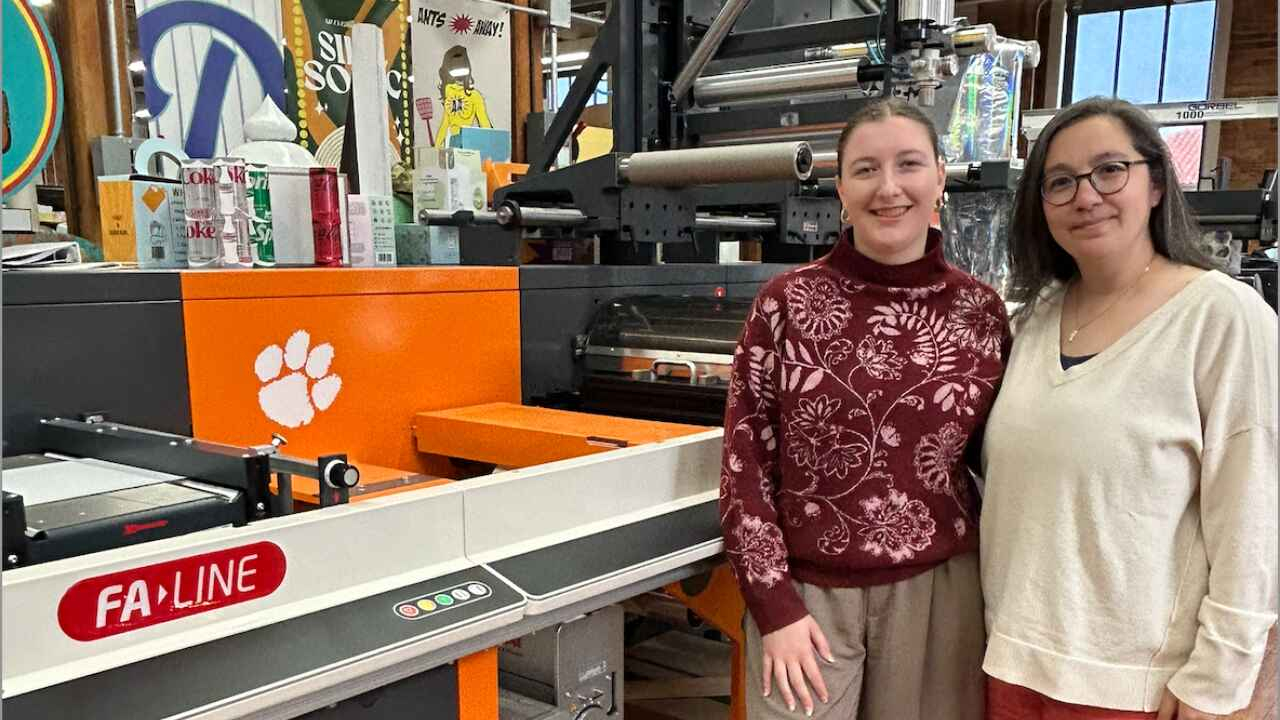
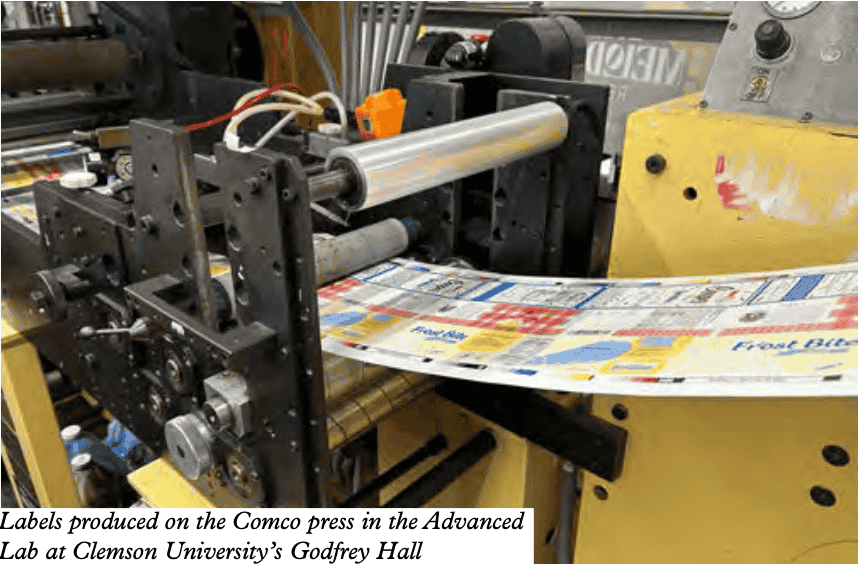
Step inside the Advanced Lab at Clemson University’s Godfrey Hall, and you will see machinery donated from suppliers in the print industry. This includes a Nilpeter FA-17 and a Comco Captain press from 1990 that allow students to get a feel for printing labels. Outside of the Advanced Lab, Clemson University has two additional label presses: a Sohn 4400 small stack press and an Omet VaryFlex 530 press, the latter of which is in the university’s Sonoco Institute of Packaging Design and Graphics.
‘We’re not teaching them to be perfect every time,’ says Michelle Fox, a senior lecturer in Clemson University’s graphic
communications department. ‘We’re teaching them to learn how to make mistakes, think critically and figure out how
to solve problems.’
Clemson University’s graphic communications program prepares students for careers in the print industry, including label manufacturing. The university, located in Clemson, South Carolina, is a state school with about 24,000 undergraduate students and 5,000 graduate students. It offers one of the country’s leading graphic communications programs, with about 400 students, who learn the steps of print production, from Adobe design tools to platemaking and
print technologies, including flexography, offset and screen printing.
Alongside its graphic communications major, Clemson also offers a packaging science program that focuses on the structural and materials science aspects of packaging.
The graphic communications program is housed at Clemson University’s Godfrey Hall, while the packaging science program is located at the Sonoco Institute.
Students go into a variety of careers, including sales, branding, marketing and flexography. Fox notes an increasing trend of students pursuing roles in flexo, sales and R&D.
Education today
Clemson’s graphic communications program starts with the fundamentals, such as the principles of design and what plates are. Throughout their time in the program, students learn how to conduct market research, create promotional and
functional labels, and provide and receive peer feedback. Alongside these technical skills, students also learn employability, or ‘soft’ skills.
Fox says that education today focuses more on employability skills, such as having difficult conversations, owning deadlines
and taking charge of the learning process, than it did in the past.
‘So many of our students are coming in strong, motivated and highly intelligent,’ Fox says. ‘It’s those small little tweaks that I believe make us more dynamic, like thinking ahead of a deadline, speaking with more confidence and handling a project with more confidence.’
Fox has taught print for 20 years, 10 years at the high-school level and 10 years at the higher-education level.
She has seen the student body become more diverse, with more women and more ethnic diversity in the program.
“I really loved how wide open this major was, the number of options it offered”
Schools are still recovering from the changes brought by the Covid-19 pandemic, Fox says. It moved many students online, and teaching hands-on content to them in a virtual setting was
challenging. Though students are no longer learning virtually, the pandemic has had a lasting impact.
‘Confidence isn’t where it used to be in students,’ Fox says of the impact of Covid-19. ‘They’re so smart that if they give themselves the chance to be a little bit more confident, they could do so much more. One of the things I hope I instill in them, is the confidence to be independent and do really great things, or to try and fail at them. Making mistakes is really scary to them, and I think the fear of mistakes is one of the biggest changes I’ve seen. But I’ve also seen over the past year or two that with some gentle nudging, they’re really growing and having a lot more confidence.’
Student perspective
Caroline Yaman is going into her senior year as a graphic communications major at Clemson University. She chose to pursue this degree because she felt it would open a variety of opportunities for her.
‘I really loved how wide open this major was, the number of options it offered. Because I really don’t like being tied down
to one thing,’ Yaman says. ‘I loved how there were about 10 different tracks, which had both creative and technical aspects to it.’
Yaman is particularly interested in flexography. ‘It’s really interesting with all the complexities with it,’ she says. ‘I really enjoy platemaking and the pre-flooding process and color management. I’m a big problem solver; I really like working through things. With flexo, there are just so many things that can go wrong, and you have to figure them out. There are so many elements in it that you have to figure out to get the perfect print.’
The graphic communications program requires students to
undertake two internships. Yaman’s first was a sales internship at a commercial printing company; she intends for her second to be in flexo.
During her time as a student, Yaman has enjoyed running the Nilpeter and Comco presses and making plates. She has had the opportunity to be a teaching assistant for the inks and substrates lab. Yaman has been able to attend industry events, such as the Flexo Pre-Press Platemakers Association conference and the Flexographic Technical Association’s Women of Flexo conference, with support from both Clemson University and the events themselves.
For a future employer, Yaman wants someone who is, she says, ‘not only supportive of me and trusts me, but also has high expectations and pushes me. Learning is really important to me. So, an employer who encourages me and gives me opportunities to continue learning and not just stay stagnant.’
Challenges
Print programs in education are tackling one of the most significant issues facing the industry: the shortage of skilled labor. But these programs at both the high school and university levels are shrinking in number, as they close or get absorbed, leaving fewer funnels through which students enter the industry.
Fox believes that a longstanding myth that print is dying has
fueled closures of these programs.
‘That’s really concerning to me,’ Fox says. ‘It’s not that there is
a lack of need in the industry, because there very much is a need that’s being unmet.’
Fox wants to get the industry involved in keeping these
programs alive. She also hopes university students can help
keep them running by going to high schools themselves to teach these programs.
Fox herself has gone into elementary schools to introduce young students to basic print production concepts. She even once taught a group of girl scouts to run the Comco press.
‘If we can keep those high school programs alive and well, and feed them into the community college and college programs, that’s going to help keep the print programs stay healthy and ensure our workforce stays healthy,’ Fox says.
Additionally, Fox has seen companies in the industry pull back on offering internships in recent years due to smaller staff sizes.
‘They don’t necessarily have the bandwidth to take on interns,’
Fox says. ‘For our program that requires two internships, it makes it even more difficult to place students with meaningful experiences.’
Amanda Bridges, an assistant professor in Clemson’s graphic
communications department, has been teaching in higher
education since 2005.
She says that, like all fields in education, resources can be a
challenge, though Clemson University’s program fares well in that regard due to support from the print industry and the university. Some of the substrates, plates and machinery that students make use of are donated by industry suppliers. Finding qualified faculty who are interested in teaching can also be difficult.
“Any graphic communications educator would tell you that money, resources and just being able to get the things you need to teach can sometimes be an issue”
‘Any graphic communications educator would tell you that
money, resources and just being able to get the things you need to teach in this field can sometimes be an issue,’ Bridges says.
AI in the classroom
AI has been a complex topic in education across various fields
and levels. Fox doesn’t want students to rely on AI to do their thinking for them. Rather, she wants them to command AI and use it as an accessory.
‘I know our students are resilient. I know they’re leaders. I know that they have tons of skillsets, and they’re going to find
how to implement AI in the workplace to make things more
efficient, to make things part of a process, but not take over a
process,’ Fox says.
AI could create opportunities in the classroom. For example,
Fox would value having students provide and receive more peer feedback than they currently do, but they are limited on time. Feedback from an AI agent could potentially fill that space.
‘It’s not driving their decisions,’ Fox says. ‘It’s giving them a
litmus test opportunity to get a baseline before they take it to
their peers.’
In Bridges’ design classes, students learn to use generative AI
options in Adobe software products. Students also can use AI to generate some of the content in their designs.
‘We definitely want to be on the front end,’ Bridges says. ‘We
don’t want to be left behind in this. The industry is going to drive how we use it. It could just be a tool, or it could be something that really impacts our industry in some different ways. So, it’ll be interesting to see.’
Yaman says many of her professors support the use of AI in the classroom. In one of her classes, the students learned how to code and create personal assistants using AI.
‘You are going to go into the workplace, and you are going
to need to know how to use it,’ Yaman says. ‘I’ve been getting
opportunities to learn it a lot more and how to apply it responsibly in a design way and also in a practical production way.’
Overall, Fox is excited for the future of the industry for her
students and for how quickly it is changing.
‘The fact that there’s a press that runs off of an iPad, and now
we can add digital stations at the end – that’s something that I
never thought I’d see in my lifetime,’ Fox concludes.
Stay up to date
Subscribe to the free Label News newsletter and receive the latest content every week. We'll never share your email address.