Automated flexo ecosystem demonstrated in St Gallen
Esko, Gallus and Asahi joined hands to present the latest developments in flexo automation, AI, water-based platemaking and ECG printing.
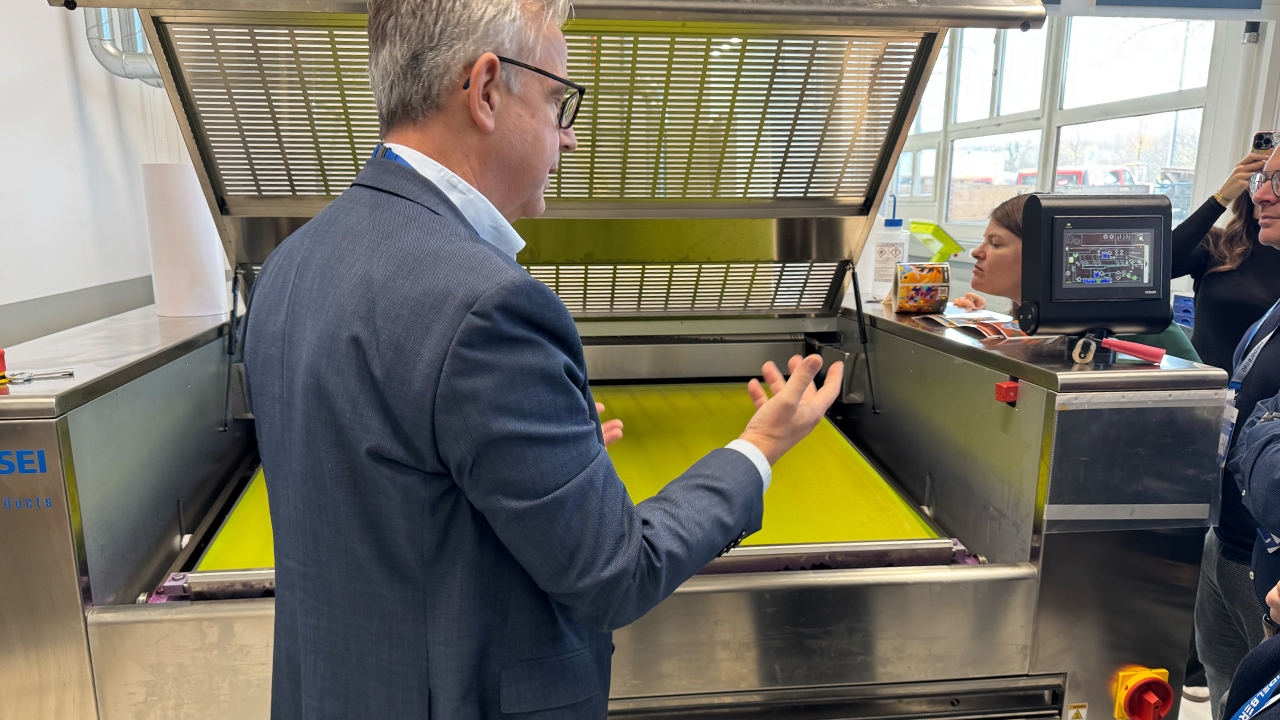
Dr Dieter Niederstadt, technical marketing manager at Asahi Photoproducts Europe, demonstrates the company's water-wash plate processor
Esko, in partnership with Asahi and Gallus, has held a flexo innovation open house at Gallus’ Experience Center in St Gallen, focused on the latest developments in sustainable flexo printing, platemaking and automation.
Asahi is a partner at the Gallus Experience Center, where they have been working closely together to optimize flexo workflows supported by Esko’s imaging and automation systems, Asahi’s latest water-based plate systems and Gallus’ Labelmaster 440 modular press platform. Extended color gamut (ECG) printing has been a particular focus for the three partners during the event.
The day started with some thought-provoking presentations on sustainability and AI.
Geert De Proost, director of market intelligence and product partnerships at Esko, drew delegates’ attention to potential problems printing materials manufactured with varying amounts of post-consumer recycled (PCR) materials.
‘This is due to local variation of surface tension, contamination residues influencing ink laydown and uneven material thickness and surface roughness influencing ink laydown. In addition, recycling components can contain micro-particulates or gases resulting in defects and bubbles, so we are looking at materials with less dimensional stability.’
"We have cut the time taken to process a plate by one-third. We do not need to dry the plates for two hours, as we need to do by using a solvent wash process"
Flexo does have key advantages over gravure for such materials, said de Proost, as the 3D plate architecture and softer polymers support uneven substrates with impurities and adapt to uneven surface tension.
Jan de Roeck then discussed the current status and future of AI for label and package print converters.
‘Automation is the number one challenge for converters, but so far businesses have yet to experience any significant impact from AI,’ stated de Roeck.
De Roeck outlined the areas where AI is being actively integrated into Esko tools. These include the generation of marketing materials with localized language content and Smart documentation. De Roeck gave examples of how a PDF can be dragged and dropped to find all related artwork, and how closely matching CAD files can be discovered from an existing CAD file. ‘This all requires the appropriate Metadata and can be achieved without leaving your preferred application.’
Another example is the Print Clone technology Esko launched at Labelexpo Europe 2026, which leverages AI technology to enable digital press operators to replicate colors from previously printed packages, regardless of the original printing process.
Esko is integrating more AI-driven tools into its design and pre-press programs. Operator Assistance in ArtPro+, for example, segments each image into elements, allowing object selection in complex, unstructured artwork.
Esko Comply is a new module for WebCenter which offers an intelligent, automated way to validate critical components of product packaging and promotional materials, using customizable rules and AI to check labels and packaging for potential errors such as missing allergens, incorrect barcodes and FDA formatting violations.
In-house platemaking
The next speaker was Dr Dieter Niederstadt, technical marketing manager at Asahi Photoproducts Europe, who introduced the company’s water-wash plate systems installed at the Gallus Experience Center.
Niederstadt said it is now far more viable for even smaller label converters to take flexo platemaking in-house. High levels of automation, the compact footprint of plate imaging and processing systems, the elimination of solvents and the speed plates can be mounted and registered on a modern flexo press like the Gallus Labelmaster, all make it practical and beneficial for flexo printers to take platemaking in-house.
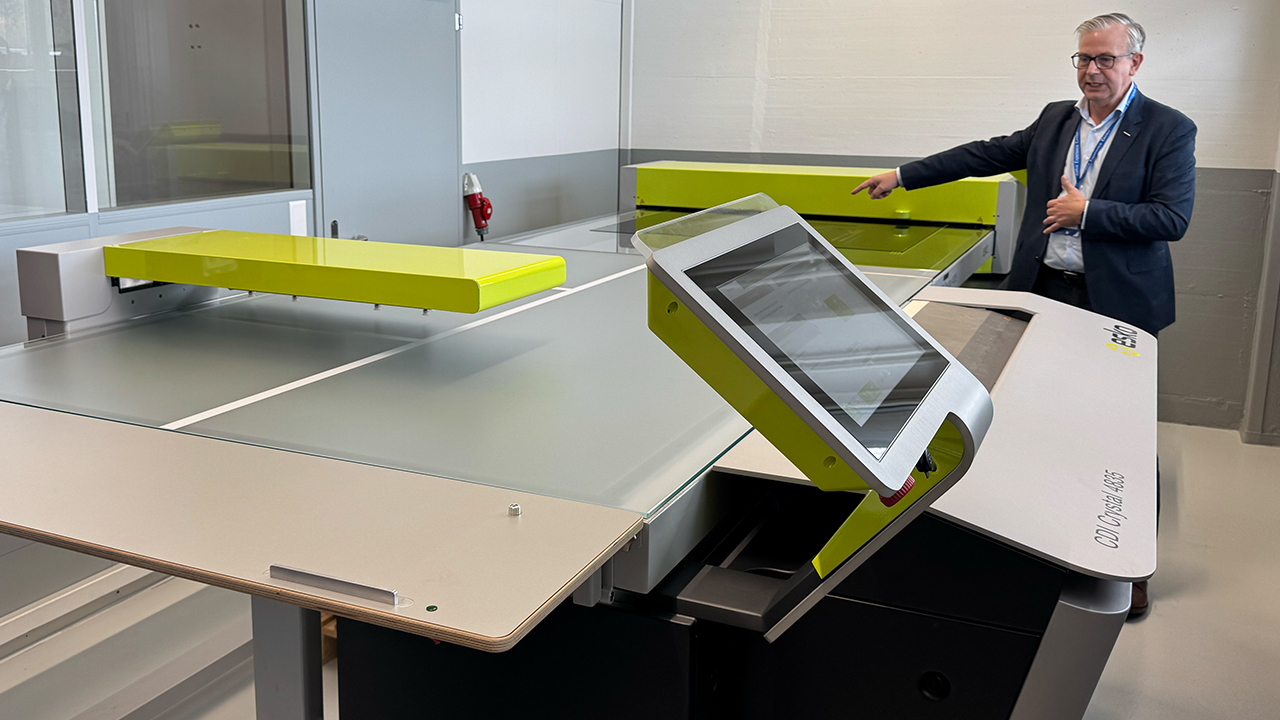
The flexo platemaking installation at the Gallus Experience Center starts with an Esko CDI Crystal 4835 plate imager with integrated XPS exposure unit, combining simultaneous LED-UV main and back exposure. LED-UV is ‘on-off’ without the warm-up time needed for mercury lamps. The presented machine and plate size was 48 x 35in/1200 x 900 mm, which is ideal for narrow and mid-web press formats, but available for larger converters in 42x60 inch/ 1070 x 1524 mm too.
The Esko Automation Engine uses hot folders to fully automate the pre-press workflow from PDF artwork through color conversion, step and repeat and optimum output parameters for the imaging unit, while the Esko Print Control Wizard automates the calibration workflow. This all reduces the need for skilled flexo pre-press operators.
Water wash revolution
Asahi has demonstrated its recently launched AWP-Revo water-washable plate, part of an ecosystem designed specifically for narrow- to mid-web format printers. The system supports a maximum plate size of 25 x 30in with larger formats currently under development.
The AWP-Revo plate is the first developed by Asahi, which requires only water, eliminating the use of detergents. ‘Our previous AWP plate required water, detergent and anti-foamer. AWP-Revo only needs water and anti-foamer, and sometimes we don’t even need anti-foamer,’ said Dr Niederstadt. AWP-Revo plates are available in 1.14mm and 1.70mm thickness.
To use the AWP-Revo plate, printers must operate both the Revo plate processor and the AWP-Loop Petite water recycling unit, which allows up to 90 percent of washout water to be filtered and reused.
The full AWP-Revo process delivers a print-ready plate just under 60 minutes. ‘We have cut the time taken to process a plate by one-third,’ said Niederstadt. ‘We do not need to dry the plates for two hours, as we need to do by using a solvent wash process.’
Asahi’s AWP-Revo plates increase press uptime through the incorporation of CleanPrint technology, which ensures Ink is present only on the top of the dots with no visible fill-in.
‘The AWP-Revo plates also have a lower surface energy of approx. 28 dyne vs 38 dyne for standard plates. Lower surface tension means easier ink transfer,’ said Niederstadt.
Together, the Esko and Asahi imaging, washout and water recycling units form a highly compact system, which should fit into the more limited space typically available at smaller label converters.
For flexo printers who want to retain their existing solvent processing systems, Asahi was promoting its AFP-REVO plate, which reduces the amount of solvent required. The AFP-Revo technology is a bridging technology offering the benefit of the same printing plate quality as AWP-Revo, but making use of existing solvent wash customer infrastructure.
For fully automated platemaking workflows with no manual intervention, Esko and Asahi have demonstrated the CrystalCleanConnect system, which integrates the AWP CleanPrint processor with either the CDI Crystal 4835 XPS or CDI Crystal 4260 XPS imagers.
ECG printing
A powerful demonstration of ECG printing took place on the Gallus Labelmaster 440 press at the Gallus Experience Center, as part of a joint project between Esko and Asahi.
The demonstration job was a striking design that really showed off the vibrancy and depth of image ECG can achieve.
The screening technology used was from the Esko Quartz family, with a combination of Crystal VQ 175 line for smoother reproduction across larger image areas and SQ screening for the more detailed image elements. This combination prevented any appearance of moire effects in challenging tonal areas while forming a simplified and highly automated workflow.

Esko says the superior ink transfer capabilities of its Quartz imaging technology allow a wider color gamut to be achieved. The demonstration job involved matching seven spot colors to a deltaE ranging from 1.19 to 3.00 using just three process colors from the CMYK+OGV set. Inks were Pulse Roll Label Products Puretone DC.
Uptime of the press can be achieved by matching ISO colors.
Calibration of the Labelmaster 440 press was carried out with the Esko Print Control Wizard to a Fogra 55 color target. The job was printed on the new Asahi AWP CLFQ 045 plate, which is Esko Quartz certified. Two different Apex aniloxes were used for CMYK (GTT-XS) and OGV (GTT-C5) inks. The job was printed on Avery Dennison Cleanflake PP50 White.
Gallus modular systems
Following the press demos, Thomas Schweizer, CSO of the Gallus group, gave an overview of Gallus’ System to Compose, which allows customized press configurations to be built from several different print, embellishing and die-cutting modules, including both digital and conventional technologies. This allows the System to Compose to be used to specifically configure a Gallus One, Gallus Five or Gallus Labelmaster, depending on the target segments and customer needs.
"Automation is the number one challenge for converters, but so far, businesses have yet to experience any significant impact from AI"
Schweizer said the Gallus One, Gallus Five and Gallus Labelmaster presses are all field upgradable and the Gallus One, is also available with the Gallus MatteJet technology launched by the company last year.
Also new is the Gallus Alpha standalone roll-to-roll digital press, which Gallus characterizes as a ‘gateway’ to its ecosystem.
Gallus Screeny has also launched a new rotary Screen module, now available for the first time on third-party machines. It can be either rail-mounted or installed as an in-line press module. With support for screen formats ranging from T85 to T208, the unit is available for print widths of 340mm (13in), 440mm (17in), 580mm (23in) and up to a web width of 600mm (23.6in). It runs at speeds of up to 120 m/min.
Stay up to date
Subscribe to the free Label News newsletter and receive the latest content every week. We'll never share your email address.