Concordia Group shows power of cooperation
As the labels industry consolidates, Concordia demonstrates a powerful model based on voluntary cooperation rather than on mergers or acquisitions.
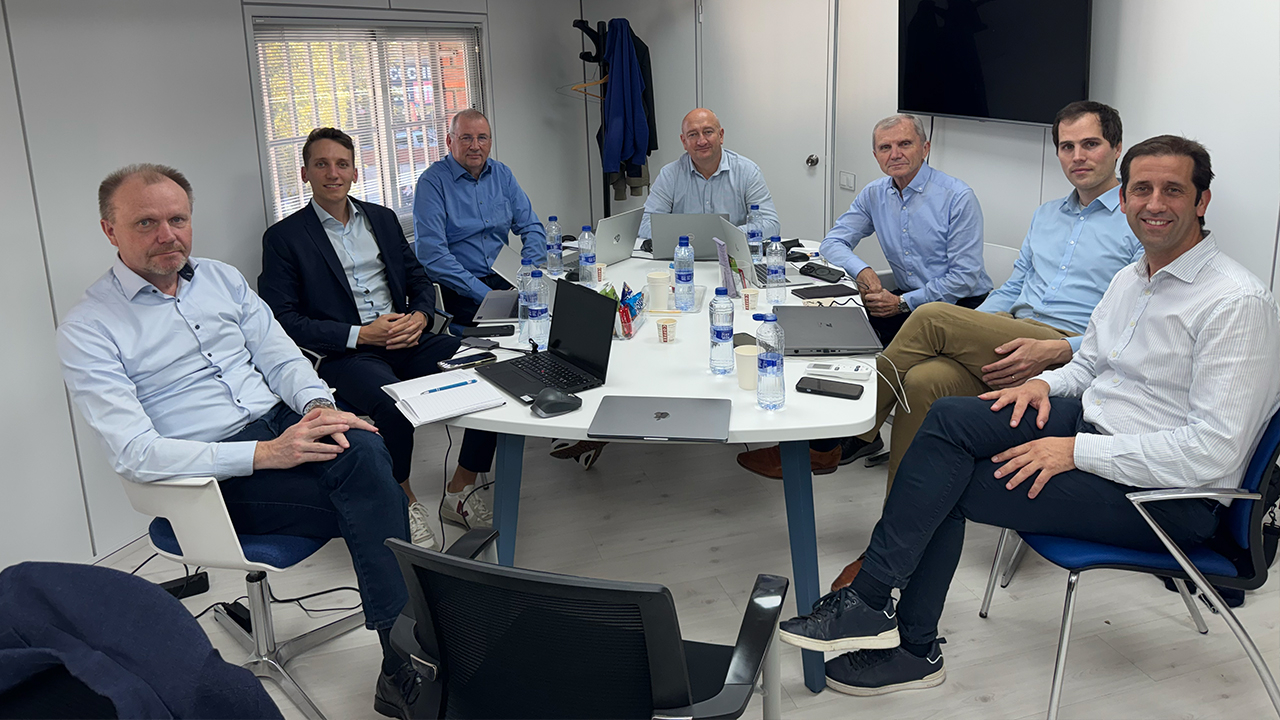
L-R: Jussi Oksanen, managing director Auraprint; Simon Sohm, COO Carini; Peter Overbeek, CEO Eshuis; Adrian Steele, director Mercian Labels; Roberto Sala, COO Arca; Frederik Parrein, Co-CEO Digi-Paq; Francesc Egea, director general of IPE, Spain
Consolidation among label converters is an accelerating trend on both sides of the Atlantic. This M&A activity has been driven mainly by private equity looking to capitalize on the strong growth of package printing as other graphic arts sectors continue to decline.
But mergers and acquisitions are not the only model for industry consolidation. Over the last 30 years, the Concordia Group has demonstrated that converters can also come together in less formal, voluntary confederations that still confer the benefits of being part of a larger group.
Concordia Labels was established in 1994 by four family-owned businesses: Iwaco (Denmark), Arca Etichette (Italy), Caposa Sinel (Spain) and Labelpak (Belgium). The key objectives were to act as a buying group and to share best practices.
Today, just one of those original founding members remains, Arca Etichette, now joined by Auraprint (Finland), Carini (Austria), Digi-Paq (Belgium), Eshuis (Netherlands), IPE (Spain) and Mercian Labels (UK).
Francesc Egea, director general of IPE, explains the group’s core philosophy: ‘The first thing to understand is that Concordia itself is not selling anything and there is no legal entity behind it. Concordia is a strategic alliance of independent companies. We collaborate closely, share insights on market trends, new technologies and best practices, and challenge each other’s thinking. It is a powerful sounding board for leaders and their teams, and that collective strength naturally creates strategic commercial advantages, including raw material sourcing.’
There is no membership fee, but there is a membership agreement that includes undertakings to deliver on certain responsibilities. ‘But how each business is run rests entirely with each of the individual members themselves.’
Committee structure
Each member company nominates one person to the Concordia board, which meets twice a year at one of the group’s factories. The meeting L&L attended in November was held at IPE Etiquetas & Sleeves in Barcelona.
Beneath the main board are various subcommittees. Perhaps the most important is the purchasing committee, which handles joint sourcing of materials and dies.
‘The subcommittee for volume raw material purchasing is where our collaboration is the deepest,’ says Jussi Oksanen, managing director of Auraprint. ‘We are grouping our volumes with a total spend of 150 million EUR [174 million USD]. As part of this process, we share the experiences we have with different suppliers in terms of product quality and service.’
Every second month, a team call provides updates on the status of purchases and allows the group to predict volume requirements going forward.
‘The final purchasing decision is down to each individual company,’ says Oksanen. ‘They can pretty much do what they like, but the benefit of pooling a lot of the bulk use materials is that, obviously, you are able to be more competitive against the larger consolidated groups. But it doesn’t stop anybody from having their own independent supply chain as well. So there’s a sort of a balance here.’
“We would like to get to 10 members, as long as their geography and approach fits with the rest of us. Size-wise, I think the ideal profile is an owner-managed business with between 10-50 million EUR turnover”
Another important subcommittee is technical and production, which provides for regular technical workshops, plant visits, and sharing of best practices across printing, finishing and quality control.
Peter Overbeek, managing director of Eshuis, explains: ‘We meet twice a year for a deep dive at one of our companies, and we share in the latest technologies, developments, learnings, new products, new technologies, or where somebody is investing in something completely new. You can go there and collect all the information that you want instead of reinventing it for yourself. This is very, very powerful.
‘To give you one example, as we are recording this interview today, obviously, the breaking news is the MPS (bankruptcy) story. We have a number of different exposures to that situation around Concordia, so we’ll be talking about that and what the collective approach may be, how we can source servicing or parts or whatever.’
Other committees include IT and cybersecurity, which cover collaboration on ERP and MIS systems, data protection and common standards for cyber resilience.
The sales and marketing committee covers exchange of market intelligence, joint benchmarking and exploration of opportunities with multinational customers, and sustainability covers joint initiatives around legislation, certifications like FSC, ISO and EcoVadis and sustainable materials.
Overbeek stresses that these are not just ‘top-down’ initiatives. ‘We shouldn’t forget the importance of the teams that operate as interfaces for the technical committees. They are talking directly to their peers. So it’s not purely channelled from the top table here. It’s actually part of developing your own team, to be able to check your own performance and to learn how other organizations with similar challenges do things.’
Range of capabilities
While all Concordia Group members convert pressure-sensitive labels, they also produce a wide range of other products that bring added benefits to the group.
Between them, Concordia Group members produce PS labels for a wide range of applications, including FMCG, industrial, security and specialist medical applications, alongside booklets, shrink sleeves, sachets and flexible packaging. In addition, both Arca Etichette and Auraprint are agents for Ravenwood linerless label/sleeve systems, and Arca Sistemi is a division dedicated to manufacturing labeling machinery.
Concordia members can offer any product produced by another group company.
‘You can front the sale and manage the customer relationship while actually it’s being printed in another plant,’ explains Adrian Steele, managing director of Mercian Labels. ‘I think this is very important, because outsourcing to a third party where there is not an established relationship is always a problem.’
Steele says this spread of capabilities also makes it easier to diversify.
‘Mercian Labels is today 100 percent pressure-sensitive labeling. I don’t do anything else. But if we had a change of strategy and we wanted to produce Ravenwood linerless sleeves or sachets, the chance of making that a strategic success in my own market is very significantly higher. You cut down the time and cost of that journey, whilst not compromising any markets for members of the group. You can only do that if you’re not a direct competitor and you share a lot of trust.’
Resilience
One of the key advantages of being part of a bigger group is increased business resilience. This was clearly demonstrated during the Covid pandemic.
‘We met regularly, especially when a new communication came from the suppliers,’ recalls Roberto Sala, CEO and sustainability manager at Arca Etichette. ‘One thing that I particularly took out of the difficult events of 2022 was how important it was to have availability of a wide range of materials. I’m more comfortable now. If we have a repeat of that situation, we can work together to source materials. After Covid and the 2022 UPM supply crisis, people are much more alert to having single supply chain exposure, so that’s a good piece of resilience.’
One of the requirements of Concordia membership is to offer disaster recovery facilities to other group members, taking account of different areas of expertise and operational capability.
“The subcommittee for volume raw material purchasing is where our collaboration is the deepest. We are grouping our volumes and buying with a value of 150 million EUR”
‘It’s certainly been very useful for us when you can say to a blue-chip customer, I’m a member of Concordia, I’ve got seven trusted partners who can provide disaster recovery from data that we will securely share with them,’ says Overbeek. ‘This is a huge box ticked for a lot of people.’
Adds Overbeek: ‘The Concordia network enhances each member’s credibility, scale and resilience. Together, we can present ourselves as a globally connected group with shared values and capabilities, something that major brand owners increasingly demand. Eshuis, for example, manages international Coca-Cola self-adhesive and wraparound labels projects and benefits from shared know-how and backup capacity within the group.’
The future
Going forward, the Concordia Group is looking to expand its geographical reach.
Simon Sohm, managing director of Carini, says: ‘Between us, we already cover a lot of territory. For example, Carini operates in other markets outside of Austria. But there are markets where we have very little or no coverage. Ireland, France, Poland, quite a lot of eastern and southeastern Europe, we don’t have anything at all.
‘We would like to get to 10 members, as long as their geography and approach fit with the rest of us. Size-wise, I think the ideal profile is an owner-managed business with between 10-50 million EUR [12-59 million USD] turnover. If you start going too small, you may not have the resources to contribute to the committees and enjoy the benefits. And if you go too big, then you are not really engaging with the same level of mid-sized customers as we are and facing the same challenges. It has to be independent, able to take their own decisions, and must have a good use of English at all levels of the management team.’
While PS label production is core, ‘we also actively encourage a wider range of products because it adds technical skills to the group.’
The size of the company also relates to its degree of innovation and ability to take advantage of new opportunities, says Sohm. ‘We all make our own decisions pretty fast. If you are part of a big group, then you know what needs to be done, but before it can be done, it has to go up and down through management layers. We can be much more agile. And when you talk to people who have a very similar approach to businesses in a different marketplace, with whom you’re non-competitive, then actually you can be much freer about exchanging information.’
As the pressure grows on independent label companies in a consolidating market, it will be very interesting to see how Concordia’s co-operative model develops and how it impacts the future development of our industry.
Stay up to date
Subscribe to the free Label News newsletter and receive the latest content every week. We'll never share your email address.