McDowell Label’s differentiation factor
The Texas converter’s proprietary technology enables its customers to stand out on the shelves.
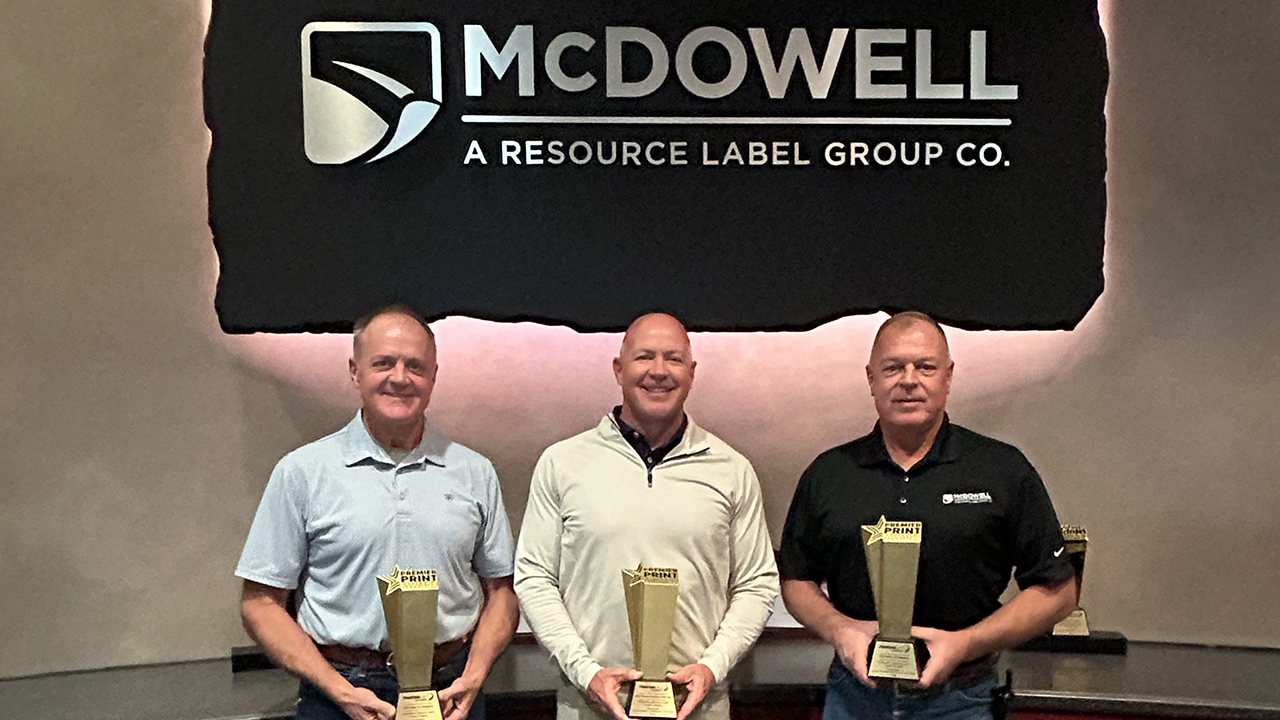
L-R: Jeff McDowell, John McDowell and David Wayne McDowell
This article and interview with John McDowell were completed prior to McDowell’s last day at Resource Label Group on February 9. McDowell says: ‘I am exploring many new opportunities that have been presented since the separation. For now, I am excited to serve my board of director duties with the FTA and remain engaged with the Regulatory Affairs Committee at TLMI.'
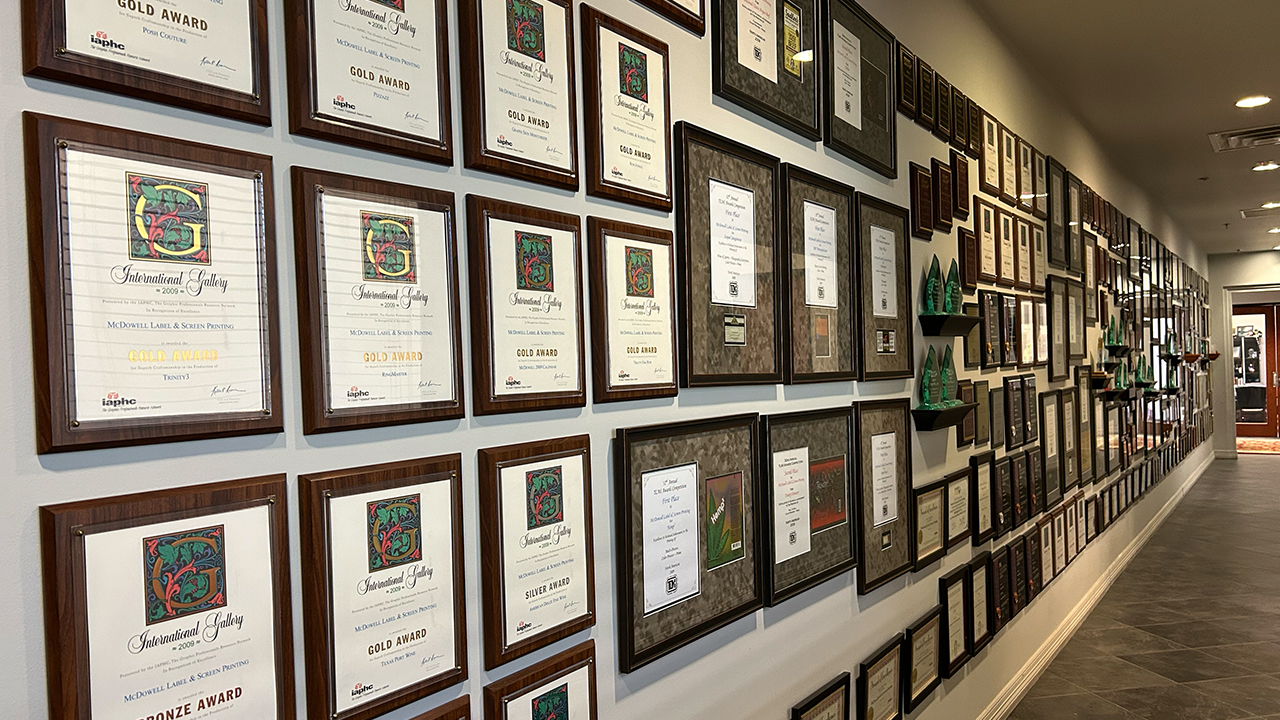
The walls at McDowell Label’s facility in Plano, Texas, serve as a testament to the company’s achievements. From floor to ceiling across multiple hallways, these walls showcase the 1,347 print awards that the converter has won, starting with its first TLMI recognition in 1997.
‘There’s really nothing more gratifying than when you have third-party industry peers recognize the quality of work that you manufacture and execute, day in and day out, as among the world’s best,’ says John McDowell, president of McDowell Label, a Resource Label Group (RLG) company. ‘The brand owners that we serve, they value that. They want to be part of that.’
McDowell attributes this success to the company’s blend of proprietary technology and its strong sense of identity, centered on partnering with brands that seek differentiation. The converter focuses on creating labels with crisp image quality and unique embellishments, helping clients stand out in competitive marketplaces.
‘We don’t try to be all things to all people,’ McDowell says about McDowell Label’s brand identity. ‘We’re hyper-focused on identifying verticals or market segments, and brands within those verticals and market segments. At the end of the day, these brands, whether they’re traditional retail brick and mortar or even direct to consumer, it’s a very competitive landscape. We allow our brands to out-graphic their competition because the reality is, as a consumer, whenever you shop – whether it’s online or traditional brick-and-mortar retail – a brand has only one-sixth of a second to capture your attention.
‘We afford that brand the ability, through our technologies, our printing excellence, to provide brand cohesion, to attract that customer, the consumer, and invoke them to engage with the brand.’
“RLG recognized our market differentiation, the unique brand identity that we have, the culture of quality that we employ”
McDowell Label produces pressure-sensitive labels, shrink sleeves and flexible packaging – all with solely flexographic technology. While the business breakdown does change from year to year, John McDowell said that currently about 70 percent of the company’s revenue comes from shrink sleeves, while about 28 percent is labels and the last 2 percent from flex pack. Its primary end-use markets are functional beverages, wine and spirits, health, beauty and cosmetics, dietary supplements and sports nutrition. A fast-growing segment for McDowell Label is pet care products.
As a Resource Label Group company, McDowell Label is part of a network of more than 30 facilities across North America. In Plano, McDowell Label has about 100 employees. It operates 10 flexo presses, but as part of RLG, it can tap into a broader system of locations and technologies to meet customer needs.
From father to son
Dave McDowell founded McDowell Label in 1981, after a decade of working for Stan Avery at Avery Label. He started the business in a room in John McDowell’s childhood home and built it from the ground up.
‘I’m the youngest of three boys, raised largely by a single father,’ says John McDowell. ‘Growing up, it was a very competitive, machismo household. The two older boys and I used to always grapple and verbally position the moxie of who’s the best. We never considered that the best was dad, but a time eventually came when we ultimately realized it was him all along.’
John McDowell and his brothers initially worked in different industries, with John McDowell owning Gold’s Gym health clubs in Dallas, Fort Worth and Houston. He sold the health clubs in 1996 and joined his father’s business. He thought he would move on to a new business venture after a few months.
The experience proved pivotal to McDowell Label’s future. Dave McDowell had been thinking of selling the business. John McDowell convinced him to teach him how to run it instead.
Over the next few years, John McDowell brought his two brothers into the company. David Wayne, the eldest brother, serves as plant manager, while Jeff, the middle brother, is the production manager.
Their father officially retired when Resource Label Group acquired McDowell Label in October 2020.
RLG acquisition
John McDowell had not initially intended to sell the company. But McDowell Label eventually grew to the point where it became a challenge to self-fund its accelerated growth, and John McDowell began looking for a partner.
He wanted to make sure he selected a partner that would benefit the company. He spent about two years considering six potential companies before deciding to move forward with Resource Label Group.
RLG stood out as a partner because it recognized McDowell Label’s identity as one focused on high excellence and skilled craftsmanship.
'RLG recognized our market differentiation, the unique brand identity that we have, the culture of quality that we employ,’ John McDowell says. ‘We’ve been able to proliferate that throughout the entire enterprise. They didn’t want to come in and change what we did. They wanted to optimize who we are.’
Additionally, John McDowell believed that RLG, with its dozens of facilities and diverse capabilities, was well-suited to navigate market challenges. This felt especially pertinent at the time, as the pandemic disrupted workplaces, supply chains and global markets.
With access to RLG’s capital, McDowell Label has grown its workforce and upgraded its technology.
‘We’re able to respond more swiftly, more intentionally, to market segment growth, specific brand growth or specific technology growth,’ John McDowell says. ‘We’ve recapitalized the company. We’ve reinvested in the company. Like any relationship or partnership, both parties have to uphold their end of the bargain. We grew the sales revenue of the business, and they capitalized the infusion for us to reinvest in order to add capacity, optimize our technologies, and continue to grow. We’ve enjoyed the dynamics of the enterprise network. We move business to other facilities, and in time, they move business to us.’
John McDowell’s role also included responsibilities at the greater RLG network, where he purveyed and parlayed subject matter expertise, cultivated talent, developed key strategic accounts and identified cohesive technology for and throughout the entire network of facilities.
Printing capabilities
McDowell Label utilizes eight Omet and two Gallus presses. ‘We have a fantastic partnership with Omet,’ John McDowell says. ‘I’m a big fan of its press technology. It is an Italian, multi-generation, family-owned company. Omet is about as nerdy about manufacturing presses as we are about manufacturing labels and packaging.’
McDowell Label’s machines are combination and multi-process printing presses, capable of printing multiple substrates, high-definition UV flexo, rotary screen printing and micro-embossing stereograms. Each press has multiple foil, die-cutting and emboss/deboss stations.
McDowell Label only has flexo presses. The converter was an early adopter of digital technology in the packaging space in 2005. However, the technology was still in its early days and not quite yet ready to meet the company’s production demands. The current technology makeup works well for the company, and it can tap into RLG’s network to meet customers’ digital needs.
‘I’ve always believed that the digital print engine and digital technology are the way of the future, and in my lifetime will be the primary print engine in our industry,’ John McDowell says. ‘It’s made some quantum leaps and great advancements, but it still hasn’t arrived to serve our niche of business.’
McDowell Label’s finishing technology is from BW Converting/Accraply and Rotoflex. The converter is renovating its pre-press department by adding capacity to address a recent bottleneck issue. The company recently upgraded with a new, wider Esko CDI Crystal unit for platemaking.
Proprietary technology
John McDowell attributes much of McDowell Label’s success to its proprietary technology, which he calls the company’s ‘secret sauce’.
‘We’ve always been on the leading edge of innovation, innovative technologies,’ he says. ‘We’ve coveted technology, a lot of which has been, over the years, proprietary, which we’ve developed here. We’ve certainly invested in it, too.’
At the heart of this is the company’s Crisp-Dot-Technology, or CDT, its proprietary pre-press and art production technology developed many years ago. CDT came out of a long-time goal of the converter’s, a priority since Dave McDowell’s days, to create the perfect dot.
CDT enabled the company to print very fine dots, long before the rest of the industry’s pre-press technology caught up. It allows the converter to print screen tones and vignettes with no discernible dot gain.
‘There were times people accused us of printing offset and digital when 100 percent of our operations are flexo because we can print a very crisp dot,’ McDowell says.
McDowell Label operates on two principles to achieve this perfect dot.
The first is the importance of the original artwork quality. McDowell Label often rebuilds art files received from customers. Sometimes a received artwork file looks nice on the screen, but when the file is preflighted and distilled into vector layers, it becomes clear that it is not high-quality enough to manufacture an excellent product, necessitating the rebuilding.
The other principle is that environmental quality can also not be compromised, so McDowell Label aims to operate a clean, quality-controlled facility.
“There were times people accused us of printing offset and digital when 100 percent of our operations is flexo because we can print a very fine dot”
John McDowell notes the importance of skilled operators in printing fine dots. ‘One thing that often gets lost in our industry, even with the advent of innovative technologies, is that our industry is still very much a craft,’ he says. ‘It’s very artisanal, and our press operators are, in kind, very much like craftsmen, because it’s a skilled trait. In our industry, you can take two identical presses that employ the same prepress, same plate technology, same material, same substrates, and you may or may not get the same results. Hence, the training curated for our team of operators, specific to our standard, is also what sets us apart.’
McDowell Label has worked with its suppliers to create other proprietary technologies as well, such as embellishments, inks and coatings. One example is the company’s micro-shimmer technology, developed with one of its ink suppliers, Cyngient. These proprietary technologies, which McDowell Label does not sell, provide customers with a tool to distinguish themselves from their competition.
‘We’ve been able to bake into our DNA and culture an award-winning mindset,’ McDowell says. ‘We treat every job, every order and every portfolio that we serve as an award winner.’
Stay up to date
Subscribe to the free Label News newsletter and receive the latest content every week. We'll never share your email address.