Trigon Digipack redefines packaging
The shift toward digital versatility is no longer a futuristic concept; it is a present-day reality for Trigon Digipack.
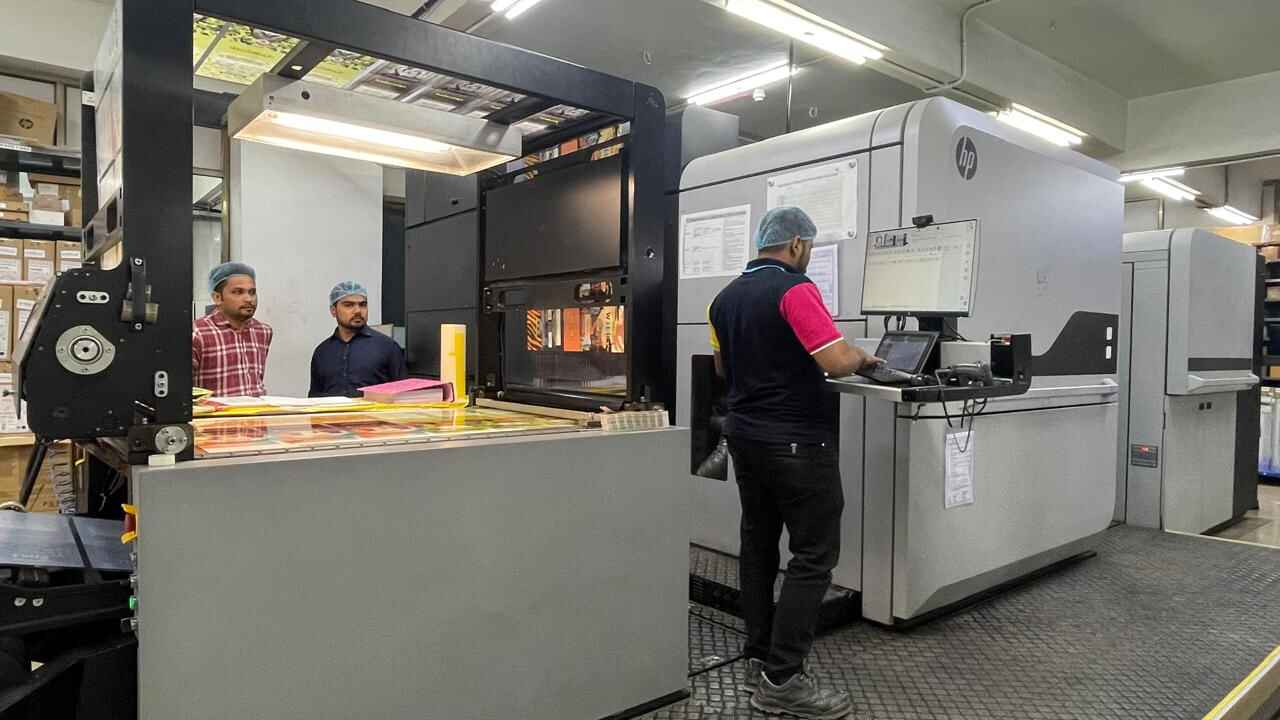
HP Indigo 25K machine at Trigon Digipack
The global packaging sector is currently navigating a tectonic
shift, one where the traditional boundaries separating labels,
flexible packaging and folding cartons are dissolving. This
convergence was the defining thought behind the rebranding
of Labelexpo to Loupe (as an acronym, LOUPE stands for Labels and Outer Packaging Embellishment), signaling a new era of multi-format conversion. Amidst this backdrop of change, one name emerged with distinction: Mumbai-based Trigon Digipack.
Trigon’s recent streak of accolades has sparked a renewed
curiosity about the company’s trajectory. What began as a modest pre-press and mock-up house has transformed into a digital titan, making it a natural focus for this exploration into the future of integrated packaging.
The architect
Every great transformation starts with an architect who understands the foundation. Anil Namugade, the founder and owner of Trigon Digipack, did not inherit a printing empire. He built one from the technical ground up. Beginning his career in the trenches of the early digital era as a scanner operator, Namugade mastered the intricate nuances of color reproduction and substrate behavior.
His journey took him through the ranks of industry leaders like Kodak, where he developed a deep understanding of pre-press workflows. It was during these years that he identified a glaring inefficiency in the market.
‘While massive FMCG brands had their logistics solved, they struggled with the “mock-up phase”; the agonizing wait between a digital design and a physical sample,’ shares Namugade.
In 2008, alongside co-founder Milind Deshpande, Namugade
launched Trigon in Mumbai as a specialized boutique for packaging proofing and product mock-ups.
This ‘service-first’ mindset became the company’s DNA, while
Namugade’s background as a technician gave him an edge. He wasn’t just selling a print; he was selling the ability for a brand manager to hold a center-seal pouch or a rigid box in their hands within days, rather than weeks.
His philosophy is simple: ‘If you can perfect the prototype, you can dominate the production’. This philosophy is rooted in Namugade’s commitment to the customer, and in a team-oriented leadership style, based on mutual respect rather than a rigid corporate hierarchy.
Expansion
Today, Trigon operates from nearly 100,000sqft of space across Mumbai, Vasai, Delhi, Bangalore and Dubai. The 2024 expansion at the Vasai (near Mumbai) facility was particularly significant, with the addition of a 3D flat-bottom pouching machine and a full line for rigid boxes and composite canisters.
This expansion has allowed the company to master the full
spectrum of packaging: from center-seal pouches to high-barrier laminates for the snack and beverage industries; premium labels with complex embellishments and cold-foiling; folding cartons that enable brands to test new markets. The company also specializes in rigid boxes for luxury cosmetics, perfume and beauty products.
The great pivot
Trigon’s evolution from 2008 to today is a timeline of bold technological bets that anticipated the ‘all-in-one’ mindset. ‘Starting our business with a Kodak Approval NX, we have come a long way. While the specifics of the pioneering Kodak printer might seem modest compared to our current technology, it ignited a passion for innovation and exceptional packaging that continues to fuel our success today,’ comments Namugade.
“Suddenly, a startup could order 500 high-quality pouches with the same quality as a million-unit run”
For its first six years, Trigon focused on the ‘Trupac’ mock-up
technology, concentrating on creating high-fidelity, ‘true-to-vision’ prototypes that allowed brands to test and visualize their packaging before full production.
‘At a time when brands had to wait weeks for a physical sample of a pouch or a box, Trigon promised turnaround times of just three to four days,’ Namugade adds. ‘By using actual packaging substrates, be it metalized film or textured board, we allowed FMCG giants and startups alike to hold the future of their brand in their hands before committing to massive analog runs.’ This era solidified Namugade’s reputation as the go-to partner for the creative community, bridging the gap between imagination and manufacturing.
With Trigon’s services grabbing more attention, Namugade
decided to transition from mock-up to production. In 2018, he
invested in an HP Indigo 6900 label press, replacing the HP Indigo WS6000 digital press installed at Trigon in June 2017. Recognizing that the short-run demand was exploding, Trigon quickly became a leader in digital labels. However, Namugade didn’t stop at self-adhesive labels. He pushed the technology into shrink sleeves and in-mold labels (IMLs), categories that were traditionally the domain of large-scale rotogravure printers.
While many converters hesitated during the global pandemic,
Trigon accelerated. In 2021, the company installed Asia’s first HP Indigo 25K press designed specifically for digital flexible packaging. This was a direct assault on the conventional idea that pouches required minimum orders of massive size. ‘Suddenly, a startup could order 500 high-quality pouches with the same quality as a million-unit run,’ recalls Namugade.
In 2024, Trigon repeated this feat by becoming the first in the region to install the HP Indigo 200K. This press, which offers 30 percent higher speed and 45 percent higher throughput, enabled the company to scale its labels to flexible packaging,
transitioning to an industrial level by reaching speeds of 56 m/min.
‘We installed the new machine in our newly built 50,000sqft facility in Vasai, near Mumbai, to increase capacity for flexible laminates. We also enhanced our converting capability by installing a 3D flat-bottom pouching machine to cater to a premium market segment and be the only company to offer such pouches with digital printing,’ shares Namugade.
At the new facility, the company also installed a full line of equipment to produce rigid boxes and canisters to meet the demand of its existing customers. All this was done to become a one-stop packaging provider and be at the buyer’s doorstep
when needed.
New frontier
Perhaps the most powerful weapon in Trigon’s arsenal is variable data printing (VDP). Unlike conventional printing, where every pack in a run is identical, digital printing allows for absolute personalization. Walking through his ‘hall of fame’,
where he proudly displays all his awards and recognitions, and printed samples and mock-ups, Namugade shares: ‘The
difference between digital and conventional printing isn’t just about speed; it’s about business agility.
‘While conventional printing requires physical plates for every design – a process that can take two to three weeks and incur
significant setup costs – digital printing requires only a file. You just need to give me the data, and I’m good to go.’
This agility has allowed Trigon to serve over 100 global FMCG brands while simultaneously supporting over 500 startups.
“The winners in this new era are those, who can provide a cohesive experience across every surface of a product”
Trigon’s work on a Mother’s Day campaign for Tata Tea serves as a landmark example. The order consisted of 3,000 packs, each featuring a unique image of a mother and daughter accompanied by a personalized message.
‘Every pack looks different from each other,’ Namugade explains, highlighting how this technology transforms a mass-produced product into a personalized connection between
the brand and the consumer.
This capability extends into security printing as well. By using invisible inks, microtext and Guilloché designs, Trigon helps brands combat rampant counterfeiting in the Indian market,
ensuring that every product is as secure as it is beautiful.
Sustainability metrics
In today’s world, a company’s success is also measured by how it impacts the environment. Trigon has aligned its digital expansion with the growing demand for eco-conscious packaging. By moving away from physical plates and cylinders, the company has eliminated the chemical waste typically associated with plate production.
Furthermore, digital printing’s ‘print-to-need’ model directly addresses the industry’s massive overstocking problem. For the hundreds of startups Trigon supports, this means zero obsolete inventory, a critical factor in reducing the supply chain’s carbon footprint. These startup facilities are increasingly experimenting with recycled, recyclable and compostable substrates, ensuring that the ‘outer packaging’ is as sustainable as it is beautiful.
The future through the ‘Loupe’
As the industry prepares for the 2026 edition of Loupe India, the Trigon Digipack story serves as a benchmark for what a
modern converter can achieve. It is no longer enough to be just a ‘label guy’ or a ‘pouch guy.’ Or as Namugade says: ‘The
winners in this new era are those, who can provide a cohesive experience across every surface of a product.’
Trigon’s story is a roadmap for transforming the Indian packaging industry. By viewing every challenge through a wide-angle lens, the company has proved that in the world of packaging, the only real limit is the one you place on your own vision.
Trigon enhances finishing capabilities with Orthotec
Trigon Digipack has installed an Orthotec FDC-3030 twin-head flatbed hot-stamping and die-cutting machine. The investment aligns with the company’s strategy to meet the growing demand for premium, high-impact packaging from brand owners across segments.
Before the installation, Trigon Digipack faced challenges with
registration accuracy, hot-stamping consistency and productivity, especially on complex jobs. Multi-step workflows and manual interventions were impacting turnaround times
and overall efficiency. The Orthotec machine addressed these challenges, and since then, the impact on production has been tangible. Setup times have decreased, repeatability has improved, and material wastage has decreased, contributing to higher productivity.
Namugade shares: ‘The twin-head configuration of the Orthotec FDC-3030 was a key differentiator. The machine offers greater flexibility and efficiency. Its solid build quality,
precision engineering and ability to handle demanding substrates made it a clear choice for us. It delivers industrial-grade performance while remaining operator-friendly, which is
critical in a production environment like ours.’
The Orthotec FDC-3030 is currently used for a wide range of
premium applications, including luxury labels, cartons, specialty print jobs and packaging components requiring intricate die-cuts and high-quality foil stamping. The machine is particularly effective for short to medium runs, where detailing, finish and consistency are critical.
Stay up to date
Subscribe to the free Label News newsletter and receive the latest content every week. We'll never share your email address.