Software suppliers tackle industry’s perfect storm
Workflow integration separates market leaders from struggling converters, with automation shifting from optional to essential.
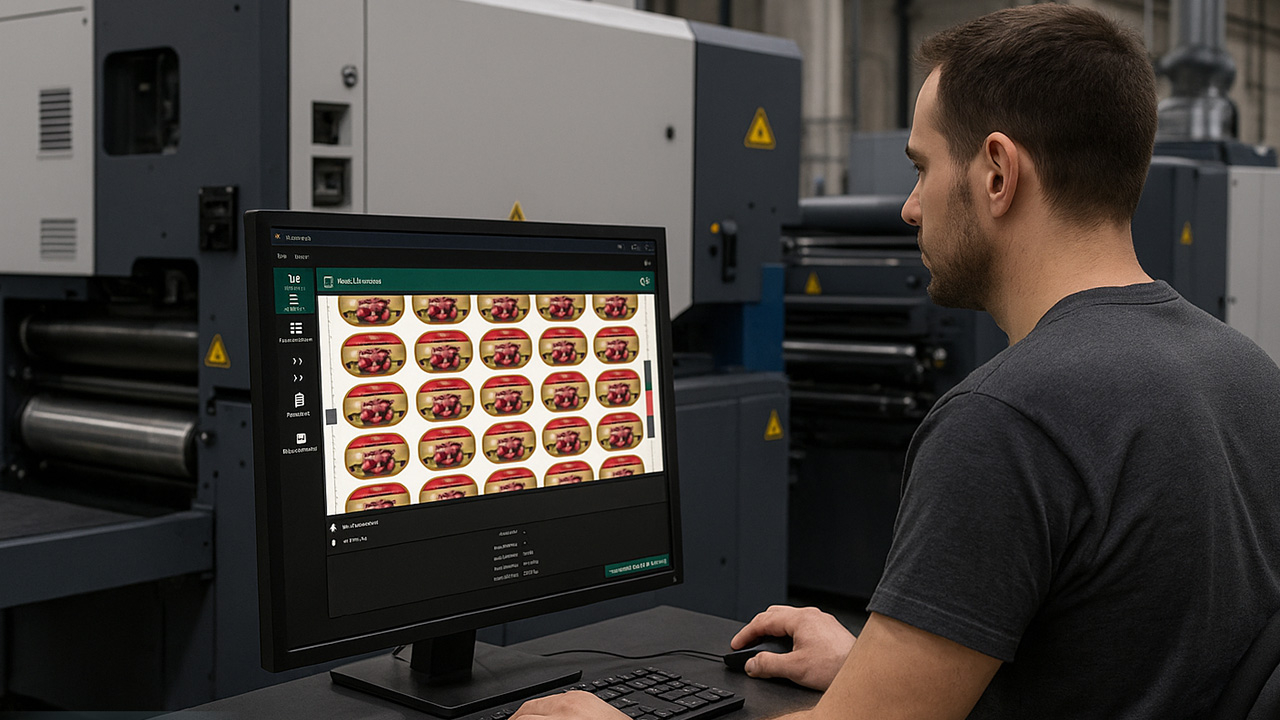
Hybrid Software’s SmartDFE enhances connectivity with MIS and ERP platforms, streamlining operations for faster turnaround and increased automation
One of the Hybrid Software’s customers has recently increased output by 3,000 SKUs per month without hiring a single additional employee. The secret was not a faster press or more floor space, but an integrated workflow system that eliminated manual touchpoints across the entire production process. This productivity gain exemplifies a shift happening across the label and packaging industry, where software automation has become the difference between thriving and merely surviving.
The response from the supply chain has been unmistakable: workflow automation is no longer optional; it is the foundation of competitive operations.
The perfect storm is hitting converters
Printers are navigating what Craig Tait, chief product officer at ePS, calls ‘a perfect storm’ of market pressures. ‘An unprecedented shift toward shorter runs and increased SKU proliferation is putting new strain on already thin margins,’ he explains. ‘The most critical pain point is the reliance on fragmented, disconnected systems that create silos and block a real-time view of the business.’
The shift from analog to digital print technology has changed the type of orders converters handle. ‘The volume of orders is higher, but with shorter run lengths and tighter lead times,’ notes Peter Dhondt, director of global and strategic accounts at Cerm. ‘If the workflow within the organization is not optimized to manage this effectively, then pressure builds in the CSR and production teams, and this is when costly mistakes can happen.’
Mike Agness, Hybrid Software executive vice president for the Americas, points to persistent fundamental issues that plague even sophisticated operations. ‘Files received are still not print-ready, which means a pre-press technician needs to do work on them to print properly. This goes for both flexo and digital print production.’
“Up to 55 percent of the lead time of a sales order or job can be taken up by admin and preparation, leaving less than half for production”
For many converters, manual processes create a cascade of problems. ‘Too many converters still run complex workflows on spreadsheets and manually enter data, creating errors and costly surprises that are often discovered too late on press,’ observes Tait. His company’s data shows that ‘by replacing these manual touchpoints with a connected workflow, process complexity can drop by 30 to 50 percent. The result: fewer mistakes, faster turnaround and complete visibility from quote to production.’
Sistrade identifies additional operational pressures, including ‘escalating energy and material costs, excessive waste from idle machines and the demand for shorter print runs with tighter delivery windows.’ These challenges are ‘compounded by rising compliance needs for variable data and personalization, leading to inefficiencies in production planning and inventory management,’ notes Isabel Ferreira, head of marketing and communication at Portugal-based Sistrade.
The convergence of these pressures is forcing converters to rethink their operational models, with workflow integration emerging as the primary lever for maintaining competitiveness.
Labor crisis
The workforce shortage has emerged as perhaps the most urgent challenge facing the industry, with demographic data painting a stark picture. ‘If you look at the age pyramid across Europe, there is a peak in the 50-60 year-old group, falling significantly through 40 to 50 and 30 to 40 and beyond,’ reports Cerm’s Dhondt. ‘The people are just not there, so technology must bridge this gap.’
The impact extends beyond simple headcount. ‘The labor shortage has exposed a critical vulnerability in the industry: an overreliance on tribal knowledge that walks out the door when an experienced employee leaves,’ explains Tait. ‘The impact of this is realized daily in slower estimating, brittle production schedules and a general lack of operational resilience.’
“The labor shortage has exposed a critical vulnerability in the industry: an overreliance on tribal knowledge that walks out the door when an experienced employee leaves”
For pre-press departments, the shortage creates particularly acute problems. ‘The labor shortage and finding qualified pre-press technicians impacts our clients considerably,’ notes Agness. ‘Many times, converters have a single pre-press person on staff. If that person moves on or is on vacation, our clients need some backup to keep their files moving.’
Sistrade quantifies the impact: ‘Labor shortages have led to revenue loss, increased error rates in picking and handling and prolonged lead times, exacerbating supply chain disruptions.’
‘Our philosophy is to build expertise directly into the system, so every job moves faster with fewer manual steps,’ states Tait. ‘By automating RFQs, estimating, job creation and production planning, teams spend less time on admin and more time producing.’
This approach fundamentally changes the skill requirements for new employees. ‘Complex, accurate quotes can be created without years of experience, because built-in logic guides the process,’ Tait adds. ‘The goal isn’t to replace people, it’s to make them more effective, free their time for strategic work and amplify decision‑making across the plant.’
Cerm’s MIS takes a comprehensive approach to automation. ‘Online web to print, pre-press software and production machines can be seamlessly connected with two-way communication,’ Dhondt explains. ‘This massively increases productivity driven by technology, enabling label and packaging converters to do the same level of business with fewer people or similarly support growth without the need to increase headcount.’
Maximum impact
Workflow providers identify several key areas where automation delivers immediate return on investment. Tait of ePS outlines five critical automation zones: ‘The front-end intake process is the largest win: RFQs flow directly into estimating without manual intervention, cutting delays, errors and hidden costs.’
The benefits extend through the entire workflow. ‘Automating pre-press handoff through structured specs, automated die and cylinder lookup and digital approvals, removes long-standing bottlenecks,’ continues Tait. ‘Planning becomes faster and smarter, with constraint-aware batching, ganging and automatic sequencing by ink and substrate. The result: production plans created up to 20 times faster, maximizing efficiency and reducing costly delays.’

Cerm emphasizes the power of product-based workflows as the foundation for automation. ‘Cerm is a product-based workflow, unique SKUs containing technical specifications and production routes to go either digital or analog depending on quantity,’ Dhondt explains. ‘This data drives an automated workflow from sales order, ganged production run opportunities, communication with pre-press software for step and repeat file prep, pushing data out to machines for automated set up and receiving real-time production data back for tracking and performance analysis.’
The company reports measurable results across its customer base: ‘We see this achieved throughout our customer base, reporting KPIs of reduced lead times, improved OTIF, increased revenue per employee and ultimately profitability increases.’
For pre-press specifically, Agness identifies two critical opportunities for automation. ‘Online proof approvals and step and repeat layouts should be integrated and automated,’ he states. ‘Online approvals offer, through status updates, visibility throughout the organization about in-process or completed pre-press tasks, immediately when a client approves the proof.’
Sistrade’s Ferreira points to ‘estimates automation, pre-press automation, dynamic job batching and integrated scheduling with presses, allowing for seamless handling of short runs and variable data. Robotic systems for finishing and packaging also offer quick wins by minimizing downtime.’
Ultimate Tech sees particular opportunity in SMB market segments. ‘The biggest opportunity is in small to medium companies, because today there are no pre-press tools available for them in a reasonable quality/price ratio that enables them to have a high level of automation,’ notes Watson. This represents a significant untapped market where workflow automation could deliver transformative results for operations that have been priced out of enterprise-level systems.
Theurer.com identifies product configuration as the foundation for automation success. ‘We see the greatest potential for automation at the very beginning of the workflow, during product configuration,’ Tobias Theurer, managing director of the company, explains. ‘With our flexible calculation and configuration module, articles are created as the foundation for both sales and production processes. Through simple customization, we can map any customer-specific requirements, from special quality standards to unique logistics labels or complex production steps.’
The system enables end-to-end automation. ‘Once configured, jobs can automatically move through the entire workflow, from estimating with standardized Business Templates, through automated job creation and scheduling, to production feedback via Direct Machine Interface and performance analysis in Actual Costing and Business Intelligence dashboards,’ Theurer adds.
Manual processes on the chopping block
When asked which manual processes converters most want to eliminate, workflow providers point to repetitive, error-prone tasks that consume time without adding value. ‘Customers are focused on eliminating non-value-added work,’ states Tait. ‘Every minute spent re-entering specs from an email, chasing artwork approvals or hand-building a job bag is a minute lost from producing sellable product. The absolute priority is to eliminate low-value, high-risk tasks that consume time and introduce errors.’
The hit list is extensive and consistent across suppliers. ‘Top of the list: manual re-entry of specifications into estimating and ERP, wiped out through automated intake,’ continues Tait. ‘Other top pain points include the constant chase for artwork approvals, the manual creation of job bags and spreadsheet-based scheduling.’
‘We see bottlenecks in order intake where orders are coming in from multiple sources, email, online portals, the printer’s customers’ ERP systems, Excel spreadsheets,’ Dhondt reports. ‘At Cerm, we have tools, including AI, to automate this process and remove manual and repetitive tasks.’
Continues Dhondt: ‘We see bottlenecks in pre-press from receiving customer artwork, one-up proof approval and prepping the file ready for production. Manual processes can be significantly removed here through integration, replaced by automated workflows that communicate and synchronize status changes, preflight reports, proof approvals and step and repeat.’
Hybrid Software’s Agness highlights specific automation wins that demonstrate the value proposition. ‘Generating a proof file and sending it automatically to the customer is very helpful and eliminates repetitive work,’ he states. ‘Letting the system prepare optimum step and repeat layouts for output saves a lot of operator time and also assures that the print provider is printing labels as efficiently as possible.’

Sistrade’s clients consistently target ‘manual proofing, imposition planning and barcode labeling, which introduce errors and slow approvals.’ The company reports quantifiable improvements: ‘Through our workflow automation consulting, we’ve helped clients automate these steps, cutting turnaround times by 30 to 40 percent and eliminating error-prone data entry.’
Ultimate Tech emphasizes the importance of human capital. ‘Tasks that are repetitive, tasks with little value for human interaction. This is specifically the case for imposition, ganging and nesting,’ Watson explains. ‘As we help more and more customers automate, they quickly realize that the software can handle all their work with no human intervention for them to focus on high-value tasks like creativity, customer care and designing new offerings.’
AI transformation
Artificial intelligence is reshaping how converters approach production scheduling, though perspectives vary significantly on the current state and future potential. The divergence of opinion among workflow providers reveals both the promise and the challenges of AI implementation in specialized manufacturing environments.
‘AI is transforming production scheduling, moving from reactive, rules-based systems to predictive, intelligence-driven decision-making,’ reports Tait. ‘AI models now suggest optimal batching strategies to reduce makeready times, flag potential delays before they occur and run multiple what-if scenarios to identify the best production outcomes.’
Cerm sees AI as essential for managing the complexity that overwhelms human planners. ‘In dynamic production environments, it is unrealistic to expect planners alone to effectively deal with changes to delivery dates, new priority orders coming in, which jobs should be run together, impacts of machine breakdowns, changes in staff availability,’ Dhondt notes. ‘It is the new technologies, including AI, that will help to solve the challenges and support better decision-making.’
However, Agness offers a more cautious perspective that highlights the challenges of applying general AI to specialized industries. ‘While AI will have a future, it needs to learn our industry and particulars about our industry,’ he states. ‘AI won’t have a considerable impact on our business immediately because our industry is too specialized to collect accurate information for business or process decisions. Chances are the advances in AI will be what converters teach it about their particular workflows on a micro level and not a global, macro level open-to-public AI engine.’
This view suggests that the most effective AI implementations will be those customized to individual operations rather than off-the-shelf applications.
Ultimate Tech acknowledges both the opportunities and the learning curve ahead. ‘Artificial intelligence is not new to automation, but it has certainly taken a new leap with generative AI and agentic AI,’ Watson observes. ‘AI is great at assessing quickly a vast amount of data and can help production professionals make decisions more quickly. But like any tool, there is always a better way to use it, and it is important for customers to learn about the limitations and opportunities of AI before scaling it to the entire organization.’
Theurer.com describes a shift from reactive to proactive scheduling. ‘Artificial intelligence is transforming production planning from manual rescheduling to continuous optimization,’ states Theurer. ‘In C3 AI, the system continuously calculates the optimal production plan based on the current production situation and automatically adapts it when conditions change, for example, due to rush jobs, machine downtimes or delayed materials.’

The company emphasizes multi-objective optimization. ‘The C3 AI engine determines a global optimum across multiple weighted objectives, such as the minimization of missed delivery dates, the minimization of set-up times, the maximization of overall equipment effectiveness and the reduction of lead times,’ Theurer explains. ‘Planners define the strategic weighting of these objectives, while the AI continuously balances them and proposes the optimal schedule.’
The consensus appears to be that AI will play an increasingly important role, but implementation requires careful consideration of industry-specific requirements and realistic expectations about current capabilities.
Sustainability reporting
Regulatory requirements are transforming sustainability from a marketing initiative into a core business function with significant implications for data management. ‘Sustainability is no longer a marketing initiative, it’s a core business requirement with significant data demands,’ states Tait. ‘Brand owners expect auditable, part-level traceability, requiring converters to capture a complete raw-to-finished genealogy for every job, including supplier certifications, energy use and waste attribution.’
Sistrade points to specific regulatory drivers with challenging deadlines. ‘Sustainability mandates are demanding granular data on material traceability, recyclability and carbon footprints, with stricter EU and global regulations requiring verifiable reporting by 2025,’ Ferreira reports. ‘This shifts focus to eco-friendly inks and substrates, increasing the need for integrated tracking systems.’
“Sustainability is no longer a marketing initiative; it’s a core business requirement with significant data demands”
Cerm observes increasing pressure from multiple regulatory sources. ‘As more and more legislation is introduced, PPT, EPR, EUDR, and responsibilities on the converter increase, we are seeing the need for more data and reporting for sure,’ Dhondt notes. ‘With scrutiny via audits and specific reporting, then the flexibility of the MIS to support and extract data is key.’
The message is clear: sustainability data management is becoming a table-stakes requirement for converters working with major brands, and workflow systems must be equipped to capture, track and report this information seamlessly.
Untapped opportunities
Looking beyond current automation efforts, workflow providers see significant potential in areas that remain largely unexploited. Tait envisions self-improving systems that learn from every job. ‘The most significant opportunity is building a self-correcting business ecosystem,’ he states. ‘Too often, valuable production data is locked in reports instead of being used to shape future performance. Real-time feedback, like actual run speeds and waste, should flow back into core systems to refine estimating standards automatically. If a job consistently runs faster than planned, the following quote becomes more competitive and more accurate.’
This creates a virtuous cycle of continuous improvement. He also sees opportunity in transparency that strengthens customer relationships. ‘The broader vision is complete operational transparency through live job status portals for brand owners. Converters maintain control while delivering the visibility customers demand, strengthening relationships and unlocking deeper operational insights.’
Cerm emphasizes end-to-end integration as the critical missing piece for many converters. ‘Many converters have invested in automation in specific parts, studio/pre-press, digital and flexo presses and finishing lines, but often the full integration between them is missing,’ Dhondt states. ‘These gaps between, or in other words, where the process flow breaks down, can cause jobs to stall, errors to creep in and margins to erode.’
Material waste represents another significant opportunity with direct bottom-line impact. ‘Waste reduction, improvements in processes can be achieved by using tools to optimize ganging/nesting and to minimize set up waste,’ Dhondt notes. ‘Given that substrate material cost can represent around 40 to 60 percent of total costs, then just a one to two percent reduction can have a significant financial impact.’
Agness identifies data silos as a key target for improvement. ‘The biggest untapped opportunity for many is when they have silos of data, but the current method for data input is done manually,’ he observes. ‘If we can look to eliminate touches and interruptions during production, efficiency will be gained and fewer errors will occur.’
Ultimate Tech zeroes in on pre-press as the area with the most unrealized potential. ‘In labels and packaging, definitely in pre-press. Many label printers tell us they prepare jobs manually,’ Watson states. ‘Labor costs are some of the highest costs a company can have, thus automation is key to enhanced productivity, quality and viability.’
Digital integration with brand owners
The relationship between converters and brand owners is evolving toward deeper digital integration, fundamentally changing the nature of these partnerships. ‘Digital integration is reshaping the way converters and brand owners collaborate,’ states Tait. ‘With open APIs and secure portals, RFQs, specs, artwork, live job status and compliance documents can be exchanged seamlessly. The payoff is clear: brand owners gain the transparency they demand, while converters maintain a single, auditable source of truth.’
The strategic advantage extends beyond operational efficiency. ‘By offering transparency and protecting sensitive data, converters can differentiate themselves in a crowded market and position themselves as strategic partners rather than just vendors,’ Tait adds.
Cerm emphasizes close collaboration with integration partners to create robust ecosystems.
‘We work very closely with our partners to ensure integration between our systems is effective and robust,’ Dhondt explains. ‘This could mean a web-to-print storefront that has been customized for the brand-owner and is fully integrated with the Cerm MIS, enabling real-time pricing and online ordering from product catalogs to be synchronized.’
Agness emphasizes the practical realities of integration. ‘Brand owners don’t want to change their systems generally speaking, so adapting what their systems can output and what the converters can accept and explaining how efficiencies can be gained can accelerate the entire production process,’ he states.
Theurer.com emphasizes standards-based integration for seamless collaboration.
‘C3 enables converters and brand owners to collaborate digitally on every level, from product data to delivery,’ Theurer notes. ‘With C3 Web-Portal 2.0, brand owners can log in to view and manage their own products, create new variants or SKUs and directly release or reorder items online. They can also track order progress in real time, view production or delivery status and access quality and sustainability information.’
Looking ahead
The consensus among workflow providers is clear: the industry stands at a transformative moment where integrated, intelligent systems separate market leaders from those struggling to survive. ‘The future of labels and packaging will be defined by agility and intelligence,’ concludes Tait. ‘Market leaders won’t be those with the newest presses, but rather those with the most innovative and connected workflows. Sustainability demands, labor pressures and rising customer expectations aren’t threats; they’re opportunities for companies that embrace integrated, intelligent systems.’
Ultimate Tech sees market disruption ahead that will reshape the competitive landscape. ‘As digital label presses become better and faster, they will create a new market opportunity for companies that are not already in labels,’ Watson predicts. ‘This enhanced competitiveness in the market will push label printers to innovate, to become more flexible and automated.’
“AI won’t have a considerable impact on our business immediately because our industry is too specialized to collect accurate information for business or process decisions”
Agness emphasizes the ongoing nature of workflow development. ‘We continue to listen to the needs of the marketplace and adapt our technology to those needs and new tools that become available,’ he states. ‘We welcome challenges from our customers and prospects, to understand their issues and put a development effort from a software manufacturer to adapt technology to resolve the difficulties they have.’
The path forward requires converters to fundamentally rethink their workflow systems, not as back-office utilities, but as strategic competitive weapons. The evidence from workflow providers suggests that the winners over the next five years will be those who invest now in integrated, intelligent systems that connect every touchpoint from initial quote to final delivery. Those who delay risk finding themselves unable to meet the speed, transparency and sustainability demands that are rapidly becoming table stakes in the label and packaging market.
The question for converters is no longer whether to automate their workflows, but how quickly they can implement the integrated systems that will define competitive advantage in an industry being reshaped by technology.
Stay up to date
Subscribe to the free Label News newsletter and receive the latest content every week. We'll never share your email address.