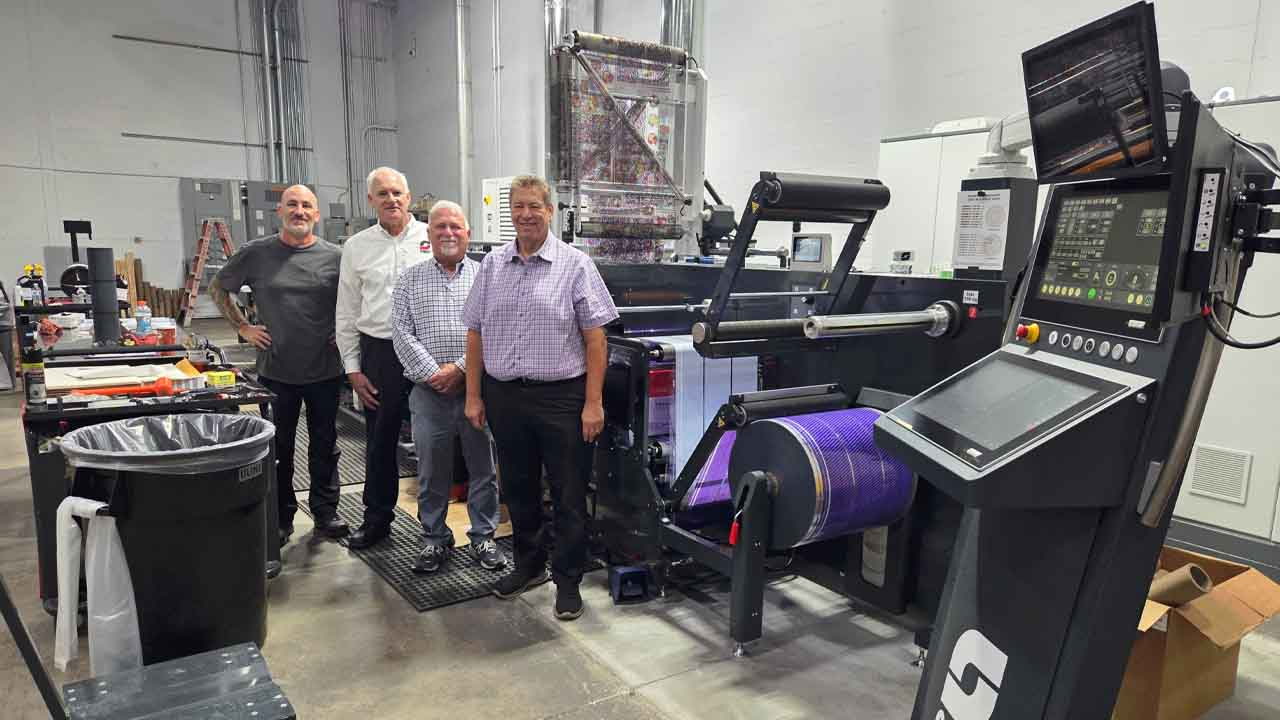
Mudrika Labels charts hybrid future with Rotatek
The India-based converter becomes the first company in the world to install a Rotatek 850 hybrid press.
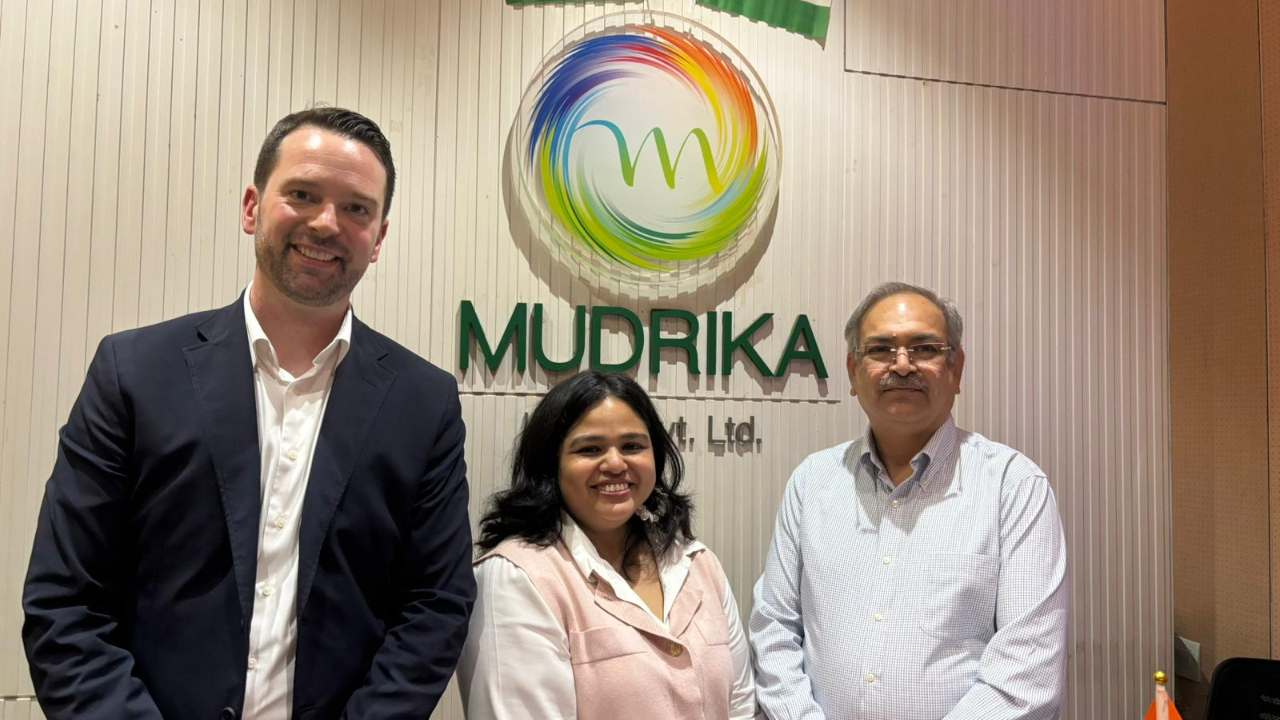
L&L and Loupe team with Manish Desai from Mudrika Labels
The landscape of Indian packaging is undergoing a profound paradigm shift, driven by growing demand for cost-effective short- to medium-run production, substrate versatility and sustainable manufacturing practices. Accelerating this evolution is Mumbai-based Mudrika Labels, which installed India’s first fully configured Rotatek Universal 850 hybrid press at its facility in Vasai, Maharashtra.
This major investment marks a significant milestone for the label sector, positioning Mudrika Labels as the global reference site for the newly redesigned Universal 850 platform. Managed by directors Manish Desai, Sandip Kadakia and Vipul Desai, the enterprise is bridging the operational gap between narrow web label applications and mid-web flexible packaging.
Over four decades of heritage
Though officially incorporated 25 years ago, the company’s roots date back nearly 40 years, the foundation of which was built on customer focus and technological agility.
Through the late 1990s and early 2000s, Mudrika earned a reputation for engineering and manufacturing precision industrial labels. The directors recognized early on that a product’s label forms its crucial first impression on the store shelf, playing an important role in consumer decision-making. Guided by this insight, the company established local manufacturing capabilities to reduce the domestic market’s reliance on imported products.
Talking more about the company’s approach, Manish Desai, director at Mudrika Labels, shares: ‘A definitive example of Mudrika’s market-disruptive approach was its development of localized heat transfer label (HTL) technology. Historically,
Indian consumer brands were heavily dependent on importing high-end heat transfer films from Korea and China, which lengthened lead times and inflated capital expenditures. Mudrika invested heavily in the necessary research and equipment to manufacture these films domestically.’
Today, the company commands an estimated 80 to 85 percent share of the domestic market for localized HTL, serving as an end-to-end partner for the nation’s largest FMCG, cosmetics and industrial product manufacturers.
As an ISO 9001:2015-certified organization, the company has scaled its manufacturing footprint across distinct business verticals, specializing in premium folding cartons, printed corrugated boxes, point-of-purchase displays and customized corrugated shipping packages. This diverse portfolio has allowed Mudrika to provide an all-inclusive, under-one-roof
packaging suite.
Before the acquisition of the Rotatek Universal 850, Mudrika had an extensive fleet of multi-color in-line flexographic and
offset presses, including multiple Lombardi flexo lines. Over the past decade, the company achieved significant growth in
self-adhesive and in-mold labeling (IML).
However, as consumer brand dynamics shifted toward product diversification and regionalized marketing, the company identified an unfulfilled market opportunity within the broader medium-run flexible packaging sector, a territory historically
dominated by high-volume wide-web rotogravure printing.
Bridging the gap
Commenting more on the company’s diversification, Desai adds: ‘In the traditional packaging supply chain, a stark division has long existed between label printing and flexible packaging production. Narrow web flexographic and digital presses efficiently handle pressure-sensitive labels and short-run shrink sleeves. Conversely, wide-web rotogravure and CI flexo presses dominate the flexible packaging segment, optimized for producing millions of linear meters of unsupported films and laminates.’
“When you install a completely new machine, you need patience. You cannot expect 100 percent capacity utilization in year one”
However, rotogravure carries a heavy capital penalty: the high cost of engraving copper cylinders makes short- to medium-run production economically unviable. For brands launching seasonal campaigns, limited-edition variants or regionalized product lines, gravure’s lengthy setup times and rigid volume requirements posed severe bottlenecks at Mudrika.
Desai explains: ‘Upon analyzing the flexible packaging market, the company identified a clear operational gap. Gravure cylinder costs remain exceptionally high, which limits brands’ ability to experiment with shorter product life cycles. On the other end, digital printing, while flexible, becomes cost-prohibitive as volumes scale into medium-run lengths.
‘The team realized that by combining the high graphical fidelity of offset printing with the in-line converting efficiency of
flexo on a mid-web platform, they could bridge this gap. The Rotatek Universal 850 provides the exact sweet spot, offering
customers lower pre-press costs, rapid job changeovers and high print quality on an extensive range of unsupported materials.’
Mudrika found its preferred machine through its long-standing technology partner, Vinsak, which represents and supports the Spanish press manufacturer.
Desai was directly involved in designing the press, its module layout and component selection. He made up to ten trips to
Rotatek’s headquarters over the past year to shape the final configuration before unveiling and announcing its purchase
at Rotatek’s open house in Barcelona in January 2026.
Technical deep dive
The Universal 850 engineered for Mudrika Labels represents the pinnacle of Rotatek’s hybrid sleeve technology, specifically configured for high-volume producers of pharmaceutical inserts, folding cartons, shrink sleeves and flexible packaging. Featuring a maximum substrate width of 870mm and a maximum printing width of 850mm, the press handles print formats ranging from 508mm to 1016mm and operates at mechanical production speeds up to 400m/min.
The machine has a redesigned offset roller train, incorporating
a fourth ink-form roller into the system, drastically improving ink distribution uniformity, reducing ghosting anomalies and ensuring flawless solid-ink coverage alongside high-screen halftones.
To maintain absolute process control during prolonged production runs, the press integrates a refrigerated ink fountain roller system.
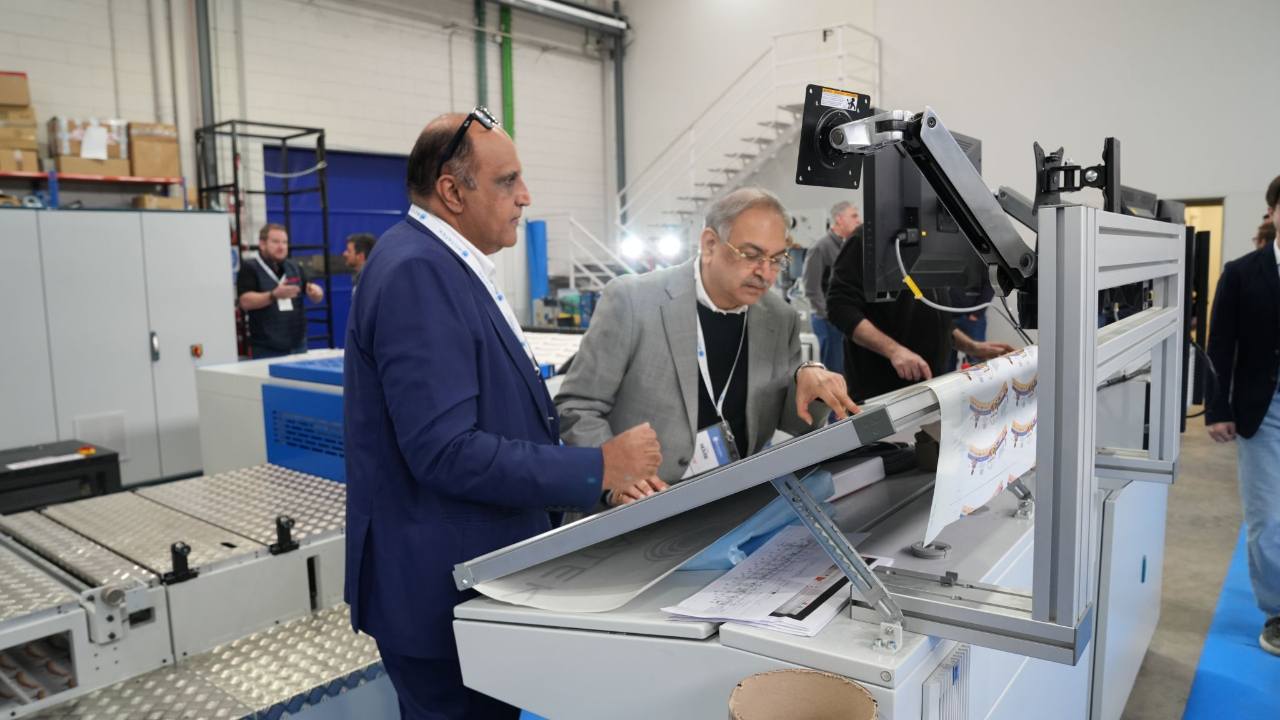
Furthermore, a fully adjustable oscillating ink roller system lets operators fine-tune lateral ink movement based on the specific chemistry of the consumables being used, whether running standard UV, advanced LED or conventional grease-based inks.
‘What distinguishes this installation is its uncompromising,
highly customized architecture, which blends seven in-line
web-offset printing units with two specialized flexographic stations. The press is designed to master a wide range of substrates, running ultra-thin 12-micron unsupported films; specialized shrinkable materials such as BOPP, PET and PVC from 15 to 400 microns; self-adhesive papers; and heavy carton board ranging from 150 to 400g/sqm,’ notes Desai.
He further adds: ‘We have not left out a single high specification on this press line. Whatever automation options, register controls or efficiency mechanisms were available from the manufacturer, have been fully incorporated, serving as a lighthouse installation for the global industry.’
Advanced sleeve technology and servo automation
The press utilizes lightweight, interchangeable sleeve technology for both the plate and blanket cylinders. A new pneumatic locking system secures the sleeves in place, providing easier installation, reduced manual handling and a more secure operational lock. The resulting reinforced chassis eliminates micro-vibrations, ensuring high print stability even at maximum mechanical speeds on cartonboard.
To achieve the precise tension boundaries required for handling stretchy, ultra-thin 12-micron films alongside rigid 400g/sqm cartonboard, the Universal 850 has replaced all traditional mechanical drive architectures with Bosch Rexroth servo motors. Every single print unit, draw roller and tension zone is governed by independent servo control, providing unparalleled web handling flexibility, micron-level registration precision and rapid automatic register pre-setting. The transversal register precision has been significantly upgraded, ensuring instantaneous alignment adjustments during dynamic speed transitions.
Converting and in-line embellishment
Beyond the seven offset units, the two in-line flexographic stations provide versatile coating, solid-color back-printing or specialized varnish applications. Integrated into the web path are high-value converting options, including an advanced cold foil lamination system for premium metallic embellishments, an automated inking supply system that maintains constant fountain levels and an automatic blanket washing system that drastically slashes downtime between jobs.
“What distinguishes this installation is its uncompromising, highly customized architecture, which blends seven in-line web-offset printing units with two specialized flexographic stations”
Adding more details about the press, Desai shares: ‘For
complete quality assurance, the press features a 100 percent
video inspection system.
'This technology scans the entire width of the web in real time,
comparing the live print against a golden master PDF to instantly detect, log and flag minor print defects, color shifts or hickeys before the web reaches the final rewinder.’
Pioneering sustainability
Beyond mechanical speed and material versatility, the configuration of the Universal 850 at Mudrika Labels addresses the printing industry’s modern imperative: energy conservation and carbon footprint reduction.
‘To pioneer a more sustainable manufacturing paradigm, we have outfitted the press with a specialized near-infrared (NIR) drying system on its coating modules. Operating at optimized light wavelengths between 700 and 2500nm (nanometer), the NIR technology penetrates deep into coating layers instantaneously, drying the chemistry from the inside out,’ comments Desai.
‘This targeted thermal transfer reduces energy consumption
by approximately 50 percent compared to conventional long-
wavelength IR systems, while preventing the substrate from
overheating or stretching.’
Additionally, the UV curing zones across the offset and flexo
units utilize LED lamps. By transitioning away from conventional mercury UV systems, the press achieves an immediate 50 to 60 percent reduction in power consumption within the curing phases.
Global ambitions
Desai remarks thoughtfully on the operational rollout strategy,
noting: ‘When you install a completely new, highly sophisticated platform of this magnitude, you need patience. You cannot expect 100 percent capacity utilization in year one. Our immediate focus remains on process standardization, which entails aligning the pre-press workflow, mastering hybrid ink profiles and validating advanced substrate applications.’
He concludes: ‘The company will first standardize and
then scale.’
By running complex in-mold labels, shrink sleeves, flexible
laminates and folding cartons on a single web platform, Mudrika Labels is not just expanding its product catalog; it is rewriting the operational rules for the modern packaging converter.
Stay up to date
Subscribe to the free Label News newsletter and receive the latest content every week. We'll never share your email address.