Blue Label Packaging expands with direct-can printing
The Ohio converter invested in a Velox digital inkjet direct-can printing machine to meet the evolving needs of the beer industry.
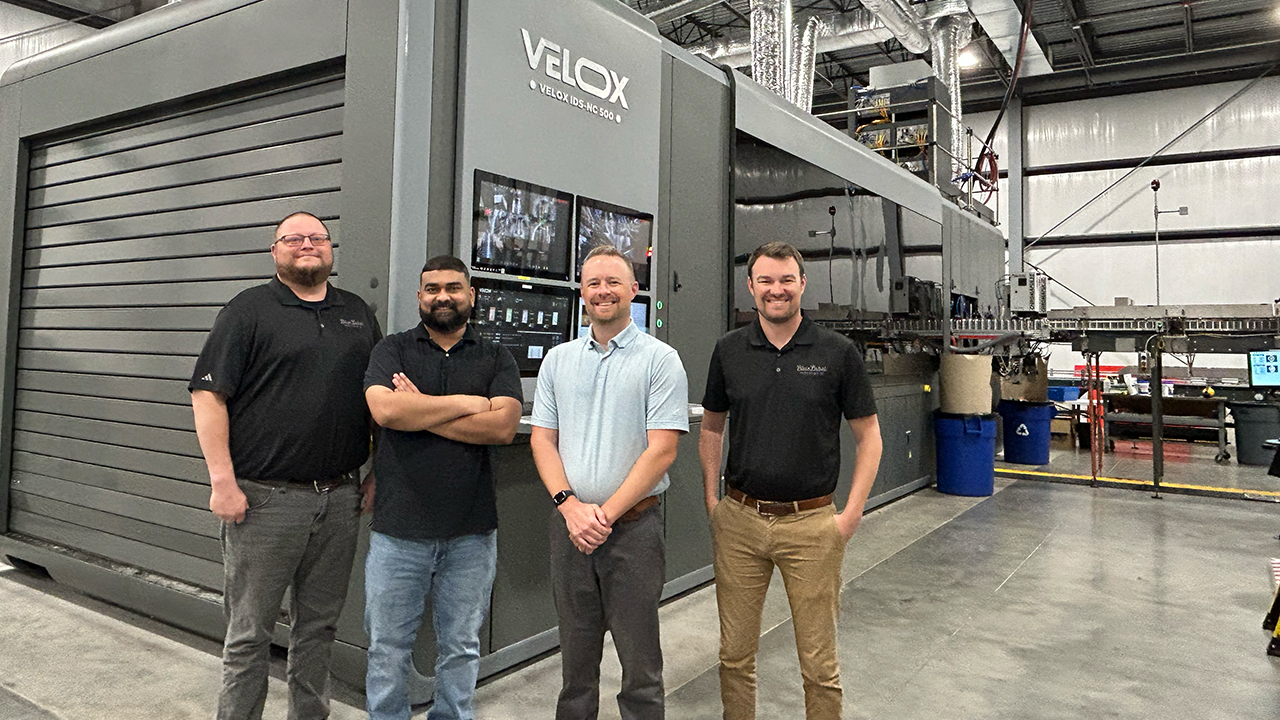
L-R: Joe Schorr, director of operations; Gopi Vemavaram, head of direct-to-object operations; Andrew Boyd, president; and Gareth Boyd, director of finance, in front of the Velox machine
The year was 1978. Norman Boyd, a so-called ‘counter-cultural revolutionary’, decided to climb Mount Everest. He hadn’t brought the right equipment, so he wasn’t able to reach the summit, but during the climb, he became good friends with his Sherpa, Ratna. When it was time for Norman Boyd to return to the US, he gave Ratna a parting gift: his brand-new pair of Nikes. The shoes didn’t fit, but rather than accept that he couldn’t wear them, Ratna used a knife to cut off his calluses and make his feet fit.
This is a story that Norman’s son, Andrew Boyd, now president of Blue Label Packaging, often returns to, believing it offers valuable lessons for running a company.
‘Your customers are going to be who they are,’ he says. ‘You can’t change people’s behavior, but what you can do is accommodate who they are and try to make your foot fit the shoe. That’s where we’ve been as a business.’
This mentality has guided Blue Label throughout its nearly 70 years of operation. The converter has adapted and invested in new technology more than once to meet its customers’ needs and wants. In its early days, it invested in digital label technology to fulfill the high-customization expectations of its client base, primarily churches at the time. More recently, Blue Label invested in direct-can printing technology to meet the evolving sustainability-driven needs of the beer industry.
Today, the bulk of Blue Label’s work, about 85 percent, is in the beverage industry. Labels make up about 80 percent of its revenue, while shrink sleeves account for 10 percent and tags for five percent. Its newest segment, printed cans, make up the remaining five percent and are a rapidly growing part of the company.
Direct-can printing
Early this year, Blue Label Packaging officially began producing direct-printed cans with its Velox IDS-NC 500 inkjet machine.
Andrew Boyd made the decision to invest in direct-can printing because he believes that’s the direction the beer industry is going in. Consumers are already familiar with direct-printed cans for sodas and large beer companies. Plus, direct-printed cans don’t require a secondary piece of packaging, making them a more sustainable option. A few years ago, Quebec went so far as to ban plastic labels on aluminum cans, as they disrupt aluminum recycling streams.
This puts pressure on breweries to adopt alternative labeling methods. And for breweries needing multi-SKU work or runs shorter than 200,000 cans, digital printing makes sense.
‘Customers are making a choice for their packaging mix due to a number of factors; some we can control, most we can’t, be it cost, be it environmental reasons, be it application set-up, be it the performance of the drink itself,’ Andrew Boyd says. ‘In our mind, we wanted to be a part of that conversation, regardless of the direction they went, and we knew that, in order to do that, we had to provide something in the direct-object realm.’
“Customers are making a choice for their packaging mix due to a number of factors; some we can control, most we can’t”
Blue Label’s direct-can customers generally have runs ranging from 6,000 to 50,000 cans, with some exceeding 100,000. These orders are larger than Blue Label’s other products. Most of these customers are brands that Blue Label has never worked with before.
A handful of Blue Label employees have been trained to operate the Velox system. Each of them applied for the position and worked alongside the installation engineers to learn how to use it. The Velox machine requires more maintenance from Blue Label employees than the converter’s other digital presses and finishing technology. ‘They have a master’s degree on that machine,’ Andrew Boyd says.
Journey with Velox
Blue Label Packaging has been on a several-year-long journey with Velox to get to where it is today with digital direct-can printing.
At the time Blue Label was looking to invest, there were a few companies with digital direct can printing technology on the market, but Velox, an Israeli company, stood out to him because several former HP employees worked there. So, while on a trip to Israel in 2022 to visit HP, Boyd stopped by Velox’s facility to see
its machinery and meet the owners.
Six months later, Boyd cut the check.
Then, just a few months afterward, on October 7, 2023, Israel went to war, delaying the Velox machine.
The year after, in the fall of 2024, Velox began dealing with financial issues that have impacted its ability to produce more machines. This also delayed the Velox machine, which finally arrived at Blue Label’s facility in 2025.
After nearly three years of navigating geopolitical obstacles and the supplier’s situation. Boyd is relieved that the machine is finally operational. When he watches it run now, he does so smiling from ear to ear.
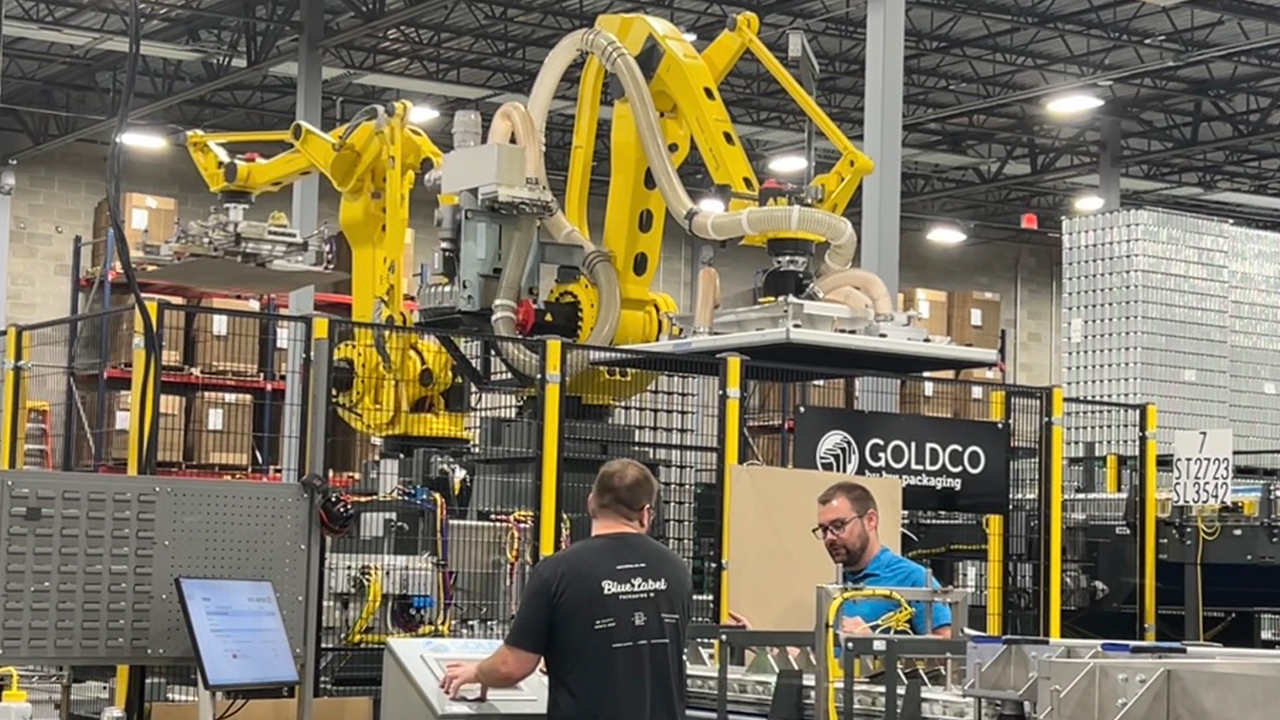
The Velox machine itself is massive, with 700 printheads, measuring 40x11x12ft and weighing 30 tons. It costs the equivalent of three or four label converting lines.
BW Integrated Systems robotic arms load blank aluminum cans onto a conveyor belt, also from BWIS. After the cans are printed on the Velox machine, the robotic arms load them onto pallets, and a Signode machine places bands around the pallets.
The machine is housed in a 30,000sqft room that was renovated for the machinery. Specific flooring had to be installed, and a wall had to be removed to move the Velox into the space. The room
had previously been a warehouse for extra rolls of material. Next
to the direct-can printing system, tall stacks of blank aluminum cans fill the room. Blue Label keeps a few million blank cans on hand to fulfill orders quickly.
Boyd is pleased with the quality the Velox machine produces.
‘It prints 900x900 DPI. The color consistency is great. Color-matching abilities are great,’ Boyd says. ‘It’s creating
a product that for the industry is really top of the line.’
A family business
Family-owned Blue Label, then called One Write Company, was founded in 1957 to produce envelopes and forms, primarily specializing in church offering envelopes. As the company grew, the church offering envelope business was split off from the rest of the company, which produced commercial envelopes. The family sold the commercial envelope company in 2002 and retained the church offering-envelope segment.
With the rise of internet donations, the company looked into what other services it could provide to its 10,000 church customers. The company decided to start producing labels for these churches and invested in early digital printing technology with an HP Indigo 4K and an A B Graphic Digicon Omega, for micro-runs as small as 100 labels.
‘For us as digital label printers, it’s been about how do you economize on all the similarities between the work, so keep your costs in line, yet still be able to deliver a piece of custom packaging for each and every small business, which is far too small for somebody that has million-dollar accounts,’ Andrew Boyd says. ‘It’s not uncommon for us to have a couple-thousand-dollar accounts. That’s a huge part of our business in terms of volume.’
Around 2012, when Andrew Boyd joined the business, Blue Label decided to focus on digital label production. It invested in an HP Indigo 6K and a Series 2 ABG Digicon Omega with hot-foil stamping. The company also decided to pursue the beverage market, specifically craft beer, an emerging industry at the time that didn’t require long runs for its bottle labels.
With Andrew Boyd, then vice president of the label division, the company expanded into labels for craft spirits, wine and cannabis, as well as specialty foods and nutraceuticals.
The company added shrink sleeves to its offerings in 2018, and in January of 2026, it officially began manufacturing its newest product: printed cans.
Digital technology
Blue Label has always been a fully digital label-printing company, using only HP label presses and ABG finishing equipment.
Its facility, located on the outskirts of Lancaster, Ohio, houses an HP Indigo 200K, four HP Indigo 6Ks, an HP Indigo 69K, a sheet-fed HP Indigo 5600 for tags and an HP Indigo 20K and 25K for shrink sleeves.
Blue Label uses the 200K, its newest label press, for labels and shrink sleeves. By taking advantage of its wider width and in-line slitting, Blue Label can print labels at double the speed.
Blue Label’s facility also houses 10 ABG finishing machines, primarily Series 3 Digicons.
Boyd prefers to work with just a few suppliers, as it allows his team to develop greater expertise on the machinery. He says that HP and ABG have both been excellent partners, and he appreciates that both suppliers invest in R&D and are forward-thinkers.
Blue Label uses Cerm for its workflow software. Boyd says that Cerm has enabled the converter to scale quickly, including for its direct object printing operations. The software supplier already had a direct-to-object workflow.
With the number of SKUs Blue Label handles, having a seamless workflow system is crucial.
Cerm also invests in R&D, and the company constantly adds
new capabilities.
‘They want to be a one-stop shop for a packaging company for an ERP system,’ Boyd says. ‘They’ve grown so much, and they’ve added so much capability. It’s good to see them profiting, and the money is going back into the business. Every year, you have more service techs, you have more capabilities possible with them. With Infigo, we launched e-commerce last year, and for the service side of it, they were able to get a lot done. We have a successful web storefront that actually hooks all the way into our MIS, and it’s giving you live, real pricing.’
“It prints 900x900 DPI. The color consistency is great. Color-matching abilities are great”
Now with the Velox machine, Boyd believes that digital direct-can printing could make up a quarter of the Blue Label’s revenue within a few years. However, he’s not sure he would recommend it for other label converters because of how much work it’s been to implement.
At the same time, Boyd notes that direct-object printing may eventually serve as a disruptive force in the label industry, particularly in a segment like beverage cans.
‘People are going to make a decision either way,’ Boyd says. ‘You either have a solution for them, or you don’t. It’s hard to convince a customer to change; it is much easier to meet them where they are.’
Stay up to date
Subscribe to the free Label News newsletter and receive the latest content every week. We'll never share your email address.