Zoom Prints enters labels market with unique approach
Breaking the traditional mold, Zoom Prints entered the label industry with digital before scaling backward into conventional flexo.
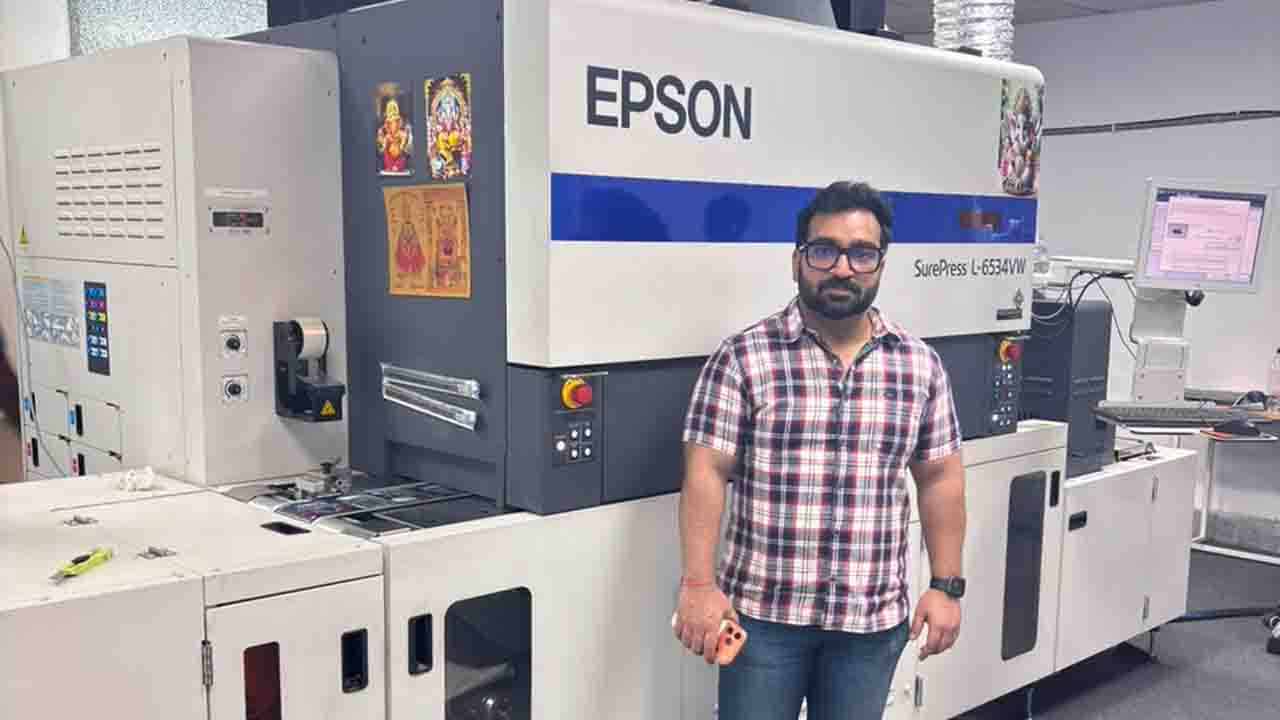
Atul Bhatt, founder of Zoom Prints with Epson
Surepress L-6534VW UV inkjet digital press
In the label and packaging industry, a company’s path to technology upgrades follows a predictable pattern: a conventional label converter, seeing a growth in short runs, invests in a digital press to complement its flexo infrastructure.
But at Delhi, India-based Zoom Prints, the team decided to take an entirely different route.
Digital roots
To understand Zoom Prints’ unique approach, one must look back at the company’s history. Founders Atul Bhatt and Harish Setia, along with managing directors Vikas Bhatt and Kapil Setia, started the parent company, Printmart, in 2013 as a commercial print business.
The founding team brought distinct backgrounds to the table.
As Atul Bhatt recalls: ‘After about five and a half years, moving from an on-the-job trainee to a senior engineer at Konica Minolta distributor company in India, I felt unfulfilled. I decided to transition out of corporate employment and start a print business.’
Taking a leap of faith, the team relied strictly on the technology they knew best. Harish Setia and Atul Bhatt purchased their first Konica Minolta press from a vendor in Delhi and started the business out of their home. Because their background was entirely hands-on with digital machinery, they had no prior knowledge of conventional printing methods like flexo or offset.
The business quickly took off. ‘After running the first press successfully, we felt confident adding two more Konica Minolta digital presses. Then Vikas joined
us temporarily, and seeing success with Printmart, he decided to join full-time and
eventually began to enjoy the business,’ Atul Bhatt explains. Starting with just one facility, the business has scaled to 35 facilities today.
Diversification
As the print industry in India grew, the commercial print market started to see intense competition. While Printmart was still profitable and growing, margins began to shrink.
‘We decided to diversify primarily because our original commercial business
had reached a saturation point and was no longer growing according to our expectations. We reached a point where we had no real USP left to sell our product, causing our profitability to stagnate even as we invested more capital,’ Vikas Bhatt says.
Consequently, the team decided to diversify. Vikas Bhatt focused on the publishing segment, while Atul Bhatt handled labels. The team originally added an Epson Surepress L-6534VW UV inkjet digital press for a different application, but it ultimately served as their entry point into the label industry.
The team started Jambui for short-run book publication and Zoom Prints for short-run labels and packaging in 2020.
The returns in the labels segment immediately felt healthier than the cutthroat commercial print space. ‘Our entry into labels was accidental, but today, I am thoroughly enjoying it. Over the last month or two, I’ve truly started to find fulfillment in this segment. Previously, we were simply reinvesting everything we earned from the commercial market into this new venture. Ultimately, I believe we diversified into publishing and labels at the exact right time,’ Atul Bhatt explains.
‘If we had waited another five to seven years, our risk tolerance might have decreased with age, and we might not have made the leap at all. And fortunately, it has been a positive journey so far.’
Our entry into labels was accidental, but today, I am thoroughly enjoying it
The company prints its label on the Epson Surepress, which offers a printing speed of up to 50m/min, embellishment capabilities and up to 88 percent Pantone coverage with digital varnish ink. The company also houses an MGI embellishment press for special effects on labels.
‘The great thing about the Epson press is that it delivers an excellent ROI, which is the primary reason we are already looking to add another machine. It ultimately comes down to service. Even a mediocre product can succeed with the right support, but here we have a great machine backed by an impeccable, highly knowledgeable service team. We have never been disappointed by their technical support and that reliability is what drives us to invest further,’ Vikas Bhatt adds.
Ashish Joshi, assistant manager, sales and marketing at Epson India, adds that a major advantage of Epson is that it is currently the only manufacturer in the digital label segment that manufactures its entire technology in-house.
‘While other manufacturers piece together unwinders, rewinders or web paths from different third-party vendors, Epson builds everything, from the media handling to the printheads at the heart of the machine, as a single system. Because all the components are designed to work together perfectly, it delivers incredibly fine, high-quality results. Fulfilling the market’s strict quality expectations has been key to growing our business,’ he says.
Beyond the press’s technical capabilities, Zoom Prints preferred working with Epson due to the close cultural alignment and shared values between the two companies.
Currently, the company prints 2000sqm a day on its Epson press and plans to add another water-based Epson digital press to bring daily production up to 5000sqm.
‘I believe Epson digital label press is the best press to enter the label segment in terms of quality and ROI,’ Atul Bhatt adds.
From digital to flexo
However, when the demands of its growing customer base shifted toward high-volume orders, Zoom Prints found itself in an unusual spot, buying a flexo press to complement its agile digital setup.
As Zoom Prints’ brand presence in the label segment grew, the team realized that its digital offering was both a blessing and a competitive vulnerability. Keeping the customers they had already won became a challenge as their demands evolved.
‘When an existing client’s volumes increase, they request a transition from short-run digital to long-run flexo production. We cannot afford to turn these clients away or suggest they look elsewhere, because if they migrate to a competitor for their long-run needs, they will inevitably take their short-run business with them next time. That dilemma forced our expansion into flexo, a technology we are still learning to navigate,’ Atul Bhatt says.
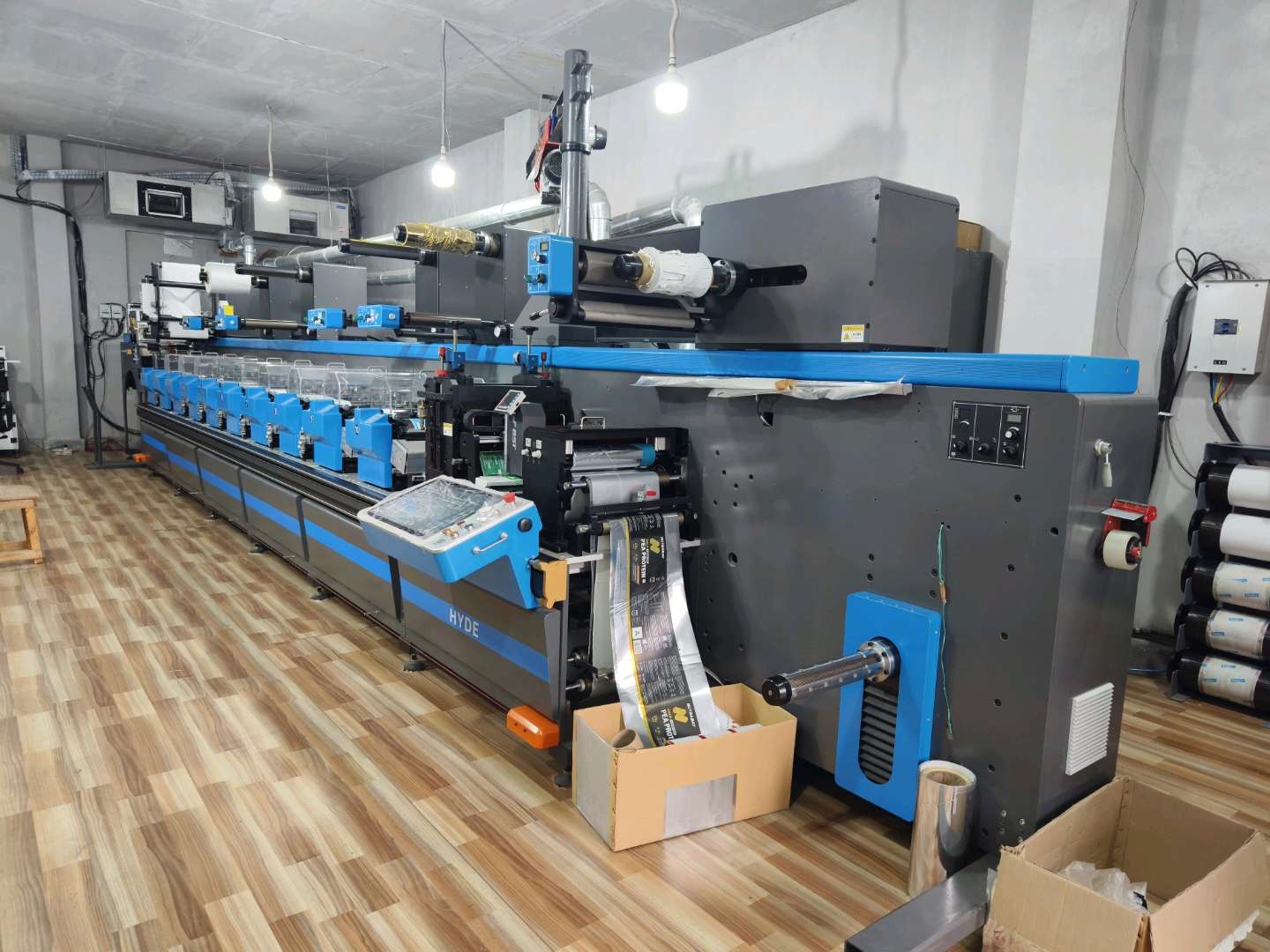
To solve this, in 2026, Zoom Prints installed a 10-color flexo press from Hyde, a Chinese manufacturer, with the machine supplied by GSP (Graphic Solution Providers).
Flexo was a completely new language for the team, which had been working with digital and offset in the past.
We cannot afford to turn these clients away or suggest they look elsewhere, because if they migrate to a competitor for their long-run needs, they will inevitably take their short-run business with them next time
‘We are not conventional printers. We don’t have the DNA for conventional print. Digital presses offer flexibility, and we are used to that flexibility. The same flexibility is not available with flexo or conventional print,’ Atul Bhatt notes.
Additionally, printing a label is only the first step.
Labels also require intricate finishing and embellishment, which means investment in necessary cutting tools and embellishment equipment.
The transition brought a stark operational culture shock.
With no prior background in flexo printing, Zoom Prints faced a steep learning curve. Its initial press purchase from Hyde included a comprehensive package of anilox rollers and cylinders tailored to the job requirements.
To a digital native, tooling and components in flexo were unfamiliar.
An economic advantage
Despite the learning curve, the Zoom Prints team views the mechanical friction of flexo as an economic advantage. Because the initial investment is substantial and the printing process is so intricate, Atul Bhatt notes that it creates a strong barrier that
prevents casual competitors from easily entering the label market.
Coming from a digital background, the team initially assumed the process would be like conventional offset printing. However, entering the label space revealed a much more complex workflow involving precise coordination of specialized cylinders, rollers and plates. The team also faced unexpected logistical hurdles and lead times for external tooling, such as semi-rotary dies, alongside the commercial challenge of negotiating these added setup costs with customers who expected them to be absorbed into large-volume orders.
For Zoom Prints, investing in a flexo press wasn’t a choice; it was a strategic decision to provide end-to-end service.
As Atul Bhatt summarizes: ‘Ultimately, once you enter the industry and invest in a digital label press, you must fulfill the customer’s end-to-end requirements. Otherwise, your only alternative is to exit the industry altogether.
‘The goal must be to provide an A-to-Z service so that once a customer comes to you, they have no reason to look elsewhere.
That is exactly how both Vikas and I view it now. Once we stepped into labels and set up the press, we began enjoying it because we could see viable margins, whereas the commercial retail market is no longer showing us those kinds of returns. So, it made sense to direct some investment here.’
With growth in a new segment and investments in place, adding professional factory floor manpower was the next logical step for Zoom Prints.
Realizing these industrial processes require dedicated expertise, the company has hired a production manager alongside dedicated sales and marketing personnel. To further drive this vertical, it is also actively recruiting experienced conventional printing professionals for leadership roles.
Epson India strengthens digital label footprint
Driven by the rise of emerging brands demanding short runs,
personalization and eco-friendly labels and packaging, the Indian label industry is seeing rapid digital printing adoption.
Capitalizing on this momentum, Epson India continues to reinforce its market footprint with key installations of its Epson SurePress L-6534VW UV digital label press for converters looking to diversify into digital labels.
Apart from Zoom Prints, another example of this transition is Ludhiana-based Dulari Printpack, which recently installed the Epson SurePress L-6534VW to mark its official entry into label manufacturing. Building on its established foundation in commercial digital printing and photo album production, this strategic investment enables Dulari to tap into high-growth, high-value label applications with faster turnarounds.
Beyond recent installations, Epson is set to demonstrate its full digital capabilities at Loupe India 2026. The manufacturer will showcase the SurePress L-6534VW for high-volume commercial and industrial label conversion, alongside its ColorWorks C6550A and ColorWorks C8050 on-demand desktop color label printers.
Together, these machines demonstrate Epson’s ability to address diverse labeling requirements, helping businesses improve flexibility, reduce waste and bring products to market faster in an increasingly dynamic environment.
The printed version of this article in Issue 3, 2026 of Labels & Labeling contained an error. Zoom Prints' Hyde flexo press was provided by GSP (Graphic Solution Provider). FIG does not represent Hyde machinery. This correction has been made across both the online article and e-magazine. Labels & Labeling regrets this error.
Stay up to date
Subscribe to the free Label News newsletter and receive the latest content every week. We'll never share your email address.