Grif celebrates 40th anniversary
The independent Brazilian label converter has built a reputation for high quality and exceptionally fast turnarounds.
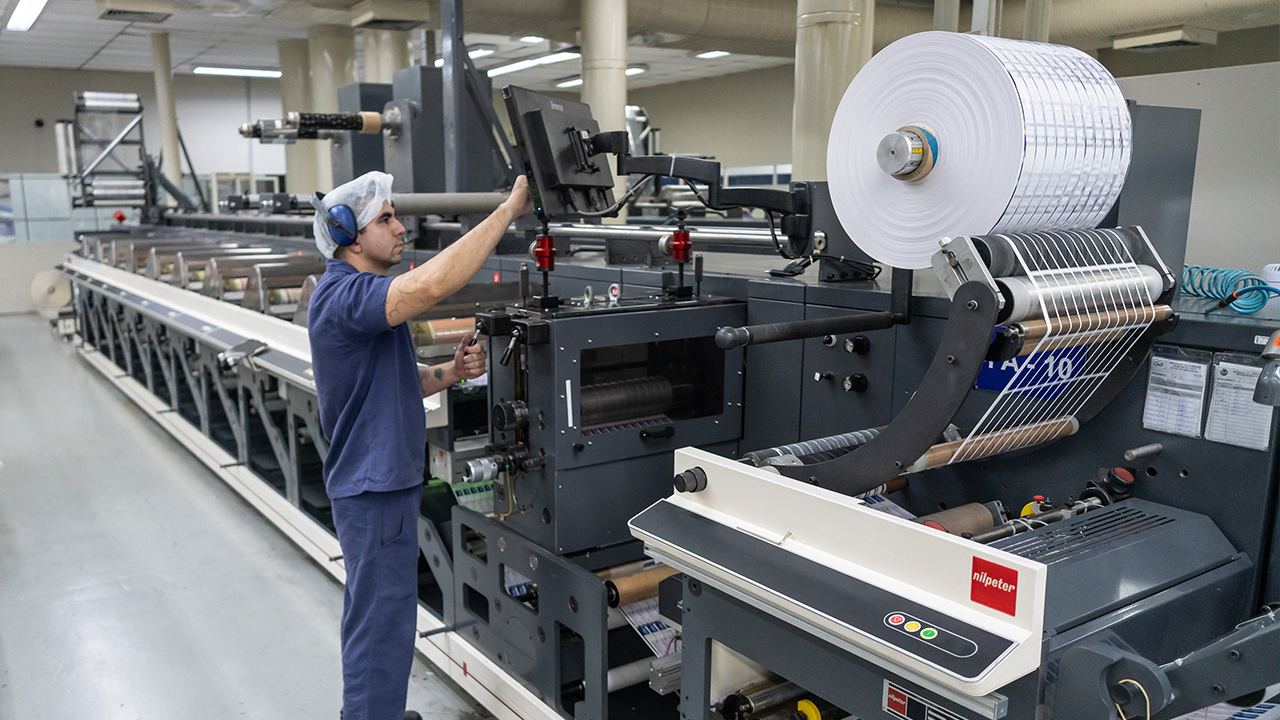
Grif Rótulos e Etiquetas Autoadesivas, which celebrates its 40th anniversary this year, has become one of Brazil’s leading independent label converters thanks to a strategy of continuous investment in new technology, a focus on high-quality printing and spare production capacity, which allows it to turn around orders with exceptional speed.
Such is the focus on the latter point, for which it is famous in the local market, that once the converter reaches 50 percent capacity, it immediately begins to evaluate further press investment.
“Our flexo presses can handle short runs very effectively thanks to their quick set-up times and features such as automatic registration”
The result is an impressive fleet of 22 printing presses, mostly high-quality combination flexo machines from Nilpeter and Mark Andy, including five installations in the last five years.
‘As soon as our production capacity reaches 50 percent, we will evaluate further investments,’ says owner and founder Francisco Paz. ‘Our strategy is based on a “just-in-time” philosophy, working as closely as possible with our customers to secure short, on-demand delivery. This requires free production capacity.’
Expansion
Grif was founded in 1986 by Francisco Paz, then aged just 24, and his three friends. The company began as a flat-bed screen label printer serving small local brands from a 120sqm facility in the São Paulo suburb of Vila Maria.
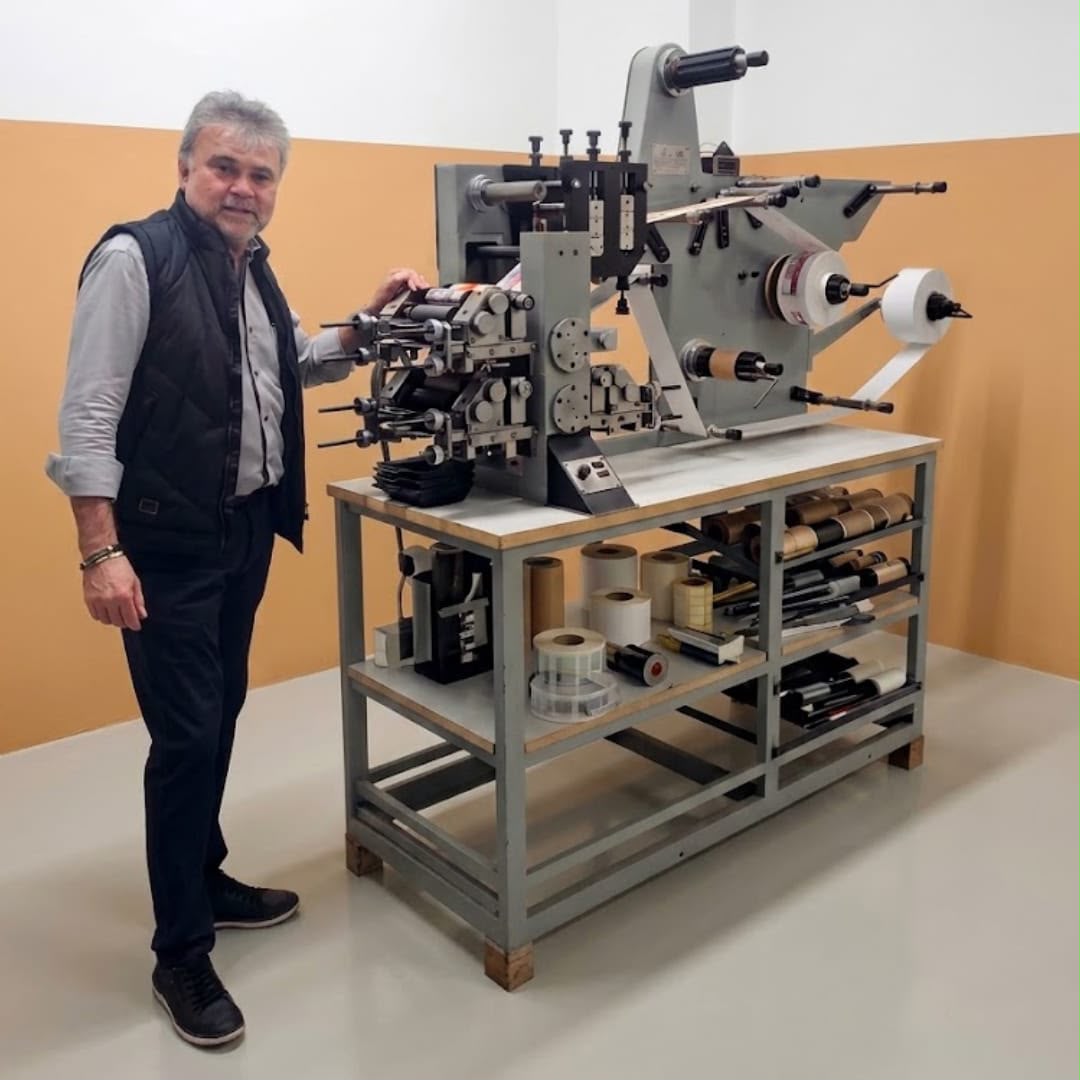
Two years later, by which time two of the founders had left (a third would depart after a further three years), the company added a three-color CI flexo press. This allowed the fledgling business, which still had only four employees, to expand its capacity and product range. This same machine is now on display in the company’s reception.
A further CI flexo press was installed soon afterward as Grif began to establish itself in the food, beverage, household cleaning product and chemical drum label markets.
Further investment took place in basic sheet-fed offset and letterpress machines, but it was the addition of combination flexo presses from Mark Andy and Comco in 2000 that helped to supercharge the company’s growth. Paz ordered both these machines (a year before Mark Andy acquired Comco) at that year’s Labelexpo Americas exhibition.
The investments allowed Grif to move into the pharmaceutical and cosmetics markets, its two largest end-user segments today, as well as focus on variable data labels for retail applications.
“We always aim to have spare capacity. It’s a deliberate strategy to focus on work which requires very short lead times. It’s something that differentiates us in the market”
Since then, investment in new presses and additional capacity has been a near-constant feature of Grif’s operation. Today, the company’s fleet features in-line converting options such as rotary screen, hot and cold stamping, lamination and die-cutting units, as well as flexo presses from Brazilian manufacturer Etirama. Grif can also count on a sheet-fed offset press and a small digital machine for producing mock-ups.
Five of these flexo machines have been installed in as many years: four Nilpeter presses, including two FA-17s, and, most recently, an SP Series from Etirama.
‘Having 10 colors with in-line process combinations such as cold foil, screen and different types of laminations allows us to present more creative products to the market,’ says Paz for the FA-17s.
Grif installed its first Nilpeter press, an MO-3300S, in 2008, and has since added multiple FB and FA models to its printing arsenal. ‘Nilpeter provides outstanding support that gives us the operational security we need, which translates into confidence in our ability to print high-quality labels at high speeds with the least operational cost possible,’ says Paz.
The company has also invested in 100 percent inspection systems as well as shrink sleeve capabilities, a fast-growing segment in the Brazilian market, in recent years.
‘The move into shrink sleeves was driven by customer demand,’ says Grif’s sales director Fernando Pirutti, who joined the company 10 years ago and has spent his entire 53-year career working at label converters. ‘Shrink sleeves have become very popular in recent years across many different markets, including cosmetics, which is our biggest sector. Lots of local brands are moving into shrink sleeves from self-adhesive labels.’
Grif has also significantly enhanced its pre-press department, which includes Esko workflow and machinery for in-house plate production and rotary screen engraving. This has helped speed up turnaround times, something for which the converter is well-known in the local market.
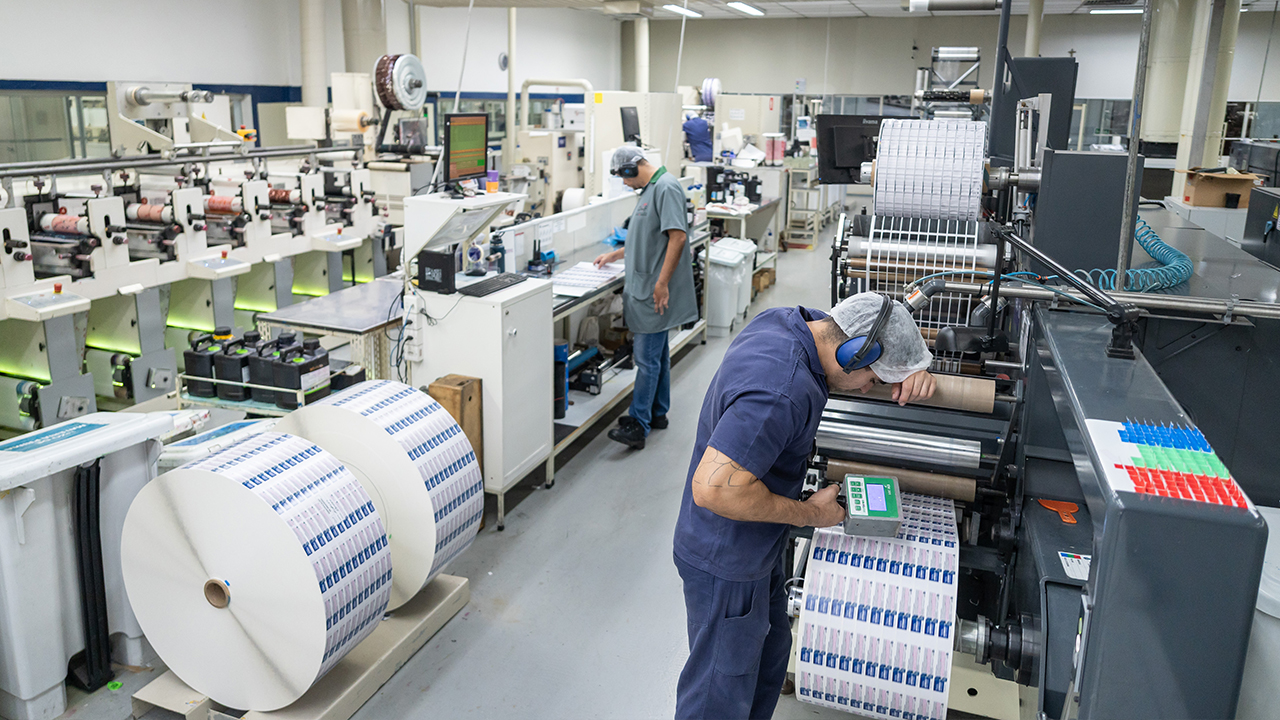
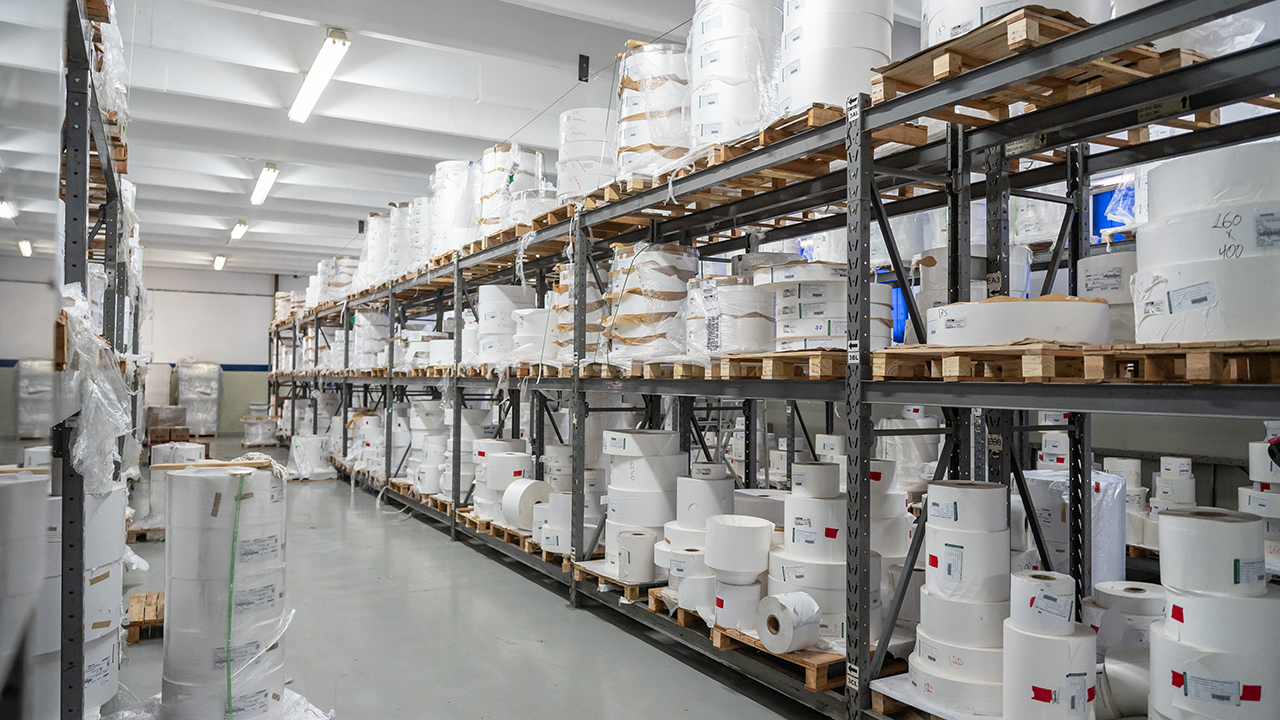
‘We always aim to have spare capacity,’ explains Pirutti. ‘It’s a deliberate strategy to focus on work which requires very short lead times. It’s something that differentiates us in the market. Investing in our pre-press department helps us to achieve that quick turnaround. We also keep three months’ worth of raw materials in our warehouse,
so we are always prepared.
‘Brazilian brands frequently change their plans at the last minute. We often receive calls from customers who need their labels within a very short delivery time, and we can do that. We are known in the market for our rapid turnaround.’
Self-adhesive labels make up around 95 percent of production, with the recent venture into shrink sleeves now accounting for the remainder; but that figure is growing. Grif’s largest end-use sector is cosmetics, a huge local industry in Brazil, followed by pharmaceutical labels. Both frequently require booklet label production, while the company’s pharmaceutical labeling expertise has led it to create separate, closed-off rooms equipped with a press for dust-free production. During the Covid-19 pandemic, Grif was a major printer of vaccine labels.
‘We have very good internal control and quality standards thanks to being certified to ISO and GMP, so the pharmaceutical market trusts us,’ says Pirutti.
Food and beverage labels are also a key sector. ‘We can produce long and short runs on our presses, any size of job,’ says Pirutti. ‘Our focus is on high quality, fast delivery and support to our clients.’
Philosophy
‘Grif’s philosophy is always to invest in the company,’ says Pirutti. He reveals that Grif is researching possible investment in a hybrid press, regarded as an effective way to replicate screen printing, while digital embellishment equipment is a further possibility.
‘Given the rising number of SKUs, to have some sort of digital capability would be an advantage,’ he says. ‘But our flexo presses can handle short runs very effectively thanks to their quick set-up times and features such as automatic registration.
‘We are less interested in the brand of the press as we are in the quality it can produce. We have highly experienced press operators who can print to very high standards.’
As well as conducting online research when deciding on new equipment, Grif visits trade shows such as Labelexpo (now Loupe) in Europe and the US, as well as Brazilian event Flexo & Labels, says Pirutti, to see the machines in action.
Investment continues outside of Grif’s technology capabilities, too. The company has upgraded to new facilities twice since its early days in a 120sqm site. The first move, to a 3,500sqm factory, came in 1996. It relocated to its current 11,000sqm site in Guarulhos, which houses its 110 employees, 10 years later.
But recently Grif has bought a 70,000sqm plot of land 20km from its factory, on which it plans to construct a new, larger facility, allowing even greater capacity, into which it can move in the coming years.
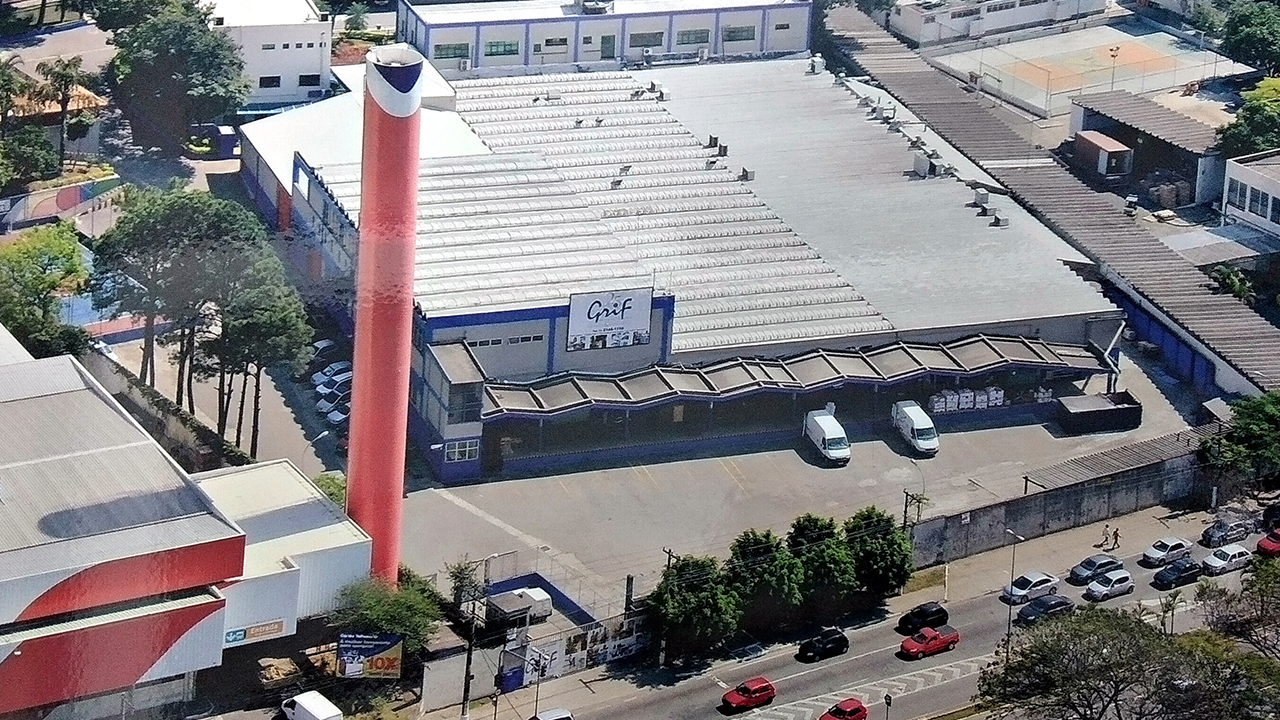
Grif remains an independent business. Pirutti, whose longevity in the local industry lends credibility to his opinion, believes Grif is the largest independent label converter in Brazil, behind only big multinationals in the scale of its production. He credits Paz for the company’s success. ‘The energy he has is amazing. He’s very hands-on, having run the sales and production departments at various times during the company’s history. I’ve been here for 10 years, but many of my colleagues have worked for Grif for much longer. It’s a great place to work.’
Pirutti is confident of continued growth in the Brazilian label market. With a local population of 213 million people, the country is large enough that Grif doesn’t focus on export, though a small percentage of production is sent to a Brazilian customer’s bases in Colombia and Italy. After four decades in business, and with a new, larger facility on the horizon, Grif’s rapid growth looks set to continue.
Stay up to date
Subscribe to the free Label News newsletter and receive the latest content every week. We'll never share your email address.