Printing trends
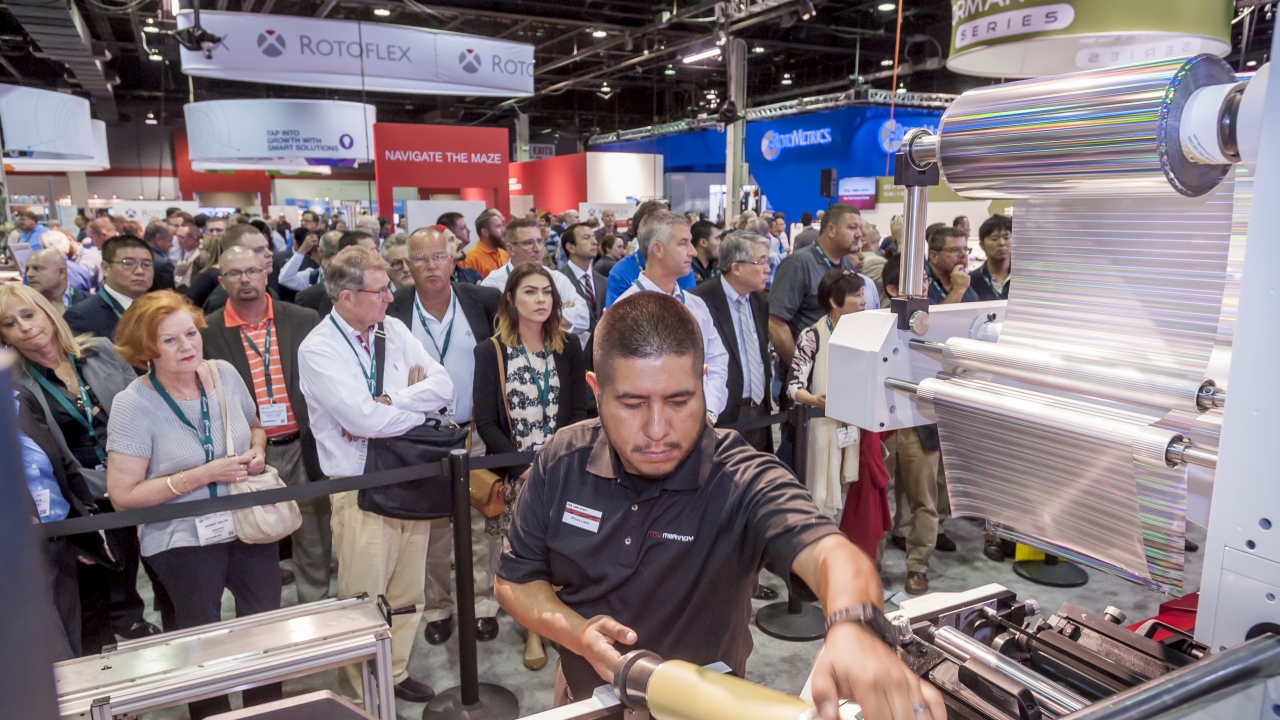
One clear trend evident at Labelexpo Americas 2016 was the blurring of lines on short-to-medium run lengths between faster digital presses and a new generation more efficient flexo and offset conventional presses.
HP Indigo, for example, is looking to directly challenge flexo printing even on medium to longer runs with its 8000 printing platform. The press runs at up to 80m/min (256ft/min), with the option to include in-line semi-rotary die-cutting with AB Graphic’s new Fast Track. To maintain quality assurance at these speeds, AVT has integrated a new in-line closed loop inspection system, the Helios S Turbo. At the same time, conventional press manufactures showed an array of presses dedicated to efficient short run work.
Omet's ‘entry level’ iFlex press has a range of features which help it compete on short and medium run work. ‘iLight’ laser beams on the print and die stations allow print and print to die-cut register to be achieved before press start and ‘iVision’ cameras keep the press in register. The shaft-driven press was demonstrated running extended gamut inks. This requires highly accurate register control, made possible by the direct drive from shaft to print and converting units.
Faster changeover on in-line converting units is a major factor in increasing conventional press efficiency. MPS showed in Chicago for the first time its EF 430 Neo press with a new side load die-cutting unit called Chameleon RobustCut, developed jointly with EMT. This allows fast die exchange from a pre-loaded cart in under one minute without the need for a hoist. The two companies claim the unit has equal stability to vertical die stations at speeds up to 650ft/min on web widths from 13 to 20 inch.
It was significant at Labelexpo Americas that more press manufacturers were running extended gamut ink sets, meaning spot colors are simulated out of 4-7 process colors and there is no need to make special spot color plates or to wash the press down between job changes. MPS, for example, ran a series of demonstrations with Kodak producing an 8-color job out of CMYK.
In the high-end automated category was Nilpeter’s FA-4*, shown with FP-4 unit for hot foil and embossing and again printing Expanded Gamut jobs.
Codimag demonstrated its Viva340 Evolution press printing with extended gamut inks (six colors out of CMYK+OGV) and using Presstek Zahara water-processed plates, claimed competitive down to run lengths of just 1,000ft (300m), particularly if off-line finishing is adopted.
Digital embellishment
Digital printing is at a major crossroads as we enter 2017, with a vast range of possible applications and options. Not only are we seeing a range of configurations offered – stand-alone with off-line finishing, hybrid conventional/digital or in-line digital – but we also see inkjet integrated as a finishing and even a first down white option.
Codimag, for example, demonstrated its waterless offset Viva340 Evolution press with a Xaar inkjet bar printing opaque white on the first station, replacing a semi-rotary screen unit.
Post-print inkjet coating, both in-line and off-line, allows fully variable spot gloss and matte varnishing and other decoration effects including digital cold foiling, and this was demonstrated by Konica Minolta on the MGI JetVarnish 3DW, an off-line unit which allows spot UV varnish, 2D/3D embellishments and foil stamping to be added digitally to preprinted rolls of labels.
Domino’s Textures system integrates inkjet varnishing into the N610i digital press, and Epson’s new SurePress 6034VW press also has integrated (UV LED) varnishing included in the base configuration. Not only can these varnish units apply variable spot matte or gloss coats, they can also take down the shininess and tactility inherent in the UV cured ink process.
HP Indigo and JetFX have jointly developed Digital Combination Printing technology which enables single pass production of digital spot and tactile varnishes and digital foils in-line with an HP Indigo WS6800 press.
Xeikon also plans to make use of inkjet in its Fusion ‘digital combination’ concept. Fusion is a modular series of digital units which will include a high opacity white, digital foiling and spot varnish, positionable either before or after the 4-5 color Xeikon printing unit. Fusion modules will be retrofittable to Xeikon’s existing presses at different speeds and web widths. A label converter in Belgium is the beta site, where a CX-3 has been combined with White and foiling modules for the health and beauty market.
Digital printing
Labelexpo Americas 2016 revealed the continuing march of inkjet print technology.
Epson added to its hugely successful water-based inkjet press its first single-pass industrial print system, the SurePress L-6034VW. The press is unique in using Epson’s own low migration UV LED curing inks and is the first to use the company’s PrecisionCore linehead technology.
Mark Andy, meanwhile, chose to complement its hybrid flexo/inkjet press with an entry level digital system, the Digital One EP dry toner press. The press images at 1,200 DPI at 62ft/min and includes a flexo coating unit. Durst has also sought to address the entry level market with its Tau 330 E, which aims to retain the quality of its larger siblings while offering a limit of 4-5 colors and using a high pigmented UV ink set for reduced ink consumption. The press is available in a 330mm width with the same print resolution as the other Tau presses and a top speed of 157ft/min.
Hybrid digital/flexo presses are an important recent development for the big conventional press manufacturers: Nilpeter’s Panorama, which matches a Screen-based print engine with a range of conventional FA-4 series print and finishing options; the Mark Andy Digital Series; Gallus DCS340; Omet JetPlus; MPS SymJet; Edale/FFEI Graphium.
Another key digital trend is the growing crossover between commercial print and packaging markets. This is exemplified by companies like FujiFilm, is involved in wide format, ink and colorants, color management, screen inks and coatings and digital inkjet heads across the whole field of tag and label, flexible, folding carton and corrugated, as well as direct mail.
Similarly with Konica Minolta, which is leveraging its inkjet and electrophotographic technologies in the commercial and wide format markets to speed up digitization of the label and packaging sector. The company’s Biz hub C71cf mid-market press – running at speeds up to 60ft/min at 1,200 DPI – is based on the established electrophotographic C1070 series engine from the commercial market. A new partnership with Spartanics offers a laser die-cut option and Aztech Converting is a partner for full rotary die-cutting. Konica Minolta is also looking at whether its Accurio Jet KM-1 B2 digital carton press might have applications in the sheet-fed label market.
In- or off-line?
A major debate in the digital world is what configuration is most efficient – in-line or off-line finishing? Durst now has a program to integrate Omet XFlex X6 modules with its Tau 330 inkjet press, with the most common configuration a priming unit and flexo printhead/die-cutting options on the finishing end.
And while digital press manufacturers and slitting operations, and operated from the same HMI. The system runs at 18m/ min (48ft/min) at 1,600 x 1,600 DPI. The digital print module can be installed on existing Werosys lines in the field, or combined with any of the Werosys Compact modules.
Similarly, Daco and Inkjet Solutions – which recently formed a partnership – have developed a rewinder with integrated CMYK Kyocera-based digital inkjet system, which can print and convert at speeds of up to 250ft/min. The two companies are now represented in the US by Sanden Machine.
Another route to digital is to incorporate a 4-color print unit on a conventional flexo press. Colordyne now offers the 3600 Series Retrofit modular inkjet unit, and recently announced a deal with Mark Andy whereby the latter will distribute Colordyne’s 3600 Series Retrofit modular inkjet unit to existing Mark Andy presses.
Package printing
We have been noting for some years opportunities opening up for label converters in flexible packaging, and even cartons on narrow or mid-web presses, both conventional and digital.
Nilpeter’s Labelexpo Americas stand had a hefty focus on package printing with the new 22in-wide FA-6*, shown converting flexible packaging at speeds up to 175m/min (574ft/min). FA-6* configurations can include one or more multi-purpose MP-6 converting units. Designed as ‘quick-change’ platforms, they have automatic unwind and rewind capabilities. These units offer multiple high intensity air drying and UV curing of process work, inks, adhesives and coatings.
In-line functions include high-speed solvent and water-based flexo printing with a reverse-side printing capability (using FA-6* repeat lengths). A UV-cured lamination capability includes glossy effects, surface protection, barrier solutions and cold foiling.
Solvent- or water-based dry lamination capability is available for special laminates, barriers, pouches and sachets. GEW’s fully air-cooled curing UV LED system, LA1 was featured on the FA-6*. Mark Andy showed a P7 press fitted with the ProLED UV curing system converting flexible packaging jobs using low migration UV LED inks with in-line solventless lamination technology.
Bobst demonstrated its M6 UV flexo press with a system to constantly monitor UV ink curing on the press. Named UV Track, this system uses two sensors to test and track the ink curing safety directly on the substrate during rather than after printing, with ink safety on each printed meter certified. An ink safety certificate for the whole roll is available immediately.
Reinforcing this trend, GEW presented its multi-point in-line UV monitor, consisting of calibrated sensors positioned along the length of the lamp to continuously measure the intensity in a UV curing system. Multipoint continuously reads and records the actual intensity across the full width of the lamp, calculating the UV energy dose on the substrate with ‘great precision’. A dose monitor is set to alert the operator before the wrong dose could have an impact on production. Low UV output, which would not adequately cure, is thus avoided, as is insufficient output from a degraded lamp HP Indigo is having increasing success with its 20000 digital press running flexible packaging substrates, demonstrating the Karlville Pack Ready laminator to deliver printed flexible packaging with zero cure time.
At the same time, Xeikon is pushing into the digital carton space with the launch of its FDU flatbed in-line die-cutter.
Stay up to date
Subscribe to the free Label News newsletter and receive the latest content every week. We'll never share your email address.