Label converters eye carton opportunity
As in-line technologies blur the line between labels and folding cartons, the entry barriers are lower than many converters expect.

Global consumption of cartonboard reached 56.3 million tons in 2025, valued at 58.9b USD, according to new research from Smithers. This will be converted into 52.4 million tons of packaging, valued at 132.8b USD. The demand will push global consumption of folding cartons to 63.1 million tons in 2030, with value increasing to 159.6b USD at constant pricing.
Behind the numbers is a structural shift: plastic packaging formats are losing ground to paper-based alternatives, pushed by regulatory pressure in Europe and mounting brand owner commitments to recyclable materials. For label converters already running flexographic presses, that shift carries a specific implication. The market they have been serving is expanding into adjacent territory, and the equipment to enter it may already be on their production floor.
“It is not about starting again; it is about using what they already know”
Single-pass flexographic presses capable of handling board substrates up to 700 microns, with in-line die-cutting, foiling, lamination and embossing in a continuous process, are the same presses that have defined premium label production for decades. Some converters are already making that connection. The question is not whether it can be done, but whether the economics work and, if so, for which jobs.
The answer from four press manufacturers is consistent: yes, in the right run length range, with the right substrate knowledge and workflow thinking, it works. And for many converters, the gap between where they are and where they need to be is narrower than they expect.
The sheet-fed gap
Traditional folding carton production is built on sheet-fed offset lithography: a mature, cost-effective technology for high-volume standardized runs, but one that carries structural costs when run lengths shorten or job complexity rises. Plate production, multi-stage finishing, high work-in-progress inventory and long makeready times create friction precisely where the market is moving fastest: toward shorter runs, more SKU variation, faster turnaround and greater design flexibility.
Sheet-fed offset handles long, stable runs efficiently. In the short-run, high-variability carton work, the economics are harder to defend. That is the gap in-line flexo is filling. Consolidating printing, embellishment and finishing into a single continuous pass eliminates the touchpoints that make short-run carton work a loss leader on a sheet-fed line. The resulting production model closely maps onto the work label converters already understand: variable, embellished, time-sensitive, margin-sensitive.
The entry point
For label converters considering the crossover, single-pass flexo is the most practical starting point. Mid-web flexo platforms from several manufacturers can all be configured to handle cartonboard substrates with in-line die-cutting, creasing, foiling, lamination and screen printing and even quality control in a continuous process. The press widths, substrate tolerances and finishing options across this group cover most of the run length and format range where in-line carton work is commercially viable.
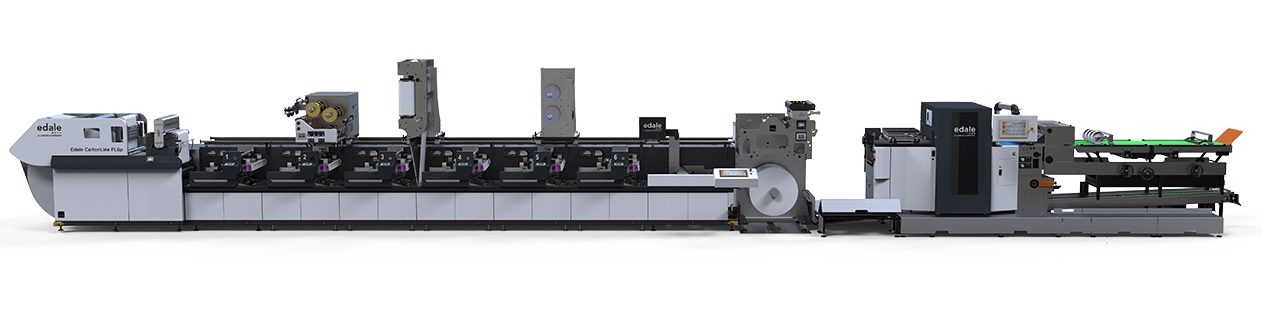
Edale, a Canon company, has positioned its CartonLine platform most explicitly at the label converter audience. At Labelexpo Europe 2025, it demonstrated an FL6p configured with six LED-UV flexo units, a rail-mounted turnbar, lamination, an EZ Foil unit and an in-line flatbed die-cutter, running at up to 180m/min on substrates up to 700 microns at web widths up to 600mm.
‘The label market is very competitive. Carton work can be more profitable, and many label converters are already outsourcing that work,’ says Lachlan Buirds, managing director of Edale. ‘They know flexo and what good production looks like. For these businesses, the question is how quickly they can turn a familiar production process into a new source of performance and margin.’
A common misconception, Buirds notes, is that entering folding cartons means becoming a traditional sheet-fed carton producer. That framing makes the opportunity look larger, more expensive and more complicated than it needs to be. ‘In reality, a lot of label converters already have many of the skills they need. They understand flexo, color, embellishment, workflow and brand expectations. It is not about starting again; it is about using what they already know.’
“The efficiency gains from running embellishment in-line rather than as a separate off-line stage are significant”
The economic case is evident most clearly in run-length analysis. Edale’s Carton Cost Calculator indicates that in-line flexo holds a production cost advantage over sheet-fed litho at run lengths up to around 75,000 cartons, though the figure varies by job. ‘It could be 10,000 on one job. It could be 83,000 on another,’ Buirds explains. ‘The issue for sheet-fed producers is that some of these shorter or more variable jobs have become loss leaders. With in-line flexo, there is an option to make money on those jobs instead.’
New York Label & Box Works, a family-owned converter with operations in New York and New Jersey, became the first company in the US to install an Edale FL5 press in 2021. It now runs both pressure-sensitive labels and folding cartons under one roof. The ability to match color between label and carton jobs has become a distinct selling point: brand customers can consolidate both formats with a single supplier and get consistent output across packaging types.
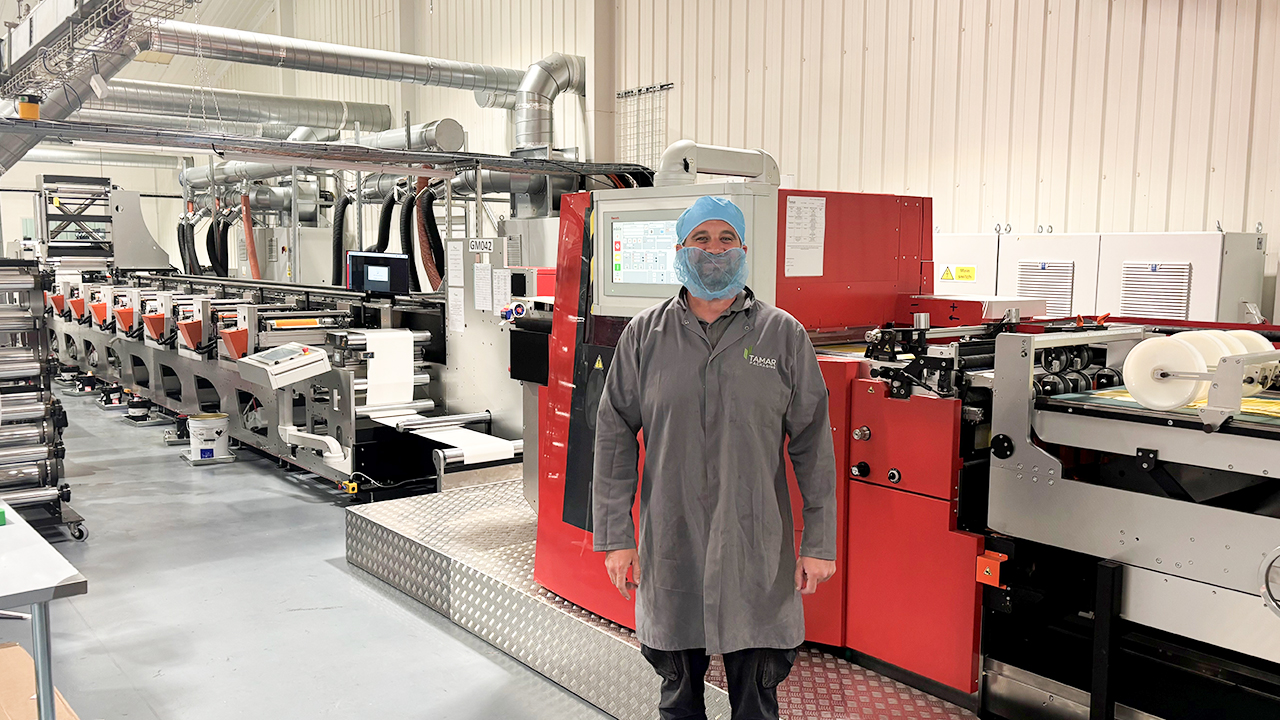
Tamar Packaging Solutions, based in the Tamar Valley in Southwest England, took a different path. Starting from a label background, the company moved entirely into in-line flexo carton production on Edale FL5 presses, carving out a niche in direct-food-contact cartonboard for the bakery market. Its competitive edge is not press speed but coating expertise: the ability to apply grease- and moisture-resistant barriers in-line, eliminating the plastic barrier layers traditionally used in food packaging. With 12 production staff and AA-grade BRC accreditation, it is a tight, efficient operation built on the workflow discipline that label converting instills.
Traffic moves both ways
Omet’s view of the market adds an unexpected dimension to the crossover story. Andrea Angeli, export sales manager at Omet, notes that the movement is not running exclusively from labels to cartons. Established carton producers are adding label capability to their platforms as the boundary between the two segments blurs in both directions.
Omet was among the first narrow web press manufacturers to enter the folding carton market, and the Varyflex platform was designed from the outset for multi‑application production. It handles printing, embellishment, die-cutting and finishing in a single pass across both label and carton substrates, giving operators the latitude to allocate work by run length, complexity and lead time rather than channeling every job through the same production route.
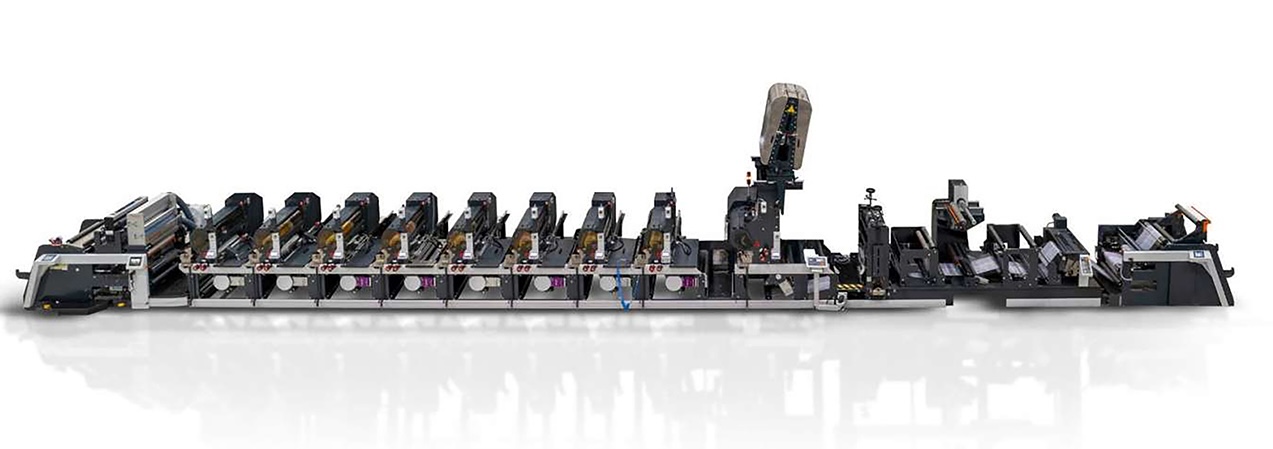
‘In-line embellishment, foiling, cast and cure, screen, transfers very straightforwardly from label to carton production on Omet platforms,’ adds Angeli. ‘The efficiency gains from running embellishment in-line rather than as a separate off-line stage are significant, and they apply equally whether you are producing a label or a folding carton.’
On substrate handling, Angeli is direct about the knowledge gap converters face when moving from PS stock to cartonboard. Tension management is the main adjustment: the board behaves differently from self-adhesive film or paper under press conditions, and the setup needs to reflect that. Omet has developed dedicated systems on the Varyflex to address board-specific tension requirements, which reduces the learning curve for converters who are new to the substrate.
Web width is a question Angeli hears consistently. A range of 21in/530mm to 26in/670mm is the sweet spot for integrated in-line production, wide enough for efficient board utilization on carton work and narrow enough to fit within a label converter’s existing plant footprint. Demand for presses in that range is growing, in part from converters who want a single platform for both applications without separate equipment lines.
The 26in argument
Mark Andy’s Performance Series S9 approaches the carton opportunity from a specific point in the width spectrum. At 26in/660mm, the press aligns with the B2 format, which is standard in sheet-fed offset, meaning label converters adding carton work can transfer many existing designs and artwork setups without changing their pre-press preparation.
‘The Performance Series S9 was designed to be both a complement and, in many applications, an alternative to B2 sheet‑fed machines,’ notes Lena Chmielewska‑Bontron, marketing manager Europe at Mark Andy. ‘It combines high production efficiency with the flexibility of web-fed technology, allowing converters to handle short and medium runs economically and respond faster to brand owner needs.’
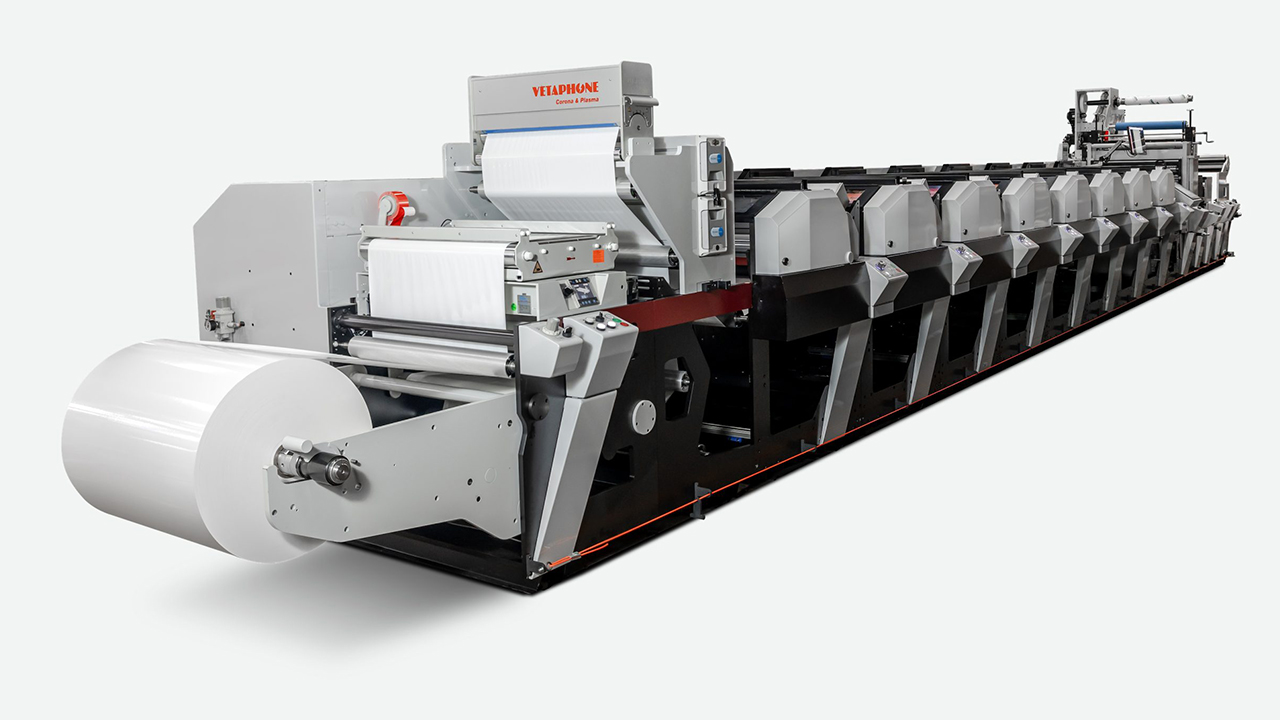
The customer profile that Mark Andy sees in Europe differs slightly from that observed by Edale and Omet. In Europe, customers using Performance Series presses are mostly flexible packaging converters seeking an economical route for shorter runs. Label converters are evaluating the move, but sheet-fed offset remains dominant in European and North American folding carton production.
Where Mark Andy sees the strongest crossover interest from label converters into carton production is in cosmetics and dietary supplements, segments defined by frequent versioning, seasonal launches and premium presentation requirements. The dynamic Chmielewska-Bontron describes is not a classic technology switch: brand owners want a single supplier capable of delivering both labels and cartons, and that commercial pressure, more than any technology argument, is driving label converters to evaluate their carton capabilities.
‘This resembles the transformation we saw earlier in the label market, when label converters gradually took over more complex applications from traditional offset printers,’ she notes. ‘A similar process is now beginning to emerge in folding carton.’
The hybrid digital-flexo dimension is where Mark Andy’s offering most clearly diverges from the pure flexo platforms on the market. The Digital Series HD HighSpeed 1200 hybrid addresses the demand for short runs, personalization, versioning and variable data in carton work by combining digital and flexo print capability in a single pass. The practical effect is substantial. Converters can handle many versions of the same carton job without new plate preparation, respond to regulatory changes in artwork without reprinting entire stocks and produce market tests or seasonal variants at quantities
that would be economically unviable on a conventional plate-based line.
One platform, three markets
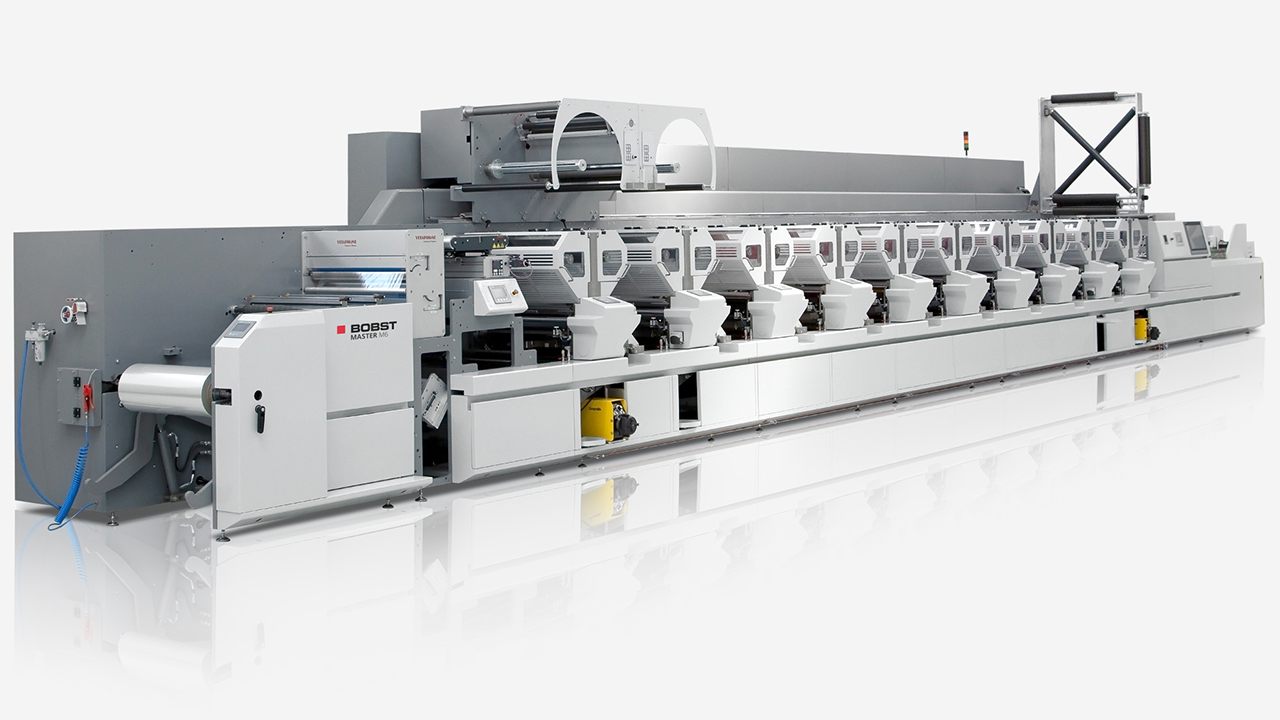
Bobst’s Master M6 was designed explicitly to handle labels, flexible packaging and folding cartons from the same machine, with DigiFlexo automation and oneECG extended color gamut technology supporting repeatable, highly automated production across all three substrates.
The M6 runs at web widths up to 26in/670mm and offers reel-to-reel, reel-to-sheet and reel-to-converting output configurations. Optional Excellence kit and V-Flower technology support fast cylinder exchange and fully automatic flexo job changeovers in under one minute, a makeready speed that changes the economics of short-run carton work considerably when set against the changeover times on a conventional sheet-fed line.
“This resembles the transformation we saw earlier in the label market, when label converters gradually took over more complex applications from traditional offset printers”
‘A growing share of interest in the M6 is coming from converters looking to diversify beyond labels and into adjacent packaging formats, including folding cartons,’ says Ludovico Frati, sales and marketing director at Bobst. ‘Rising SKU complexity, shorter product lifecycles and increasing sustainability expectations are prompting converters to look for platforms that can support more than one packaging type while preserving the efficiency of narrow-web production models.’
The market segments where Bobst is seeing the strongest demand from label converters adding carton are pharmaceuticals, cosmetics, personal care and premium food. Pharma is particularly compelling because of its compliance demands: frequent versioning, serialization, tamper evidence and variable data all favor a production model that is accurate, repeatable and flexible, a description that fits the operational profile of a well-run label converter precisely. Cosmetics and personal care follow similar logic, with in-line embellishment capability and fast turnaround for seasonal launches, adding weight to the case. Premium food shares the visual differentiation driver, with the additional pull of fiber-based, recyclable packaging formats that brand owners are under growing pressure to adopt.
The Bobst Digital Master DM55, an all-in-one system that combines digital and flexo printing and coating, embellishment, quality control and die-cutting into a single device, further extends the ecosystem for converters who want a scalable route from print to finished packaging.
Other press manufacturers showing or developing in-line folding carton production systems include Nilpeter, Lombardi, Spande and Hontec.
Bridging the knowledge gap
Press technology is the easiest part of the transition. The harder work is operational and commercial and it falls into three distinct areas: substrate knowledge, finishing discipline and workflow costing.
On the substrate, Bobst’s Frati explains that cartonboard, typically running at 200 to 350gsm, is stiffer, heavier and less forgiving than pressure-sensitive materials or unsupported films. It does not stretch or conform under press tension the way labelstock does, but it shrinks and swells with temperature and humidity variation. ‘Operators need tighter, more precise tension zones to move the board cleanly through the in-line flexo units without slipping or drifting and require less stressing, drying and curing processes to avoid issues with shrinkage, swelling and curling. Deep process knowledge is key to mastering carton production at industrial scale,’ he explains. Ink and coating performance also requires a different approach: cartonboard is porous, so ink holdout differs substantially from filmic or laminated label materials, and anilox volume and primer selection need to be matched to the board grade rather than carried over from label-side settings.
Coating coverage on the reverse side of the board requires particular care. Varnish or coating over glue tabs will prevent the carton from bonding properly during final box assembly. Spot coating, uncoated glue tabs or specific surface treatments are needed to preserve the capability of forming a strong, durable adhesive join. This consideration simply does not arise in label production, and catches converters out if not addressed at the job specification stage.
Die-cutting and creasing represent the sharpest departure from label converting practice, and the tooling choices label converters face are more complex than anything they will have encountered on the label side. There are three principal technologies to understand: flatbed die-cutting, rotary solid dies and rotary flexible dies. Flatbed die-cutting, the mainstay of sheet-fed carton production, offers superior cut quality and versatility across substrates, and tooling is robust and relatively straightforward to replace. Rotary flexible dies are better suited to the short-run, agile production model that label converters already operate, with minimal set-up time and low tooling cost. They are less robust than flatbed equivalents and not always suitable for heavier gauge cartonboard.
For converters entering carton production on a web-fed in-line platform, rotary cutting and creasing dies enable single-pass production at speed, while in-line flatbed die-cut and crease modules (as demonstrated by Edale on its CartonLine at Labelexpo Europe 2025) offer a practical alternative for short to medium run lengths where cut quality and registration precision are the priority.
The creasing requirement is where label converters most frequently underestimate the knowledge gap. Cartonboard must be creased accurately before it can fold cleanly: the crease compresses the board fibers along a controlled line to create a hinge, and if the male rule and female matrix are not precisely aligned to the board grade and caliper, the surface coating or print will crack at the fold. That is a tolerance and setup discipline with no direct equivalent in pressure-sensitive label production.
“Rising SKU complexity, shorter product lifecycles and increasing sustainability expectations are prompting converters to look for platforms that can support more than one packaging type”
The good news for converters entering the market from a flexo background is that the tooling supply chain is already familiar. Kocher + Beck, Wink, Maxcess/Rotometrics, Sysco and Lartec all supply die-cutting and creasing tooling to both the label and carton markets, and their flexible die ranges cover cutting, perforating and creasing across roll-fed and sheet-fed applications. Technifold, which exhibited at Labelexpo Europe 2025, offers a retrofittable Technicrease cassette designed to replace custom male and female creasing dies, reducing tooling cost and changeover time on existing press configurations.
For converters who want to prototype carton blanks before committing to full tooling investment, laser cutting offers a lower-barrier entry point. Lang Laser’s Cartos Singular, developed specifically for the folding carton market, allows converters to produce carton samples and scale up to production runs, with simpler operator training than conventional die systems.
‘Press is often the easiest part of the move,’ says Edale’s Buirds. ‘The bigger shift is understanding that you are not just printing a carton; you are producing a three-dimensional pack that must work in the customer’s environment.’
The structural design knowledge gap sits upstream of the press entirely, and it is the one area where label converter experience provides almost no foundation. Carton blanks must be engineered before they can be cut and creased. Blank dimensions, panel layout, glue tab positioning and crease line placement all affect how the finished pack performs in the customer’s filling line and on shelf. Esko and Hybrid Software both offer full folding carton workflow capability including structural design and 3D visualization, tools that are standard in dedicated carton operations but largely absent from label converter pre-press environments.
The workflow and costing gap is the third area. Buirds illustrates it by reference to a customer visit in China, where a sheet-fed process was running six separate operations involving 12 people. With single-pass flexo, much of that is consolidated into a single controlled flow. ‘The comparison is not only print quality,’ he notes. ‘It is labor, energy, floor space, work in progress and handling between stages.’ Structural design, board utilization and finishing efficiency all affect whether a carton job is commercially worthwhile, and converters who cost those jobs the way they cost label jobs will find it difficult to read the margins accurately until they have recalibrated their thinking.
Substrate sourcing on the roll adds a direct cost saving. Board purchased on the roll costs five to 10 percent less than the sheet equivalent, according to Edale’s analysis. Combined with the elimination of plate costs for digital-flexo hybrid configurations and reduced setup waste compared with sheet-fed litho, the total cost picture shifts meaningfully in favor of the right jobs.
Tamar Packaging’s experience is instructive on where the right jobs are. The company found early that it could not compete against litho producers on large blank sizes, with too few blanks per repeat to make the economics work. The competitive ground shifted when format size, coating requirements and in-line embellishment aligned. Finding that ground and being honest about where it does not exist, is the practical intelligence that separates converters who make money from the move from those who do not.
Loupe confirms the shift
The industry confirmed the direction of travel at Labelexpo (now Loupe) Europe 2025, where folding carton featured as a dedicated segment for the first time. Over 25 percent of exhibitors carried portfolios spanning labels, flexible packaging and folding cartons. Mid-web presses configurable for in-line carton production were shown by Mark Andy, Lombardi and Spande alongside Edale’s dedicated CartonLine. Omet’s long history in folding carton on the Varyflex platform was well represented. Mark Andy also announced that its MAPP division, which supplies consumables and plate-making equipment to packaging converters, would expand its range to include folding carton consumables. This detail signals how seriously the industry is now treating this crossover at the supply chain level. A Label Academy masterclass addressed converter diversification into carton packaging directly. The show reflected decisions that converters in multiple regions are already making.
The regulatory context gives those decisions added urgency.
The PPWR and parallel national frameworks are raising recyclability thresholds across packaging categories and putting brand owners under pressure to iterate faster on both structures and artwork. Digital and hybrid press platforms that can produce carton versions of existing label jobs without lengthy cylinder preparation cycles are well-suited to that environment.
The ability to change artwork quickly, produce short compliance runs economically and test new formats without large minimum orders is not a niche requirement. It is becoming a baseline expectation.
Label converters who have made the move share a consistent observation: the barrier was not the technology. It was the decision to look carefully at the equipment already running in the plant and to recognize that the distance between a label press and a carton press on the right platform is shorter than the industry’s historical segmentation suggests.
The converters doing this well are not treating carton as a separate business. They are treating it as a production extension of what they already do, serving customers who want fewer suppliers and greater capability from each. The market is moving that way. The technology is ready. The question left for most converters is timing.
Stay up to date
Subscribe to the free Label News newsletter and receive the latest content every week. We'll never share your email address.