Ashe Converting Equipment marks 50 years of innovation
Family-owned converting specialist celebrates half a century of engineering.
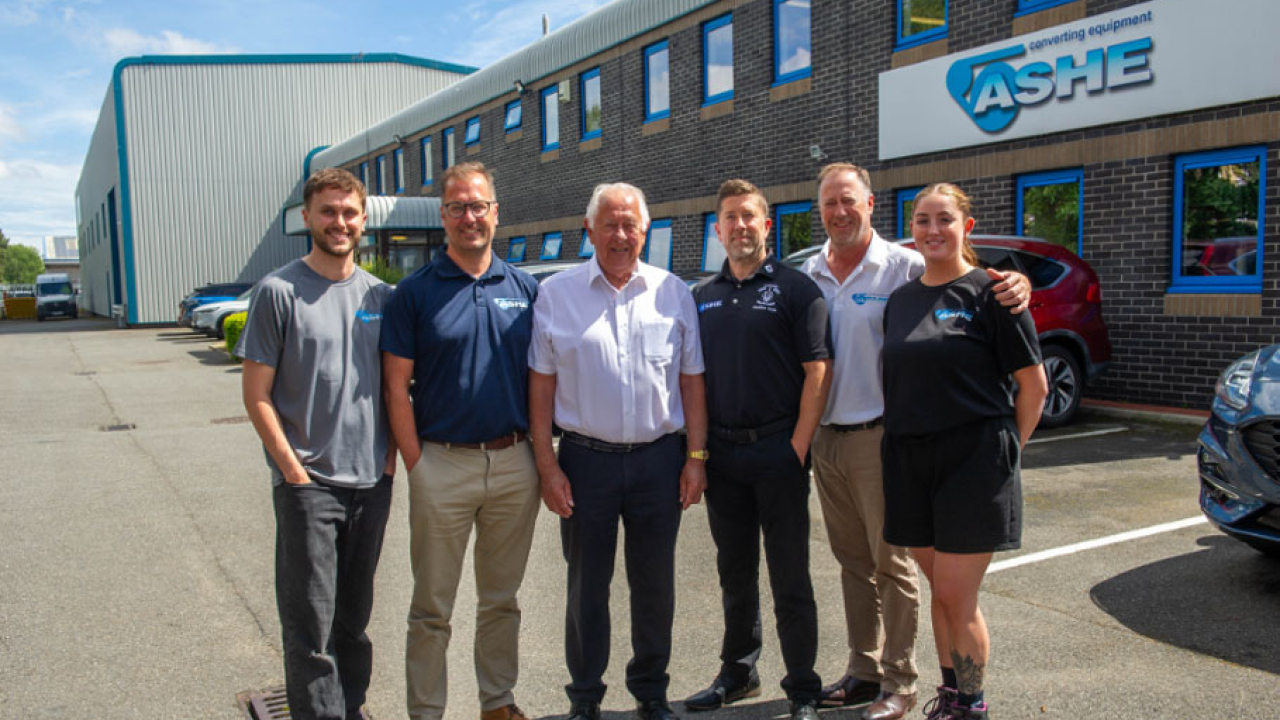
Credit: EADT / Newsquest
UK-based Ashe Converting Equipment is celebrating its 50th anniversary this year, marking five decades of innovation in slitting, rewinding and web handling technology.
Founded in 1976 by John Godbold, the Ipswich-headquartered company has grown from a manufacturer of drive control systems into a globally recognized supplier of slitting and rewinding machinery for narrow-, mid-, and wide-web applications. Today, Ashe has more than 1,250 machine installations worldwide, a subsidiary operation in the US and an extensive international distributor network.
The company's equipment is used across a diverse range of industries, processing labels, flexible packaging, paper, aluminum and specialist materials for food, pharmaceutical, cosmetics, security and industrial applications.
Despite reaching its 50th year, Ashe remains firmly family-owned and family-managed.
Founder John Godbold, now 77, continues to serve as managing director and remains actively involved in the day-to-day running of the business. His three sons occupy key leadership roles: James Godbold oversees production as works director, Matthew Godbold leads sales for wide web machinery, and Simon Godbold heads sales for narrow and mid-web equipment.
The third generation has also begun to join the business. Jordan Godbold and Ella Godbold currently work as test engineers, while Oliver Godbold is expected to join the company after completing his university studies.
The wider workforce reflects Ashe's longstanding commitment to engineering skills development. Around half of the company's 75 employees have progressed through its apprenticeship program, helping to sustain the specialist expertise required to design and manufacture advanced converting equipment.
The origins of Ashe can be traced back to John Godbold's involvement with TS Ashe and Company, a manufacturer of variable-speed drives. After acquiring Ashe Controls, a development company serving TS Ashe, Godbold expanded the business into manufacturing.
One of Ashe's earliest successes came through its work with Titan, producing control panels and commissioning slitter rewinders during a formative period for the converting sector.
The company built its first fully reversible rewinder in 1982, supplying customers in the UK and mainland Europe. Subsequent developments included proprietary servo-driven guiding systems and reversible winding technology for printed materials.
According to Godbold, the move into complete slitting and rewinding systems was a natural progression.
At Drupa 1990, Ashe introduced its first complete slitter rewinder, securing orders from customers in the UK, Spain and South Africa.
'We saw an opportunity to improve winding quality and tension control,' recalls Godbold. 'Many machines at the time generated excessive waste, so we focused on developing equipment that could deliver significantly better web handling performance.'
As demand grew, Ashe invested heavily in expanding its manufacturing infrastructure.
The company established its purpose-built facility in Ipswich before expanding production space in 1993. Further investment followed in 2000 with the addition of a dedicated assembly hall equipped with twin 10-tonne cranes to accommodate larger machinery.
A major expansion completed in 2017 increased Ashe's manufacturing footprint to approximately 45,000 sq ft.
Today, around 80 percent of machine components are manufactured in-house. Mechanical engineers utilize advanced 3D CAD systems, while dedicated electrical and software teams develop bespoke machine control systems tailored to individual customer requirements.
One of the company's most significant recent investments came in 2019 with the installation of a fully automatic five-axis machining center for manufacturing machine side frames.
Valued at more than £700,000, the system enables precision machining of side frames up to 100mm thick and has significantly improved both productivity and manufacturing accuracy.
International markets have played an important role in Ashe's growth strategy from the outset.
In 2007, the company acquired a 45,000 sq ft facility on a five-acre site in Vermont, US. The site now supports sales, service and spare parts operations, with the North American market accounting for between 40 and 50 percent of the company's business.
'We've been exporting since day one,' says Godbold. 'Serving international markets has always been a fundamental part of our business.'
Over the past three decades, Ashe has developed one of the industry's most extensive converting portfolios.
The company entered the narrow-web sector in the late 1990s after recognizing growing opportunities in the label industry. Today, its portfolio includes the Opal ISR inspection slitter rewinder, featuring 100 percent inspection capability, automatic knife positioning and multiple slitting configurations.
Other solutions include the Opal in-line/off-line turret rewinder, the fully servo-driven Opal label converting line and the Solitaire narrow web slitter rewinder, which handles filmic substrates, papers, laminates, aluminum foils and pressure-sensitive materials.
For wider web applications, Ashe's Sapphire S2 Duplex remains its flagship slitter-rewinder, incorporating the company's proprietary vacuum-roller technology for enhanced tension isolation. Additional products include the Diamond Duplex, Onyx and Solitaire Duplex platforms, as well as the Jade primary and secondary slitting systems and Emerald rewinding solutions.
The company is currently developing a new 10m-wide slitter featuring individual rewind arms and is preparing to launch a new digital converting platform with integrated in-line flexographic printing. The latter is expected to debut at Labelexpo Europe next year.
Throughout its history, Ashe has built a reputation for expertise in low-tension winding and advanced web handling technologies.
'Slitting and rewinding is an art,' says Godbold. 'You have to understand tension control and how to handle materials without introducing stress into the web.'
Looking to the future, he expects automation, inspection and security functionality to play an increasingly important role across the converting sector.
'There will be greater levels of automation and increasingly sophisticated web handling systems,' he says. 'Inspection and security requirements are becoming more important across a growing number of applications as regulatory and customer demands continue to increase.'
As the company celebrates its 50th anniversary, retirement is not yet on the agenda for its founder.
'I still enjoy coming into work,' Godbold said. 'It's a resilient and innovative industry that never stands still. There is always something new to develop.'
Stay up to date
Subscribe to the free Label News newsletter and receive the latest content every week. We'll never share your email address.