UVER: Vertical integration in UV LED curing systems
UV output doesn't stay where it's set, and a single wavelength can't cure every ink. By YongHoon Kang, CEO, UVER
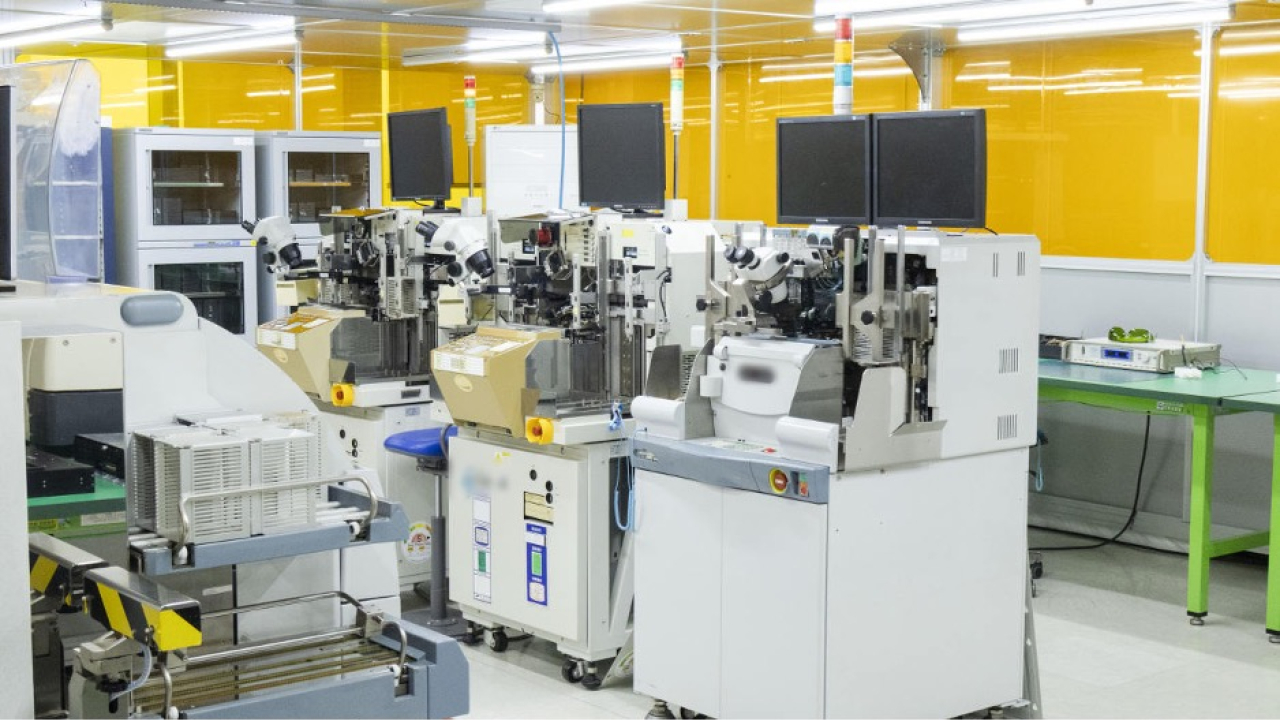
UV LED packaging process inside UVER's 100-Class cleanroom
The shift from mercury lamps to UV LEDs in the narrow web label market began several years ago, driven by lower power costs, the burden of lamp replacement, and heat-related issues. That transition is largely complete. The question now is how much more can be asked of the curing system itself.
In the field, the answer tends to come down to two things: UV output doesn't stay where it's set, and a single wavelength can't cure every ink. Both problems trace back to the characteristics of the UV LED light source itself.
UVER is a specialized manufacturer of UV LED curing systems for industrial and digital label presses. The company performs COB (Chip on Board) packaging in-house in a 100-Class cleanroom, and develops the optics, thermal structures, controllers, and control software built on top of it entirely in-house. Across this entire process, UVER holds roughly 260 patents and, over 18 years, has supplied more than 60,000 units to customers worldwide.
One Factory, from UV LED light source to curing system
LED packaging takes place in a semiconductor-grade 100-Class cleanroom that UVER operates itself. Chips are mounted on boards under controlled cleanliness, and the thermal structures, optical modules, and sensors are all designed and manufactured in-house as well. Light output, irradiance uniformity, and electrical characteristics are measured on UVER's own equipment before shipment — none of this is outsourced.
This structure gives converters three concrete advantages. First, there's no middleman margin added to module pricing. Second, lead times aren't held hostage to a supplier's production schedule. Third, and perhaps most importantly, every line has its own width, output, and stage configuration — and getting those adjusted becomes a single conversation rather than a negotiation across vendors. That's what makes OEM, ODM, and fully customized builds a realistic option.
Most importantly, because everything from component sourcing to final assembly happens in-house with no outsourcing, UVER also secures a clear cost advantage over systems of comparable specification.
One wavelength isn't enough — multi-wave technology
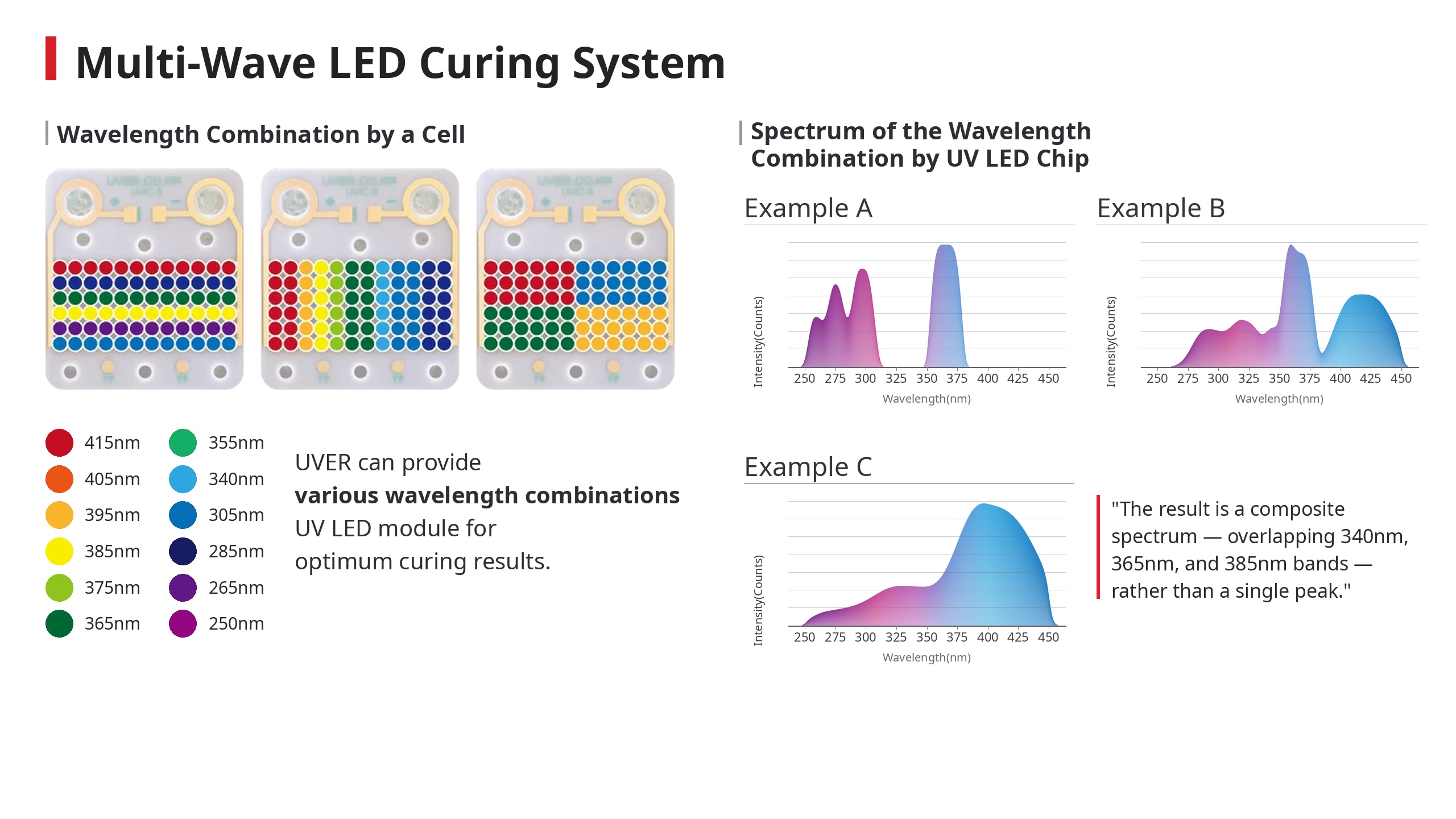
By nature, a UV LED emits only a single wavelength. That's why most systems on the market are built around one wavelength — typically 385nm or 395nm. The problem is that many inks and coatings were formulated against the spectrum of traditional mercury lamps, which cover a broad UV band. Under a single-wavelength LED source, these materials don't always respond as expected. That's why some inks, adhesives, and substrates cure well under LED while others don't.
UVER closes this gap at the light-source design stage. Because its COB architecture mounts LED chips directly onto the board, chips of different wavelengths can be arranged side by side on a single board. The result is a composite spectrum — overlapping 340nm, 365nm, and 385nm bands — rather than a single peak. This Multi-Wave light source irradiates multiple wavelengths simultaneously, extending compatibility to UV inks and coatings that were originally developed for the mercury-lamp era.
This isn't a minor spec difference. For converters, it means an existing mercury-lamp line can be converted to LED without reformulating or requalifying materials, and a single lamphead can accommodate a range of ink systems. To maintain uniformity across curing distances, silicone is dotted directly onto the LED chips, allowing precise control over irradiation width and optical characteristics.
Sense, judge, correct
UV output drifts gradually with temperature, cumulative operating hours, and contamination of the light source and surrounding components. The change is often so gradual that no one notices — a press can run an entire shift out of spec before anyone catches it. Product coming off that line reaches inspection under-cured. Spot-checking with a handheld meter isn't enough to keep up with a value that keeps moving.
"Before anyone notices, a press can run an entire shift out of spec."
UVER's Intensity Auto Calibration System closes that loop in three steps. A UV Sensor Module reads per-channel irradiance in real time and passes it to an Interface Module, which compares the reading against the setpoint and decides whether to hold or correct. When correction is needed, an Input Power Controller adjusts input power per channel across 1,204 steps.
Operators monitor the entire process from a single screen: per-channel irradiance and cumulative dose displayed as graphs and tables, alongside channel status, anomalies, alarm thresholds, temperature, and operating hours. If the deviation falls within the correction range, the system adjusts automatically without stopping the press. If it exceeds that range, an alarm alerts the operator to stop.
Correcting a channel properly is not the same as simply raising power until the reading matches the target. Pushing power into a chip without understanding how it responds to heat and light shortens its lifespan. UVER designs its calibration logic around the chip's optical characteristics together with the lens stack above it and the cooling structure below — an approach only possible because UVER builds the light source itself.
UV LED curing full portfolios, from pinning to final cure system
In digital label presses, curing rarely happens in a single pass. Pinning units, positioned between color stations, tack the ink at 2–10 W/cm² to hold dots in place before the next color is laid down. Final Cure, at the end of the line, runs at 24–30 W/cm². UVER supplies modules from 6 to 24 inches wide and 2 to 30 W/cm² in output, with a portfolio spanning everything from Pinning units to Final Cure Systems.
UVER has also recently developed its highest-output curing unit yet — an air-cooled system delivering 30 W/cm² — designed for wide-format UV inkjet printers, and has begun supplying it to global printer manufacturers.
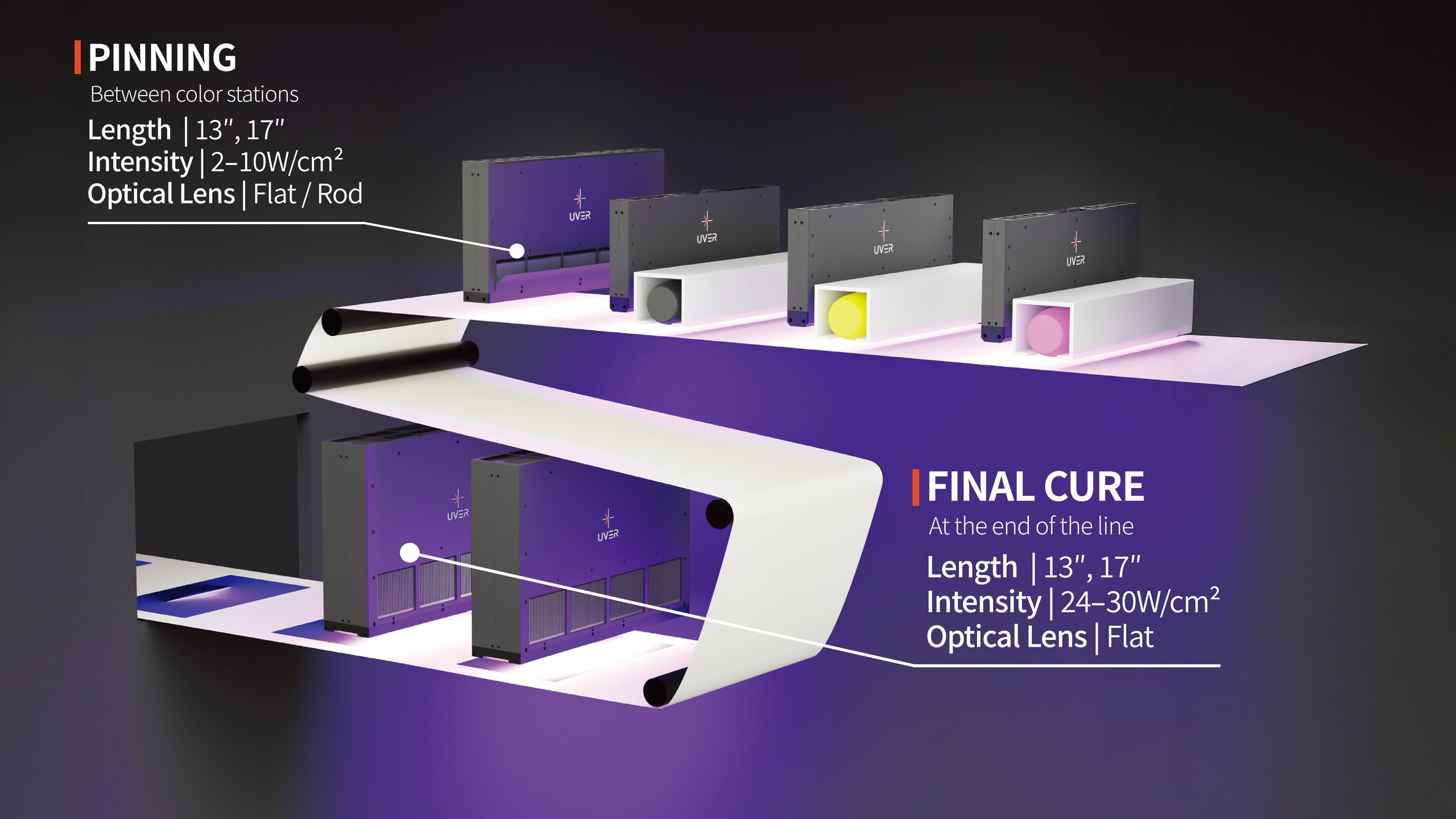
Converters often source these stages from different vendors. When they do, each unit ages at its own rate, reports irradiance differently, and works to its own reference values. Standardizing the whole line to a single specification changes that: one sensor type, one monitoring screen, one calibration logic — and a single spare-parts set instead of three. The same logic applies when retrofitting existing equipment.
There's no need to wait for inspection to find out whether curing fell short, or where it went wrong — the system flags it and self-corrects while the press is running. Quality no longer depends on the operator or shifting conditions.
Full specifications and a demonstration video of the auto-calibration system are available at www.uver.co.kr. For configurations matched to specific line widths and curing stages, contact [email protected].
Stay up to date
Subscribe to the free Label News newsletter and receive the latest content every week. We'll never share your email address.