ePS unveils technology at Connect 2026
The software company showcased its latest software release and new platform at its user conference in Las Vegas.

Doug Braun speaks at Connect 2026.
At Connect 2026, eProductivity Software (ePS) announced the launch of a platform that allows customers to pick and choose which products they want from the ePS suite of technologies, rather than having to purchase the whole platform.
This is just one of many changes at ePS, which, over the past eight months, has hired new executives, undergone a greater level of professionalization and officially split into two companies.
ePS, which will continue to provide software for the packaging industry, is now a separate entity from the commercial printing side of ePS, which has become a company called Graphic Communications. The two companies are still owned by STG, a private equity firm.
This year’s Connect event, which will be the last to include both ePS and Graphic Communications, took place Feb 10-12 at the Wynn in Las Vegas, Nevada. The event featured more than 100 conference sessions for commercial and packaging printers, with topics on software products, AI, business diversification and more.
The event also included a partner showcase, with 15 partners tabling and highlighting how their technologies integrate with ePS and Graphic Communications.
‘We share information all the time through multiple channels, through email, through social media, through visits and talks to customers directly,’ says Doug Braun, CEO of ePS. ‘But having 350 customers in a room together, you’re going to find somebody who has some similar challenges or had them, and that’s the best sharing we can give.’
New technology
ePS’ new technology highlights are the latest version of its packaging software and its new platform, the latter of which the company unveiled at Connect.
ePS released Radius 13.0, the latest version of its software, on December 31, 2025. Some of the new features of this release include an AI chatbot called Genie, an integration with CarbonQuota and a move to SQL from Progress, which will make the technology easier for customers to use, among other updates.
Going forward, ePS will also move to a quarterly release model instead of an annual one, allowing customers to benefit from faster delivery.
ePS' new platform, which is available now and continuously evolving, provides UI/UX, integration and automation, data and BI, and technology features for all customers. Beyond those offerings, customers can select from eight add-on pillars.
The pillars are ERP, which includes estimating and quoting, order and production management, and inventory; MES, which includes trimming and conversion optimization, real-time shop floor tracking, and paper and resource optimization; Control, which includes machine data capture and closed-loop optimization; Operational Excellence, which includes workflow designer, audit trail and compliance, and customization; Smart Scheduling, meaning what-if scenarios, capacity and constrains, and scenario KPIs and reporting; Quality and Compliance, which includes NCR management, corrective/preventive actions and advanced questions; Sustainability, including carbon accounting and reporting and regulatory disclosures; and Smart Supply Agility, aB2B customer portal, supplier management, and procurement and replenishment.
‘You simply select your problem area from the platform pillars,’ says Craig Tait, chief product officer at ePS. ‘It creates a far simpler way for customers to engage with us, articulate the challenges they’re trying to solve, and then receive industry-specific solutions tailored to their needs.’
Over the next two years, ePS intends to continue to build the web-first version of its software; expand into new segments like in-mold labels, woven fabrics and rigids; enhance its enterprise capabilities; advance its automation and AI functions; and expand regulatory compliance and partner integrations.
Changes at ePS
The split between ePS and Graphic Communications officially took place in July 2025. This change had been in the works for several years, not long after STG acquired the software business, comprised of the Print and Packaging segments, from EFI in 2022.
This past April, Braun was appointed CEO of ePS. He comes to the role with decades of experience in software and supply chain. Over the past eight months, ePS' new leadership hires have also included Micky Abhold as chief customer officer and Katie Kinraid as chief revenue officer.
Other changes have included more cross-training between ePS teams and a more formal account management process, with every customer having an account manager. To ensure the company continues its customer-first approach, leadership will meet in April to develop an official customer-first strategy plan, which ePS will publish.
‘We want to be the best company we can for our customers,’ Braun says.
Artificial intelligence
AI was a prominent topic at Connect. During his keynote talk, Steve Metcalf, founder of Imagine AI Live, described 2026 as the year of the AI agent. Unlike AI content generators and AI chatbots, which the general public is more familiar with, AI agents can be programmed to execute multi-step tasks without continuous human oversight.
‘Major AI companies [have] released their most powerful tools ever in their agent frameworks, and they’re being powered by these incredible agentic models, meaning the models know how to call tools, they know how to do things on the fly, that they didn’t know how to do earlier,’ Metcalf says.
In addition to his keynote, Metcalf led a workshop in which he demonstrated how to use Claude Code to create an AI agent focused on cost estimating.
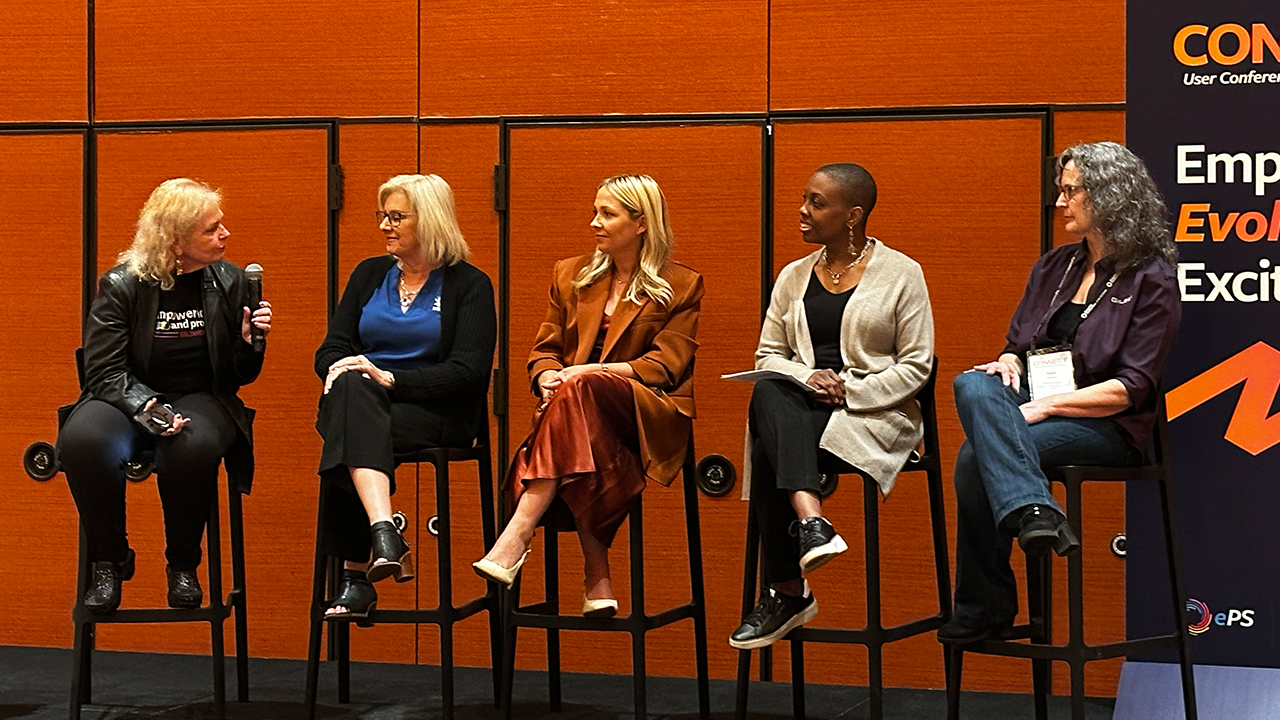
AI was also the focus of other sessions, such as a Women’s Networking Lunch panel and a roundtable discussion on the second day. Speakers discussed AI use cases, AI agents and navigating situations with employees who are hesitant about AI.
EPS has already incorporated AI into its ERP UI to provide translations into more than 20 languages, as well as an AI-powered chatbot, for the upcoming 2026.1 release on March 27. The Control pillar is being developed to advance actionable insights for the shopfloor.
Planned AI features for the future include waste insights and enhanced BI capabilities.
‘We want to be sure we’re deploying the right thing for our customers,’ Braun says. ‘This isn’t about replacing people. This is about thoughtful intelligence.’
Stay up to date
Subscribe to the free Label News newsletter and receive the latest content every week. We'll never share your email address.