Ultra Labels bets big on digital
Australian converter has spent 15 years proving that conviction, patience and capital beat price-cutting every time.
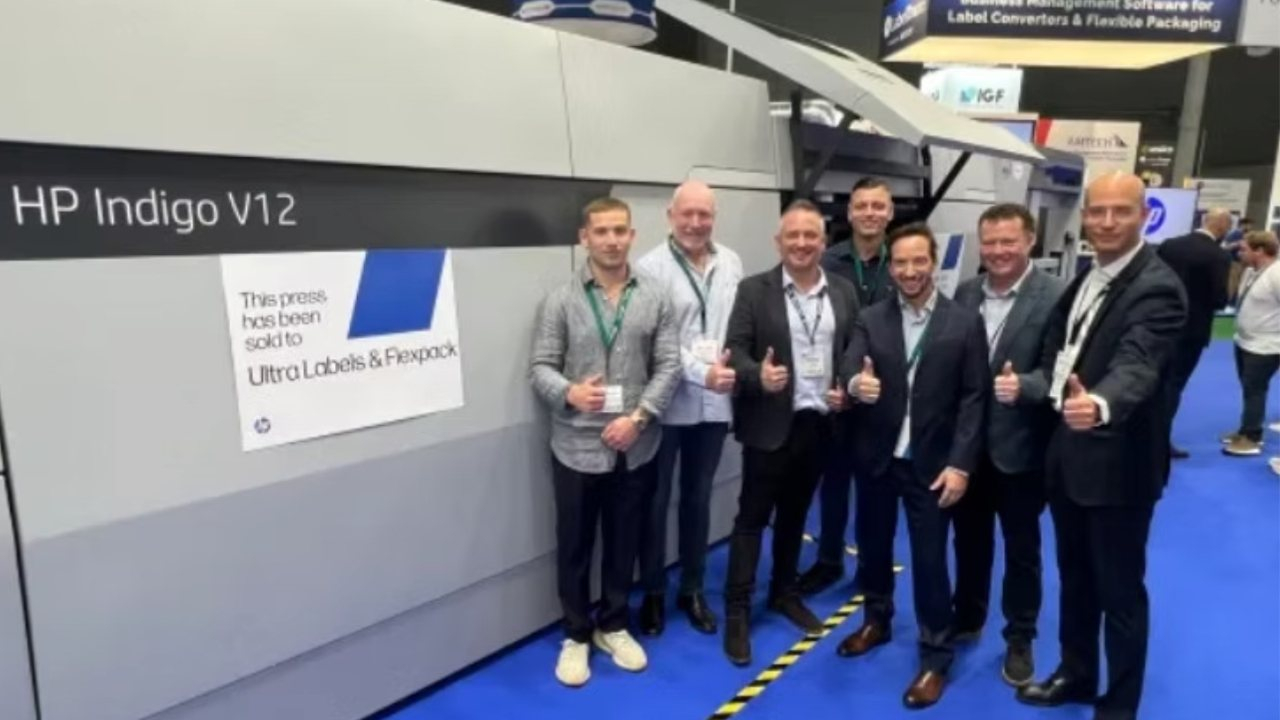
Ultra Labels with Currie Group and HP Indigo teams at the Labelexpo Europe 2025, announcing the sale of the first V12 in Asia Pacific
It was sometime around 2008. Scott Springett had just sold Clear Image, the label business he had built over 12 years, to
Australia’s second-largest wine label printer, CCL Industries. He had capital in the bank, decades of experience and no particular plan. Then Shane Kelly, a former colleague to whom Springett had given his first job in labels back in 1991, got in touch. He had a business idea and a co-founder lined up. The three men met, and Kelly and Ross Fursey laid out their vision as Springett listened. Then he told them the plan was wrong.
‘They wanted to become another flexo printer,’ Springett recalls. ‘And I said: the world doesn’t need another flexo printer. There are enough of those around.’ He had been an early investor in digital printing at Clear Image, installing one of the first HP Indigo presses in Australia in 2005. He had watched the technology’s potential closely enough to see where it was heading. ‘I said we really needed to approach this differently, coming at it from the digital angle. It was a classic story of talent meeting capital. They had the ideas and the operational know-how. I had the experience and the capital from the sale of the previous business.’
That conversation led to the founding of Ultra Labels in October 2009, with a single HP Indigo WS 6000 in a facility in Fortitude Valley, Brisbane. Sixteen years later, the company operates with three production sites across Queensland and South Australia, employs more than 80 people, prints over five million labels a week and has just taken delivery of the first HP Indigo V12 digital press in Asia Pacific. The V12 purchase, confirmed at Labelexpo Europe 2025 in Barcelona, was described by distributor Currie Group as the largest single digital sale in its history.
The thread connecting the first meeting to that Barcelona announcement is consistent throughout: Springett and his team identify where the market is heading, commit capital before the rest of the industry catches up and then have the discipline to wait.
Learning to sell digital
In 2009, digital label printing was a genuinely difficult sell in Australia. The market was flexo territory: long runs, plate costs buried in the unit price, customers ordering six months of stock at a time. Ultra Labels’ pitch required customers to think differently about the economics of labels, and not all of them were ready to.
‘It took about 12 months,’ says Springett. ‘But we had a story to tell. We could show a customer what their label looked like before they actually ordered it. We could print a single sample. No plate costs. It was faster, it was offset quality and you didn’t have to order 50,000 labels. You could order 5,000. Digital is a value product, and it was never about matching flexo prices. I told my team: this is a premium product, we have to find the customers who want it and they are out there.’
“‘The world doesn’t need another flexo printer. We had to approach this differently, coming at it from the digital angle”
The early believers came from industries defined by high SKU counts, frequent design changes and a tolerance for paying more per label in exchange for flexibility and speed. Healthcare labels for pharmaceutical and nutraceutical products needed rapid updates and small volumes. Ultra Labels did not discount its way to growth. It waited for the right customers, added a second press for redundancy to protect its lead times and assumed market leadership in Brisbane within a few years.
A Sydney facility followed in 2013. A third press, the HP Indigo 6800, was installed in Brisbane in 2018. In 2021, Ultra Labels opened a production facility in Tanunda, South Australia’s Barossa Valley, adding an HP Indigo 6K in 2022 to serve the local wine and spirits industry. By that point, the digital case had long been made. The question was where to go next.
The move into flexible packaging
The answer came, as so many of Ultra Labels’ strategic moves have, from its existing customers. Brands that were already buying labels from the company were also buying pouches and flexible bags, typically from suppliers in China. When they asked Ultra Labels to take on that work too, the problem remained the same: offshore manufacturers required minimum orders of 100,000 units. Ultra Labels’ customers wanted 5,000.
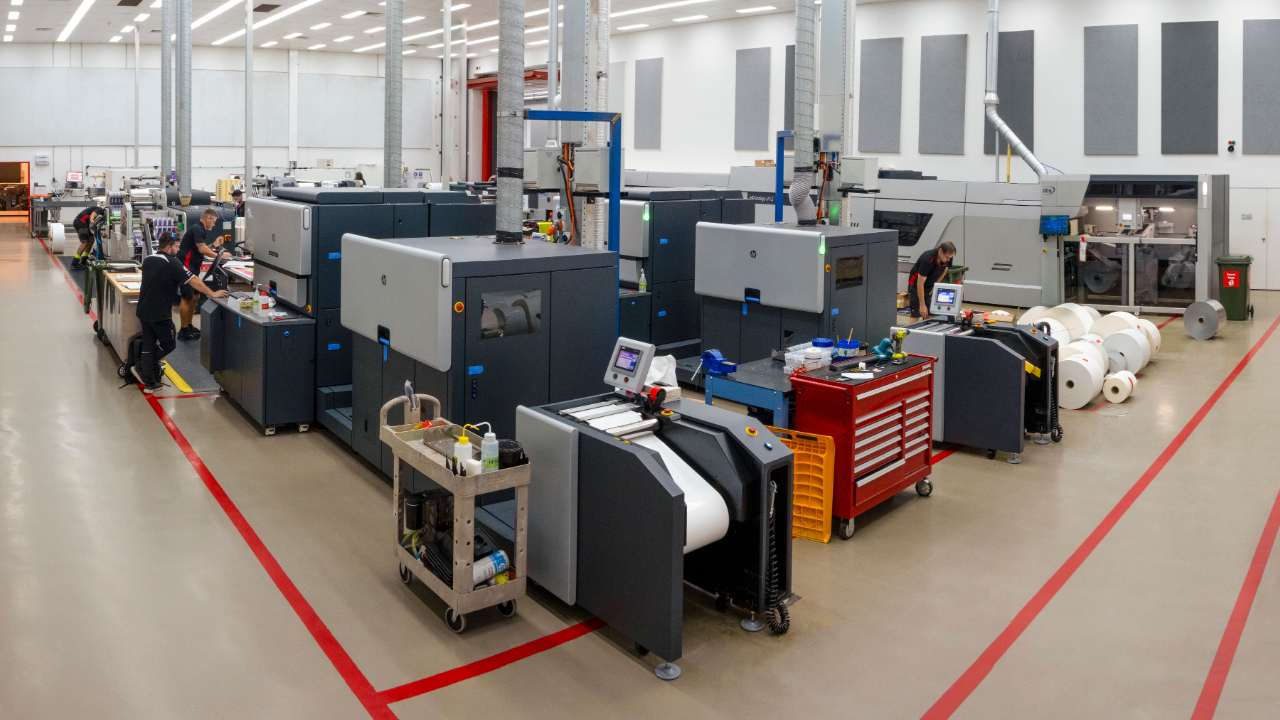
‘They would tell us they couldn’t buy from China because China wanted 150,000 units, not 5,000 or 10,000,’ Springett explains. ‘So, we kicked that idea around for years, and eventually our balance sheet was healthy enough to say yes. In 2019, we took the plunge and bought the first HP Indigo 20000.’
The printing side was familiar enough. Digital was digital and printing on unsupported film, rather than paper or facestock, was manageable. The converting side was a different discipline entirely. ‘Once you put the ink on the substrate, that’s where the similarities start and end,’ Springett says. ‘Flexible packaging is a very complex business.’ Ultra Labels built out the capability regardless, constructing a flexible packaging operation in Brisbane that now runs two HP Indigo 20000 presses, two laminators, two slitting machines, a JetFX embellishment unit and three pouch lines. A Galaxy Packtech pouch-making machine, ordered after a visit to UK converter Bakers Labels, was due to arrive imminently at the time of this interview. It was expected to push monthly pouch capacity to two million units.
The investment in flexible packaging now stands at close to 15M AUD (10.7M USD). Springett is matter-of-fact about the logic. ‘It doesn’t take long to work out the size of the flexible packaging market and the opportunities compared to labels,’ he says.
Mark Daws, director of labels and packaging ANZ at Currie Group, which supplies HP Indigo technology across Australia and New Zealand, agrees. ‘Flexible packaging is the fastest growing digital segment,’ notes Daws. ‘The ability to switch between flexible packaging and label applications, and print pressure-sensitive labels, flexible packaging and shrink sleeves on the same day is a game changer for our customers.’
The contrarian buys flexo
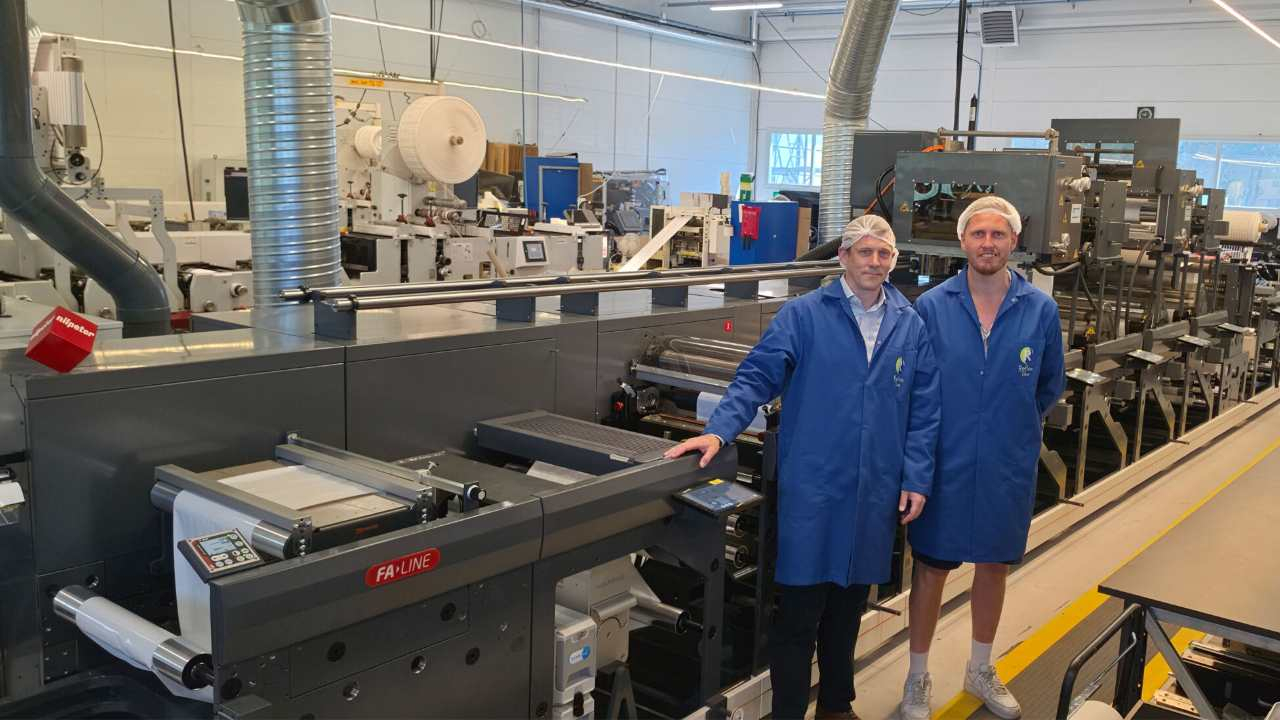
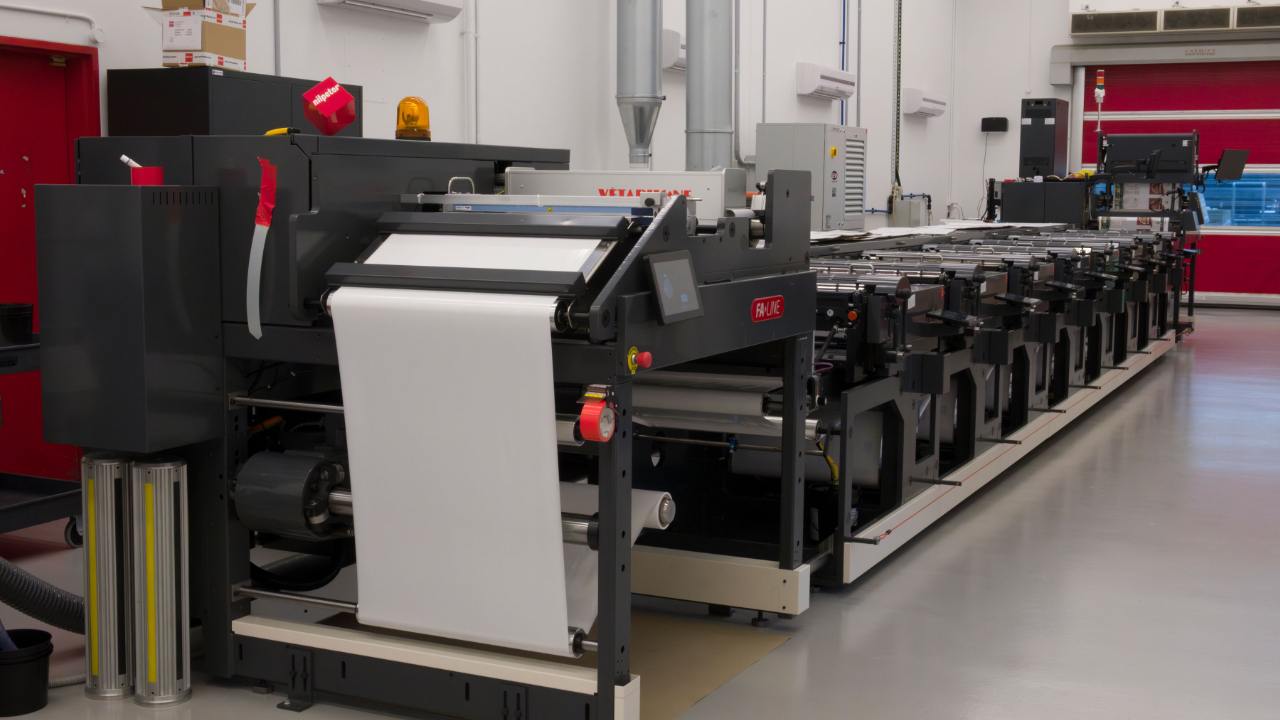
There is a certain irony in the fact that the man who told his co-founders the world didn’t need another flexo printer has now bought one. A Nilpeter FA-26, installed at Ultra Labels’ Brisbane facility, is the first 26-inch-wide press sold into the Australian market, marking Nilpeter’s debut in the country. Springett and production manager Johnny Marusic flew to Nilpeter’s factory in Denmark to seal the deal, on the same European trip that took them to Nordvalls in Sweden to see the V12.
The purchase is not a retreat from the digital conviction. It is an extension of the same logic that has driven every investment Ultra Labels has made: going up the volume curve to meet customers where they are.
‘We had some longer-running jobs on our HP Indigo 20000
presses and those machines are great up to a certain run length, but they don’t go any faster,’ Springett explains. ‘We had large customers wanting to give us more volume. The FA-26 runs at around 10 times the speed of the digital press. So, it just made sense: if we’re going up the volume curve on labels with the V12, we should do it on flexibles too.’
The FA-26 features UV LED curing technology, which reduces energy consumption and eliminates the need for mercury lamps in the workflow.
It supports Ultra Labels’ ISO 14001 environmental management certification and its commitments under Australia’s 2025 National Packaging Targets. Marusic’s existing flexographic experience helped manage the operational transition.
Seeing the V12 in Sweden
The HP Indigo V12 had been on Springett’s radar for years before he finally ordered it. He had watched the press’s development from a distance, grown skeptical when updates went quiet for a period and then received a call from Mark Daws at Currie Group inviting him to visit Nordvalls in Malmö to see the machine running at full production speed.
‘I told Mark: don’t take me on a wild goose chase. If it can do what they say it can do, I’m ordering it on the spot, because anything that enables us to produce more material faster, improve productivity and reduce unit labor costs is exactly what we need,’ Springett says. ‘We went up to Malmö. The HP team was there; we had a good question-and-answer session with the Nordvalls CEO. We talked to the operators on the press and saw it run. And when you have 20 years of experience in digital, and you see this thing, you just think: wow.’
The V12, powered by HP’s LEPx technology, prints at up to 120m/min compared to roughly 1,000m/hr on Ultra Labels’ existing HP Indigo 6000 fleet. The press is designed as a high-speed digital complement to analog flexo, enabling converters to serve medium- to high-volume runs without the setup times, plate costs and waste associated with conventional printing.
For Ultra Labels, which had already been seeing its run lengths grow as its customer base matured, the timing was right.
“Digital is a value product. It was never about matching flexo prices, we had to find the customers who wanted what we were offering”
Managing director Ross Fursey was direct about the investment’s implications.
‘This machine is going to allow us to improve our lead times, quality and customer response,’ he said at the Labelexpo Europe announcement. ‘It allows us to increase our run lengths and move up to medium to higher volume for those clients wanting higher resolution for their labels. It complements our HP Indigo 20000 presses for flexible packaging and is a step up from our existing six HP Indigo 6000 presses.’ In practical terms, the V12 replaced two of those 6000 machines, consolidating output onto a single press, reducing staffing costs per meter produced by a fraction.
Currie Group’s Daws confirmed it was the largest single digital sale in the distributor’s history, and one that carried personal significance.
‘Our relationship with Ultra Labels stretches back to 2009,’ adds Daws. ‘This will complement the HP Indigos they already have in their portfolio and will revolutionize their speed to market with a broader client base.’ HP Indigo Asia Pacific general manager Arnon Goldman echoed the sentiment at the announcement: ‘The whole idea of the V12 is non-stop printing, and I am personally excited that this is the first in Asia Pacific.’
Quality as competitive currency
The commercial ambition behind Ultra Labels’ equipment investments is validated by the presses’ actual output. At the 2025 FPLMA Print Awards, one of Australia’s most prestigious packaging competitions, Ultra Labels won three Gold awards
across flexible packaging (digital) and label (digital) categories: one for BsC Meal Replacement Shake flexible packaging, another for the Brookie’s Rainforest Gin wine and spirits label, and a third for the IP Warhammer Protein Powder label. A Hentley Farm Cotes de Hentley wine label, which had won gold at the 2024 FPLMA awards, went on to win a World
Label Award in the international L9WLA competition, a recognition that requires first winning a national association prize before being entered at the world level.
‘These awards celebrate the innovation and dedication of our team and clients,’ said Fursey. ‘We’re proud of this recognition, but even more excited to keep pushing the boundaries of print and packaging to deliver standout results.’
Sustainability: evidence, not aspiration
Ultra Labels’ environmental credentials are formally established: ISO 14001 certification, HP Carbon Neutral presses, a take-back program for HP consumables and increasing use of polypropylene labels incorporating 30 percent post-industrial recycled PP resin content. On the broader sustainability question, however, Springett resists what he sees as a gap between industry rhetoric and commercial reality.
‘The evidence for digital is empirical and irrefutable,’ he says. ‘Less energy, smaller footprint, less waste, everything is contained. That’s a matter of fact. The bottleneck with sustainability is getting the right substrates available at production scale and at a price that works. We’ve developed recyclable material options for customers and then shown them the price and watched them walk away. There has to be a point where these materials are available, reasonably priced and proven to work through production lines. We don’t see the problem being at our end. If we can get the material, we can print on it, we can make a bag.’
Discipline as strategy
With the V12 commissioned, the Nilpeter FA-26 running, and the Galaxy pouch line arriving, Springett believes the major
investment phase is largely complete. A high-speed AB Graphic International Digicon finishing line to complement the V12 remains to be ordered, but the broad shape of the business is set.
‘The table is just about set for us now,’ he says. ‘In flexibles, we’ve got the laminators, the slitters, the embellishment unit, the pouch lines. In labels, we’ve made significant upgrades. Now we’ve got to work it. Now we’ve got to go in the same direction we’ve been going, in the same markets, with the same customers.’
“We take the view that the machine should be put in and filled with the right work. I’ve seen where all
the price cutters have ended up. Their doors aren’t open today”
Brisbane’s growth trajectory adds to his confidence: population migration into Queensland, a favorable labor market compared to Sydney and Melbourne, and the 2032 Olympic Games on the horizon are all factors he cites.
In addition, the investment in flexibles alone stands at nearly 15M AUD (10.7M USD) over the past several years, with a further multi-million-dollar commitment to the V12. But Springett is just as emphatic about what Ultra Labels has not done as about what it has. The business has never competed on price. It has never over-invested in capacity ahead of the work to fill it. And it has never mistaken activity for strategy. ‘Over capacity is the killer,’ he says. ‘Putting a machine in and saying you’ve got to get it on shift straight away to get your ROI. That mentality is a killer. We take the view that the machine should be put in and filled with the right work. I’ve seen where all the price cutters have ended up. Their doors aren’t open today.’
For converters considering a move into digital production or flexible packaging, he offers the same advice he has followed
himself: find the gap before you spend the money. ‘There has to be an opportunity. When I started Clear Image, I could see
a gap in the label market. When I started Ultra Labels, I could see a gap. If you’re going into a business just to be a price taker, that’s all you’ll ever be. These businesses take 10 years to build. You need a long-term view; you need to be prudent
with your investments and your customer selections. Don’t be afraid to say no.’
Forty-one years in, Springett has seen the labels industry survive recession, disruption and a pandemic, reinventing itself at each turn. He expects it to keep doing so. The V12 in Brisbane is not the end of the story. It is, as every major investment at Ultra Labels has been, the beginning of the next chapter.
Stay up to date
Subscribe to the free Label News newsletter and receive the latest content every week. We'll never share your email address.