UV and IR fluorescent pigments in brand protection
In this guest article, Luminochem specialists explain how UV and IR fluorescent pigments are becoming key tools for brand protection.
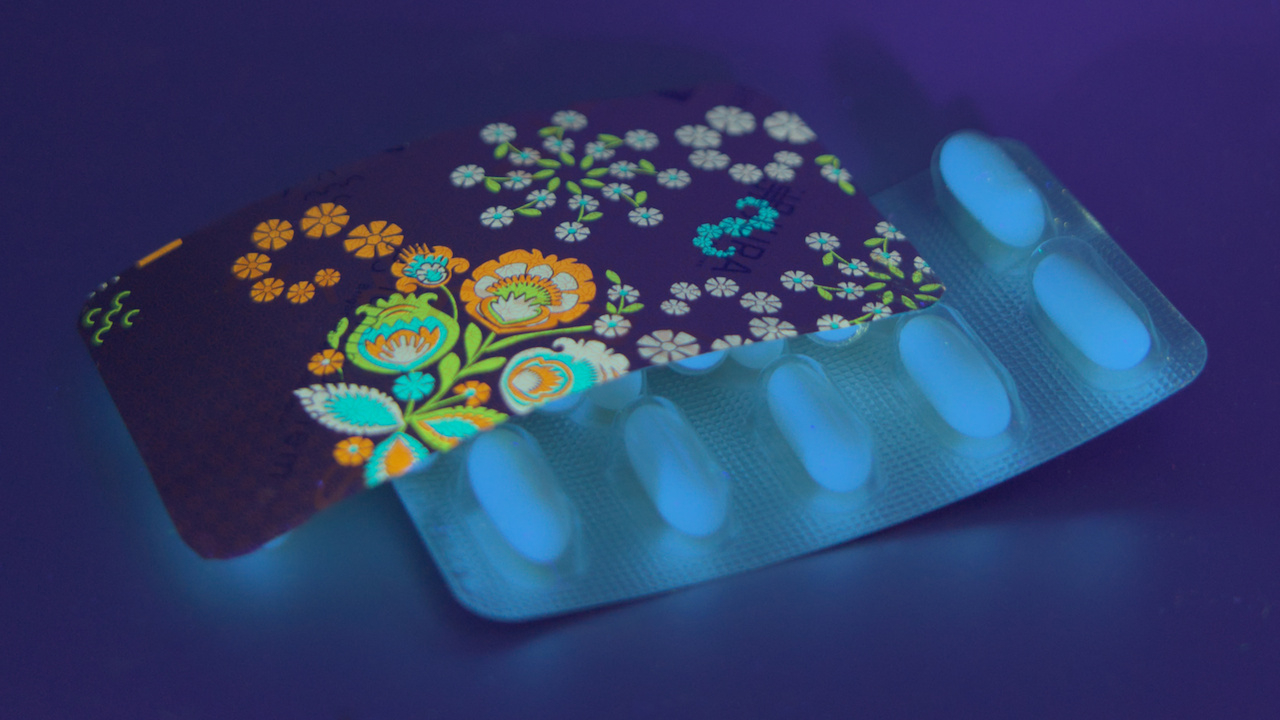

As counterfeiting becomes more sophisticated and more widespread, security features are no longer confined to banknotes, tax stamps and ID documents. The same principles long used in high security printing are now increasingly relevant in labels and packaging, where authentication, traceability and supply-chain integrity have become business-critical. Among the most effective tools in this field are UV and IR fluorescent pigments, which can support everything from rapid field checks to covert, machine-readable security.
UV and IR fluorescent pigments have been used in security printing for decades. Today, protection systems for banknotes, vouchers, cheques, share certificates, ID documents, excise seals, tax stamps, cards, scratchcards, lottery and betting slips, and other secure printed products would be difficult to imagine without them.
Brand owners now face similar challenges. They need authentication technologies that are practical, easy to verify and aligned with brand quality requirements. Counterfeiting is an increasingly costly global problem: it erodes profits, damages brand image, undermines consumer trust and puts channel relationships at risk.
This is where UV and IR fluorescent security pigments have gained importance beyond traditional security print. They can be applied directly to products, embedded into materials such as plastics, textiles or metal, or integrated into labels and packaging. In each case, they offer a practical means of identification for the trade, while enabling on-site authentication by brand owners, inspectors or law enforcement agencies.

Their use now spans a wide range of sectors. From pharmaceuticals and food products, including premium beverages and bottled water, to sports equipment, apparel, cosmetics, electronics and automotive components, these technologies add value wherever counterfeiters see a profitable gap between the market value of a branded product and the cost of making a fake.
UV for fast visual verification
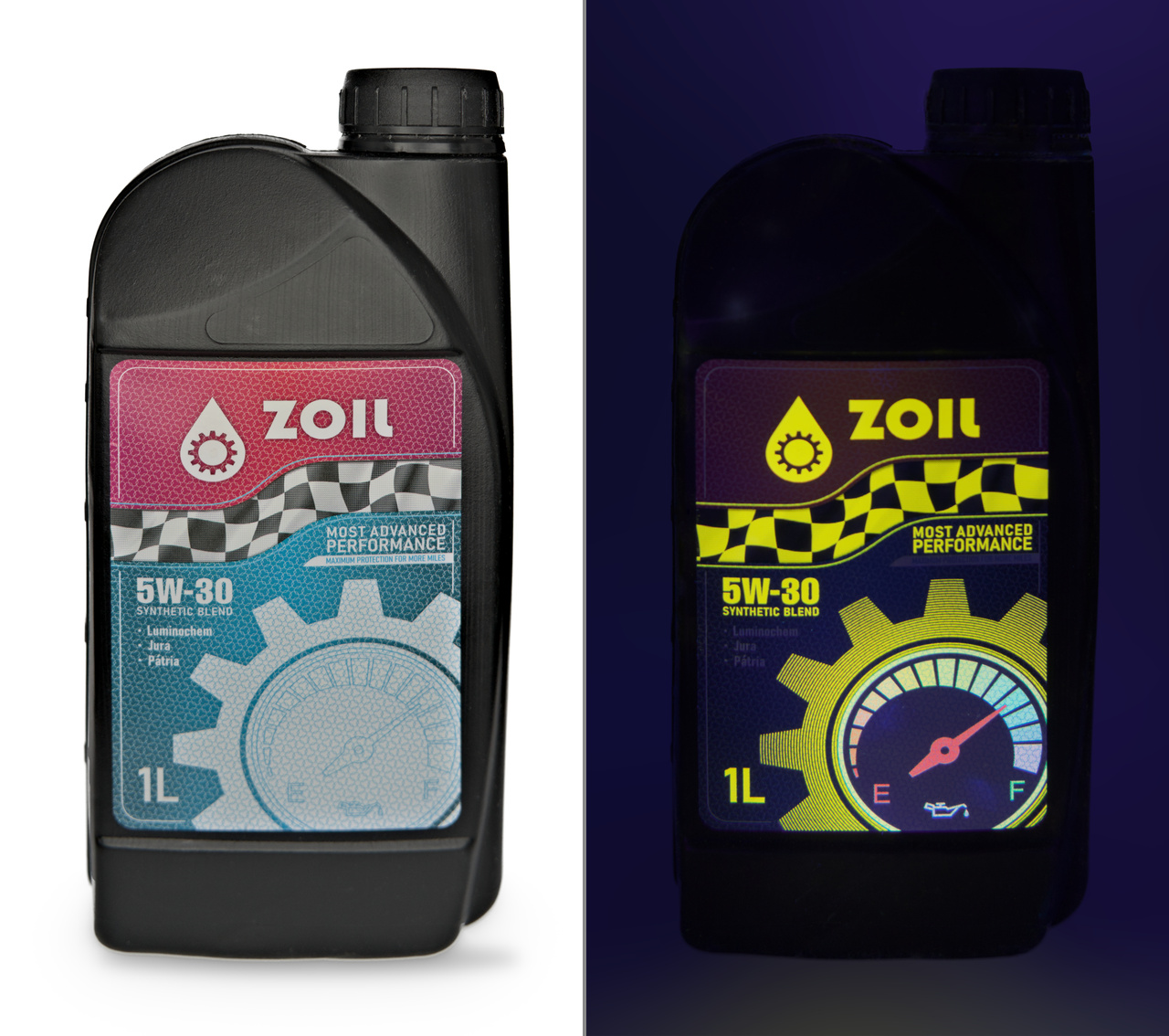
The defining feature of UV pigments, or UV fluorescent inks, is that under normal visible light they are colorless or barely perceptible (invisible), yet under ultraviolet illumination they become immediately visible, typically in green, yellow, or red, though some are also pink or white. Because the effect lasts only while the UV source is present, these inks are particularly suitable for fast authenticity checks using handheld UV lamps.
In print production, mono-, bi- and tri-fluorescent systems are also used, allowing different color responses at different UV wavelengths. In the security sector, the three most common wavelength ranges are 365 nm (UV-A), 313 nm (UV-B) and 254 nm (UV-C). UV-A is the most widely used and easiest to verify; UV-B is less common and used in more specialized cases; UV-C offers a higher level of protection because the radiation source itself is less common.
This matters because the more specialized the excitation source, the more difficult the feature becomes to counterfeit or reproduce by scanning.
These invisible inks, or more precisely inks visible only under UV light, also have another important advantage: they cannot be faithfully reproduced by copiers or scanners. They can be printed using offset, flexo, gravure or screen processes, as well as digital methods such as toner and inkjet.
One important practical point is that UV fluorescent pigment-containing inks perform properly only on papers free from optical brightening agents, since optical brighteners in the substrate can interfere with detection.
IR for covert, machine-readable security
IR pigments, or infrared inks, operate differently. In most cases, the response is not intended for naked-eye inspection but for instrument-based verification. IR fluorescent inks can only be detected using an IR camera.
This category also includes anti-Stokes materials, which can be excited by IR light while emitting visible light, making them suitable for hidden information features and machine authentication.
The terminology can be refined further into IR-absorbing and anti-Stokes inks. In practice, a print feature may be designed to absorb, transmit or transform infrared radiation in a controlled way. As a result, IR systems in printing are used mainly as covert, machine-readable security features, while UV systems more often provide rapid visual feedback that can also be checked by a human operator.
IR fluorescent taggants are generally regarded as offering a higher level of security. Simple UV markings, by contrast, are now often seen as a baseline protection feature unless they form part of a more sophisticated multi-color or multi-wavelength system.
Performance in real packaging environments
As with any print technology, end-use requirements matter. Precisely because of its diversity, the field of brand protection poses numerous challenges regarding security materials; consequently, beyond meeting specific technical requirements—such as exceptional intensity, unique color, heat and/or light resistance, and application technology demands—they must also satisfy economic criteria.
Pigment choice therefore affects more than the security function alone. It also determines whether a print can undergo downstream converting steps such as lamination.
Lightfastness is another important parameter. Highly lightfast pigments do, however, come at a higher cost, which can limit their economic use in some brand protection applications.
Application examples
Real-world applications show how versatile these technologies have become.
Tonino Lamborghini uses a sophisticated anti-counterfeit security label incorporating a hologram, alphanumeric unique identification and a unique QR code. The labels are integrated into swing tickets and warranty cards that also employ advanced printing techniques and spot UV varnishes. Through OpSec’s InSight platform, shipments of security labels are tracked to Tonino Lamborghini manufacturers, enabling the location and status of each unique identifier (UID) to be monitored throughout the production and supply-chain process.
New Balance offers another example. The brand has treated the shoe tongue label as a key authentication point and, since May 2025, has introduced QR-based self-verification on multiple models.
In luxury watches, jewelry, sunglasses, handbags and wallets, covert markers, invisible machine-readable inks and taggants can be integrated into hangtags, apparel labels and footwear packaging. Hidden text and image elements visible under UV light or IR camera add another layer of control without affecting visual appearance.
A leading premium personal care manufacturer has used this approach to protect its franchise salon network against unauthorized resale and diversion. In that case, a unique GS1 DataMatrix code printed in UV ink on the top of every bottle was combined with overt and smart coding and linked to aggregated shipment data. Here, the UV feature was intended not for the consumer, but for supply-chain verification.
In the beverage sector, invisible codes produced with UV and IR inks on branded packaging help distribution partners identify products that have entered unauthorized channels. On wine and spirits, a layered approach is common: UV fluorescent ink on the closure provides a fast handheld check, while an adjacent invisible machine-readable ink enables higher-level verification.
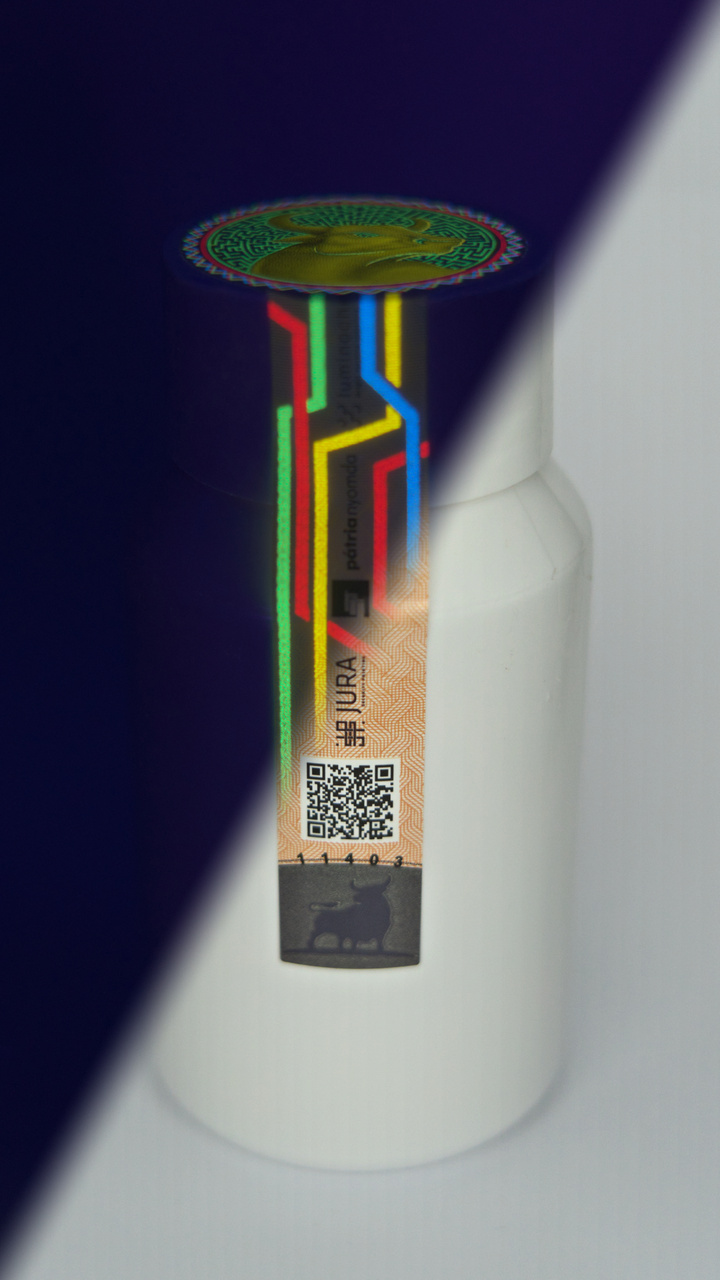
In pharmaceuticals, UV and IR markings are mainly used as B2B verification tools on plastic bottles, labels and other carriers, while fully invisible inks can also be used for covert brand protection marking. Similar principles are now increasingly seen in automotive components, where covert UV-light subsurface messages are used to protect spare-part authenticity and the aftermarket supply chain.
A value-chain issue
Brand protection is no longer solely the concern of the brand owner. It is a value-chain issue involving ink manufacturers, packaging printers, label converters, design studios, logistics partners, retailers and end users. Public authorities also have a clear stake, not least because counterfeiting can significantly reduce tax revenues.
UV and IR fluorescent pigments are therefore far more than specialist materials inherited from security printing. They have become practical, scalable tools for modern brand protection, linking print technology, packaging performance, authentication and supply-chain security.
The products featured in this article bring together the expertise of several industry partners: graphics created with software from Jura Trade Ltd., production by Azimex Ltd. and Pátria Security Printing, and UV fluorescence pigments manufactured by Luminochem Ltd.
Stay up to date
Subscribe to the free Label News newsletter and receive the latest content every week. We'll never share your email address.