Römer Etikett increases production capacity
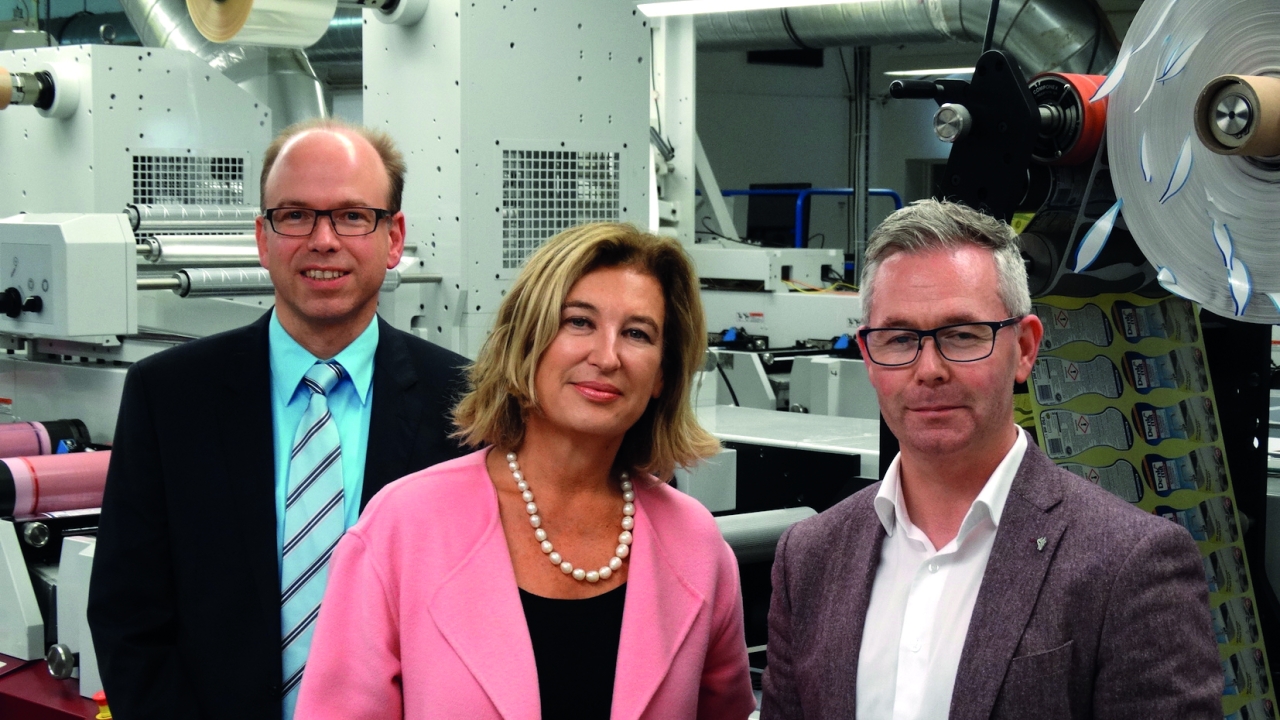
When Römer Etikett became part of the Watershed Group in 2011 it was manufacturing labels on a variety of legacy presses, both rotary letterpress and flexo. Now managed by Claus Schüring, who joined in 1997, Römer Etikett is investing heavily in new press technology – part of a strategic plan to grow the Watershed Group turnover from 17 million EUR to 30 million EUR by 2020.
Each production unit is its own profit and loss center, with facilities and knowledge shared across the group, and each retains a degree of spare capacity to cater for last minute jobs.
Key to effective group-wide integration has been the choice of a single press supplier, Mark Andy. The Group now has ten Mark Andy Performance Series lines, three in Ireland, five in Poland, and now two in Germany. All bar those in Szczecin are 430mm web width (Poland’s are 330mm), and highly specified, including screen, cold foil and laminating.
The two P5 lines at Marburg have chill drums to allow heat-sensitive substrates to be processed, and an inkjet head for the production of lottery tickets. For easy and safe die changes, especially on the wider 430mm web width, they have Mark Andy’s QCDC (Quick Change Die Cassette) system, which uses a trolley to unload and reload via a door in the side-frame. Claimed to reduce changeover times by up to 75 percent, it is part of the group’s philosophy of streamlining as many processes as possible.
Römer’s Claus Schüring commented: ‘Our first P5 was my initial experience with Mark Andy technology. They are quick and easy to make ready, run faster, waste less material, and print a better dot than any press I’ve worked with. The first P5 boosted output by 40 percent and the second will more than double our capability. Added to which, we’re making time-savings of 50 percent on existing jobs, and have seen a remarkable drop in energy consumption.’
Advantages
The Mark Andy presses are allowing Watershed to sell into traditionally offset markets, says Watershed Group CEO Liz Waters. ‘There is no doubt that today’s HD-Flexo technology is a commercial match for any print process, and offers significant advantages in certain areas such as color vibrancy.’
To ensure uniform production standards across the group, a best practice manual has been introduced to all plants. Known as ‘The Watershed Way’, it standardizes working operations to achieve maximum consistency, while also reaping cost benefits.
With identical production capability at all plants, plans are currently in place to increase the business at Römer using the international sales team in Etiko’s facility in Poland, around 600km away. According to Waters, this is attractive to the multi-nationals and PLCs, who are keen to secure back-up facilities with guaranteed print quality consistency.
With Etiko’s narrower (330mm) web width capability supporting the two 430mm P5 presses in Marburg, Waters believes she has a flexible production capability that few can rival. ‘I believe there is an optimum size of business for a converter – you have to be big enough to cope, but small enough to care, and really care about your customers. We’re as close as a small family but have the process mentality that is required for industrial production – it’s a key strength and one that we intend to build on.’
With more company acquisitions on the cards, Liz Waters is keen to sectorize the business with production facilities across Europe. Römer is a good example of this. The business grew up producing labels for the health and hygiene markets, and gradually became less competitive through lack of investment. With the new Mark Andy presses, the company has moved into higher value areas, where speed, quality and differentiation yield bigger rewards.
Stay up to date
Subscribe to the free Label News newsletter and receive the latest content every week. We'll never share your email address.