Schreiner syringe labels validated with testing
Independent testing has proven that the labels reduce oxygen ingress into COC plastic syringes.
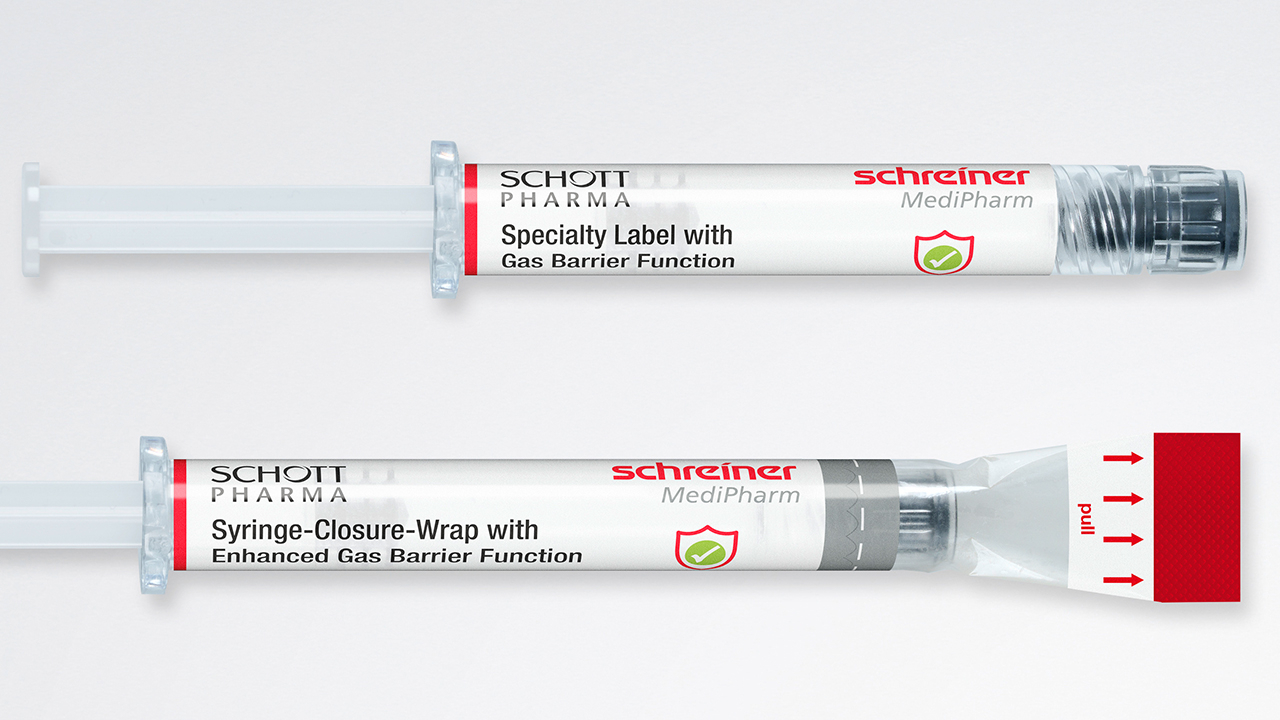
Independent testing has validated the effectiveness of Schreiner MediPharm's specialty barrier labels. An external examination proves that the company’s functional labels significantly reduce oxygen ingress into COC plastic syringes.
Sensitive substances such as biologics and biosimilars typically must be protected from oxygen ingress to ensure efficacy and shelf life. When outfitted with gas barrier properties, Schreiner MediPharm’s functional labels provide pharmaceutical manufacturers with a validated product that can be flexibly adapted to a variety of COC plastic syringes and substances.
Prefilled COC syringes are becoming increasingly important for containing and delivering modern biologics and biosimilars. Compared to glass, they offer clear benefits such as lower weight, higher break resistance, greater design flexibility for complex geometries and reduced protein adsorption. At the same time, their gas permeability is higher, meaning more oxygen can enter the syringe and may impair product stability.
To address this challenge, Schreiner MediPharm developed functional labels with an integrated gas barrier. They clearly reduce oxygen ingress, and can be easily adapted to a variety of COC syringe types without requiring modifications of the primary container or changes to existing production processes.
Schreiner MediPharm offers various label concepts with an integrated gas barrier. Its Gas-Protect-Label protects the syringe body in a large area to reduce oxygen ingress, while its Syringe-Closure-Wrap also encloses the syringe cap; the latter is sealed at the upper end in a practically gas-tight manner, simultaneously providing tamper evidence through an integrated first-opening indication feature. Consequently, it not only offers protective functions for the drug but also supports the product’s integrity across the entire pharma supply chain.
The labels’ protective effects were tested as part of external studies by Professor Sven Sängerlaub at the Munich University of Applied Sciences, as well as another renowned institute, as part of a commissioned test. In a working group led by Sängerlaub, the oxygen concentration in nitrogen-purged and sealed COC syringes was measured over an extended period of time in a contactless process using an optical oxygen sensor. The results show a clear reduction of oxygen ingress. In the case of a 1ml Schott Toppac syringe, the Gas-Protect-Label extended the period before a critical oxygen concentration was reached by approximately sevenfold compared to an unlabeled syringe. The Syringe-Closure-Wrap with an integrated gas barrier achieved a roughly ten times longer protective effect.
Stay up to date
Subscribe to the free Label News newsletter and receive the latest content every week. We'll never share your email address.