China's narrow web industry redefines its future
Xu Wencai shares his insights on China’s label industry, and the relationships between Loupe and the industry.
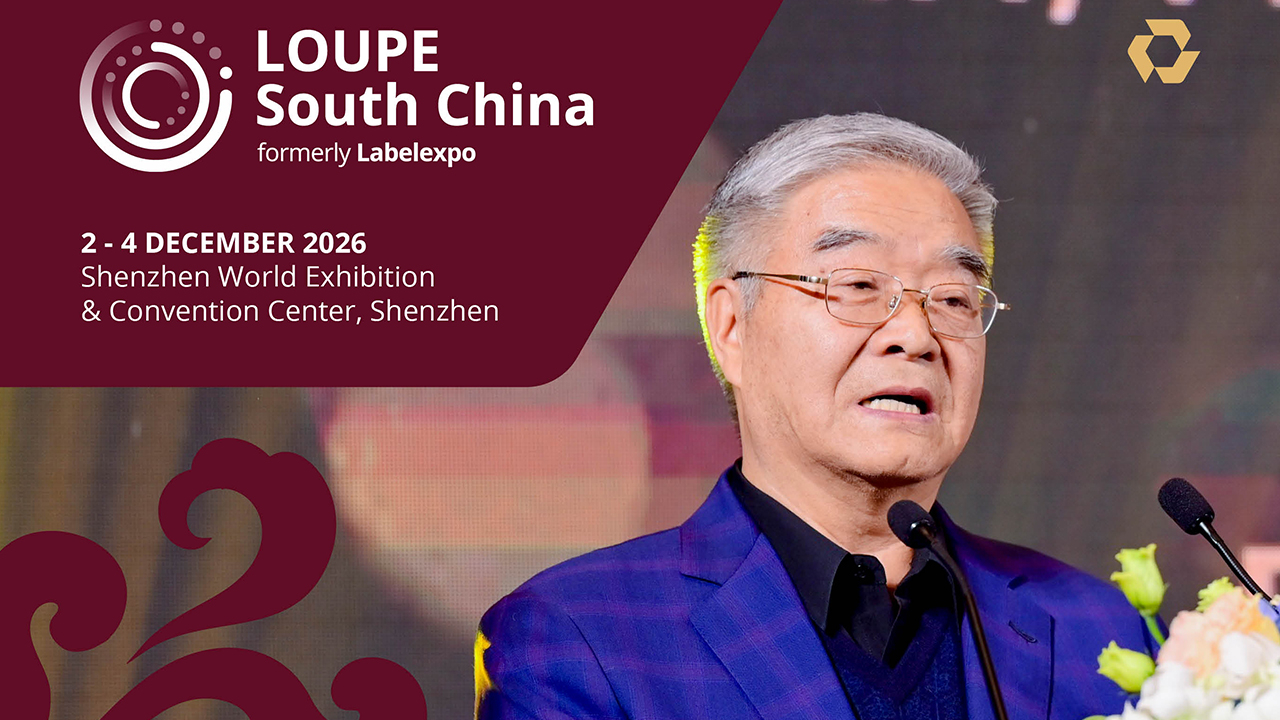
Professor Xu Wencai, chairman at The Packaging Printing and Label Association of China Packaging Federation, shares his observations and insights on the development trends of China’s label and packaging printing industry, and the interaction between Loupe and the industry.
Development trajectory: from specialization to industrial integration
Over the past decade, China’s label and packaging printing industry has undergone profound and pragmatic transformation. Five years ago, most enterprises remained confined to their niche sectors: label printers focused only on labels, carton factories on cartons, and flexible packaging producers on pouches. Today, these traditional boundaries are rapidly breaking down.
The underlying logic is straightforward: brand owners increasingly prefer to simplify their supply chains and work with fewer suppliers to fulfill more packaging needs. For example, a food brand may need labels for beverage bottles, flexible packaging for snacks and folding cartons for gift boxes under the same product line. Driven by such demand, printers capable of providing integrated packaging naturally gain a competitive edge.
In the past three to five years, this trend of industrial integration has accelerated significantly in China. Printing enterprises have invested in wide-web presses, digital presses and post-press lines to expand their capabilities. The core question in the industry has shifted from 'what do you print?' to 'what packaging can you provide?'
Such demand-side changes have also pushed upstream equipment suppliers toward cross-sector transformation. Traditional label press providers have expanded into flexible packaging. For instance, Spande’s latest AC series supports printing widths of 700-800 mm. Weigang, Zonten, Qianrun, Wanjie and others have similarly upgraded width and material compatibility, breaking technical barriers between labels and flexible packaging.
Meanwhile, technological upgrades have spurred deeper cross-sector cooperation. Label press manufacturers and digital printing firms have jointly developed hybrid printing systems, such as the model co-developed by GIP and Spande, further blurring equipment boundaries between segments.
What the industry needs most today
Despite transformation progress, Chinese packaging and printing enterprises face multiple pressures: sluggish market demand, intensified competition, volatile raw material costs, rising labor expenses and increasingly strict requirements on delivery, quality and pricing. Profit margins keep shrinking, and many enterprises are trapped in a cycle of 'revenue growth without profit growth'.
Against this backdrop, the industry’s most urgent needs can be summarized in two words: efficiency and direction.
Efficiency means intelligent equipment that reduces waste and shortens job changeover, cost-effective and eco-friendly green materials, and process optimization that shifts competition from price-based to value-based.
Direction refers to the practical choices every practitioner faces: flexo or digital printing? Labels or flexible packaging? RFID smart labels or traditional anti-counterfeiting? Focus on niches or cross-border integration? Independent innovation or collaboration?
Ultimately, what the industry needs most is not abstract trend analysis, but actionable steps that can generate orders to find a path of stable growth amid uncertainty.
The foreseeable future: smarter, greener and more connected
Green, low-carbon and sustainable development, digitalization and artificial intelligence are both national development strategies and key priorities for enterprises. How can the label and package printing industry address the challenges of 'dual carbon' goals and digital transformation to achieve high-quality development?
This year marks the start of China’s 15th Five-Year Plan period (2026–2030). Building a modern industrial system and strengthening the real economy are top strategic tasks. This dual focus on 'strengthening foundations' and 'fostering new drivers' provides clear guidance for the printing industry – a core part of the real economy – to pursue high-quality development.
'Strengthening foundations' is the cornerstone of sustainable development. The printing industry must uphold its role in the real economy; pursue green, digital, intelligent and integrated development; and stabilize its core business. It should abandon extensive growth, promote digital upgrading of production, adopt low-carbon and eco-friendly technologies, strengthen industrial chain collaboration, address weaknesses in high-end equipment and core consumables, and build a modern industrial system.
'Fostering new drivers' is the key to breakthrough and upgrading. This is not blind innovation divorced from core business, but cultivating new scenarios, business forms and models based on cutting-edge technologies. It means scaling up digital and intelligent printing, exploring high-value segments such as cultural creativity and personalized packaging, integrating 5G and AI to deliver precise services, and transforming from processing and manufacturing to creative services.
Driven by both 'strengthening foundations' and 'fostering new drivers,' three forces will continue to reshape China’s narrow web printing industry:
First, green, low-carbon and sustainable development. Stricter environmental policies and brand owners’ ESG demands are accelerating the industry’s green transition. Eco-friendly inks, solvent-free lamination and lightweight packaging have shifted from optional to mandatory. Optimized production, energy conservation, refined carbon management and carbon footprint accounting are becoming standard in leading supply chains. Enterprises without green capabilities will gradually be excluded from mainstream client selection.
Second, digitalization and intelligence. Digitalization is restructuring the entire printing workflow: from automated pre-press scheduling and on-demand digital printing to intelligent inspection and closed-loop data. AI is applied to defect detection, color management and production scheduling, significantly reducing labor reliance and error rates. Intelligence is not just an efficiency upgrade but a starting point for business model change: short runs, variable data and personalized customization become reality, turning printers from 'mass producers' into 'data-driven service providers'.
Third, smart packaging and connectivity. Printing is no longer just about appearance; it is becoming a gateway connecting the physical and digital worlds. QR codes, invisible codes, RFID/NFC tags and other technologies turn every package into a data carrier for anti-counterfeiting, traceability, interactive marketing and inventory management. Smart packaging raises requirements for printing precision, material compatibility and post-processing, while opening high-value-added growth space for the industry.
In short, as China embarks on the 15th Five-Year Plan, its narrow web printing industry stands at a crossroads of consolidating fundamentals and pursuing innovation. Digitalization reshapes efficiency, green development sets thresholds and smart packaging expands boundaries.
Loupe: a practical platform for strategic implementation
Strategy needs a platform to land; industrial transformation needs a catalyst. With over 40 years of experience serving the global label and packaging industry, Loupe (formerly Labelexpo) has become a truly global practice platform. Here, world-leading technologies meet local industrial demands, and the philosophy of 'strengthening foundations and fostering innovation' is realized through global exhibitors, buyers and international forums, making trends not only visible but usable.
The latest practice of this vision is the upcoming Loupe South China 2026, to be held December 2-4, 2026, at Shenzhen World Exhibition & Convention Center. The show will cover over 30,000sqm across two halls, doubling its scale compared with the previous edition. 2026 Label Forum hosted by The Packaging Printing and Labeling Professional Committee of the China Packaging Federation will be held concurrently.
Through brand upgrading, Loupe South China has further expanded its exhibits, features and schedules. Beyond label printing, the show covers flexible packaging (shrink sleeves, pouch making) and folding cartons (in-line processing), actively breaking barriers between segments. Flexible packaging enterprises can find label equipment suitable for narrow-web production, and label printers can access shrink sleeves, lightweight packaging and other cross-border processes. More importantly, the show brings together brand owners, end-users and printing suppliers, enabling precise matching for integrated packaging technology.
Concluding remarks
As The Packaging Printing and Label Association of China Packaging Federation, we are committed to promoting the high-quality development of the industry. We believe Loupe provides the industry with a clear, pragmatic and accessible vision of the future. Amid continuous industrial integration and rapid technological iteration, we look forward to working with member enterprises to see the direction, find answers and win the future on the platform built by Loupe.
Stay up to date
Subscribe to the free Label News newsletter and receive the latest content every week. We'll never share your email address.