The power of touch: Why tactile packaging wins
This is the final installment of a two-part series, which presents the hypothesis, research, methodology and results of The Touch Advantage study, a collaboration between Sappi and Clemson University.
In the first part of this series, I laid out the three overarching questions that we sought to answer in The Touch Advantage study, and explained the methodology and results of the first two questions:
1. What is the correlation between touching a package and sales?
2. How does premium packaging affect consumer perceptions of quality? Here, in part two, we will look at the third question:
3. How does sensory marketing affect post-purchase experiences, customer satisfaction and reviews? This third question explored e-commerce purchasing and gifting behaviors, rather than in-person retail store shopping, which was the focus of my earlier column.
The setup
To remind you of the physical setup and methodology, the study took place in a staged retail space and a staged in-home (e-commerce) environment. We had 60 participants who shopped for various items, and we collected and analyzed data on everything from facial expressions and eye movements to the number of times a shopper touched a product and the duration of each touch. For our study, we printed premium packaging on solid bleached sulphate (SBS) and added at least one embellishment. We printed the non-premium packaging on coated recycled board (CRB).

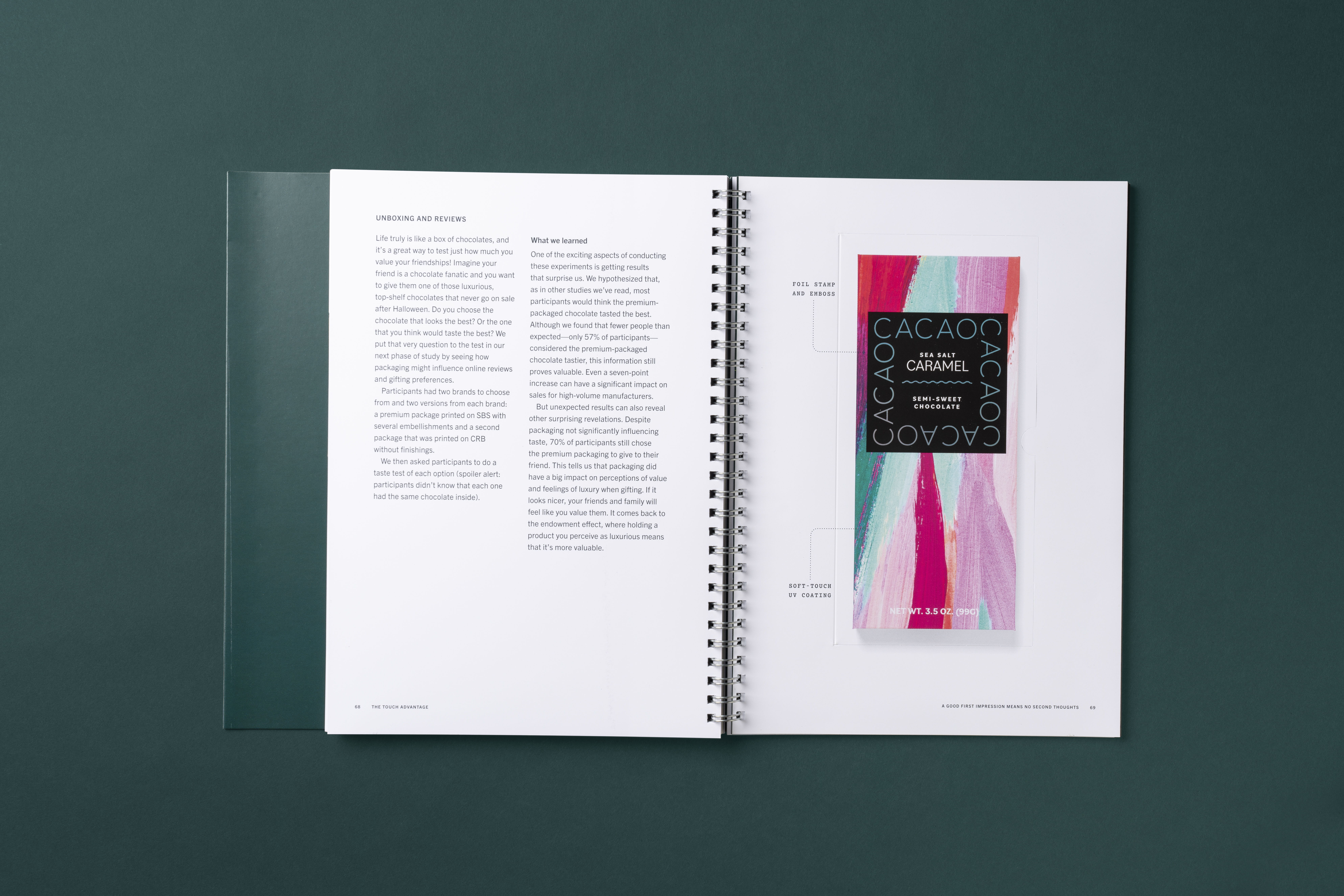
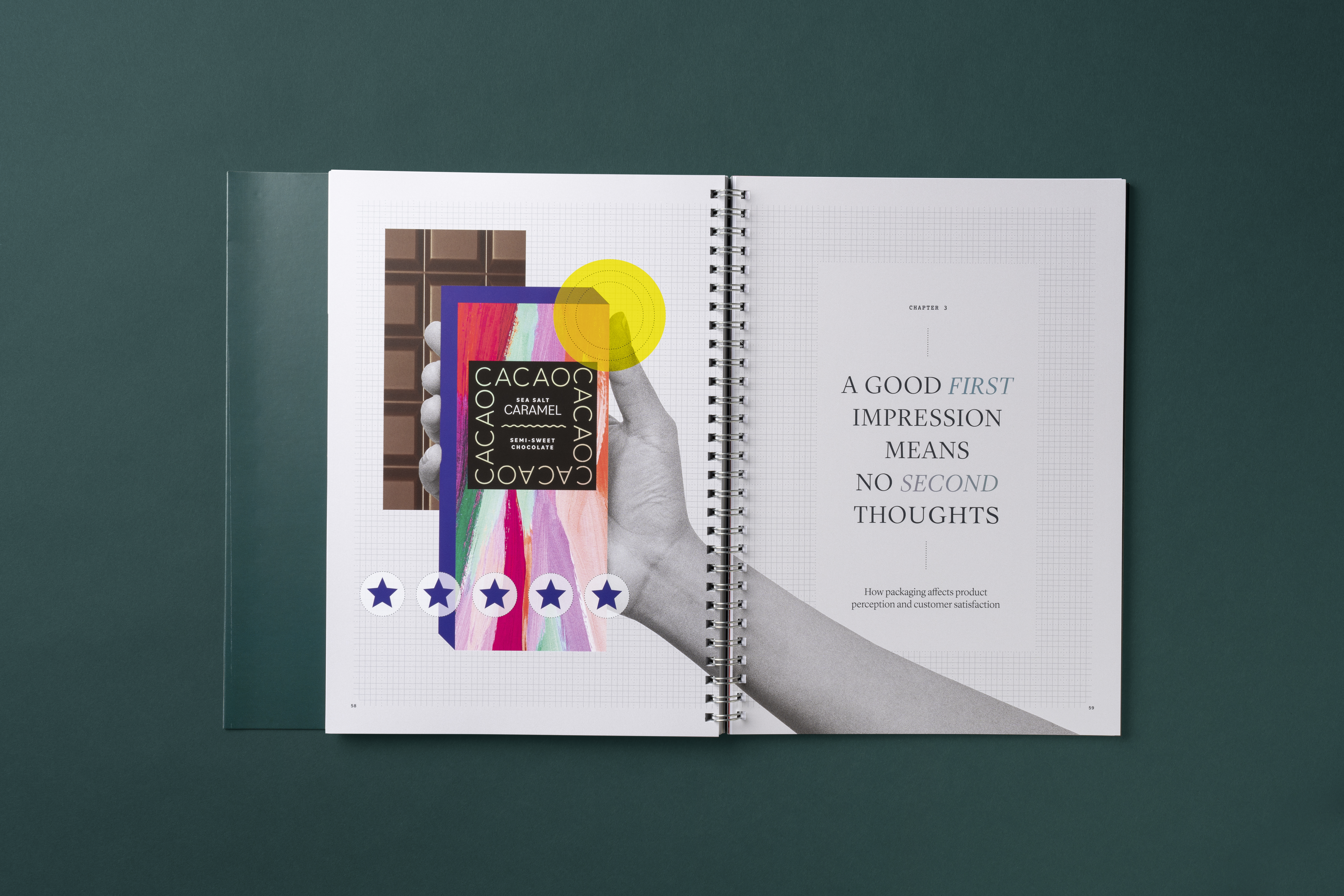
When we examined how premium packaging affects perceptions of quality, we wondered whether people would rate a product as higher quality if it were packaged in premium packaging. We also wanted to know how premium packaging affects gift-giving. To understand these two queries, we gave all the participants four chocolate bars. What they didn’t know was that each bar was the exact same chocolate. The only difference was the packaging. Two of the bars were in premium packaging, and two of them were in plain packaging. Then we asked everyone to taste the chocolate bars.
The results
Fifty-seven percent of participants said that the chocolate in the premium packaging tasted better than the chocolate in the plain packaging. A majority, but not overwhelming. Still, while 7 percent might not seem like a big deal, it is if you’re a high-volume manufacturer. Because if you’re a high-volume manufacturer, and I can tell you that putting your product in premium packaging can give you a 7 percent sales lift, that is big.
After the participants tasted and rated the chocolate bars, we asked them to consider a scenario: pretend you are going to dinner tonight with a good friend. It’s your good friend’s birthday, and your friend loves chocolate. You’re going to take them a bar of chocolate as a gift. Which one do you choose?
A whopping 70 percent of the participants chose a chocolate bar in the premium packaging. And what’s so interesting about that is that 13 percent of the people didn’t even think that it tasted as good as the plain-packaged bars. Yet they still gifted it, which proves that consumers consider packaging when gifting, and they associate premium packaging with higher quality. When we give a gift, we want to make people feel valued. We purchase things that look and feel valuable.
We purchase things that look and feel valuable
The reviews
The impact of premium packaging also influenced customer reviews. The people who chose the premium packaging to gift to their friend wrote longer, more descriptive reviews and talked more about the packaging. They wrote things like: ‘This chocolate tasted very high quality compared to the other selections.’
‘It felt luxury.’
‘The chocolate bar has a great look and feel to it.’ That last one makes me smile. ‘The chocolate bar has a great look and feel.’ Really? Is that about the chocolate, or is that the packaging?
Expressions and emotions
During another part of the study, we asked people to purchase a luxury pair of earbuds using their phone. The earbuds cost 100 USD. We simulated a home/online ordering environment and delivery.
Half of the participants received their earbuds in premium packaging, and the other half received them in non-premium or ‘plain’ packaging. We wanted to see how they felt about their package, so we examined and analyzed their facial expressions.
Now, there are 40 muscles in the face, and one of my co-authors, Dr Andrew Hurley, a packaging science professor at Clemson, is an expert in facial expression and eye movement analytics. So, unbeknownst to our participants, we were watching, monitoring and collecting their facial expressions as they received their earbuds. Next, we took that information and entered it into a software program that coded it as either positive or negative emotions. (Note: when you analyze people’s emotional response to something, it can be either neutral, which is 0, or you can have negative or positive emotions.)
The results? The participants who received their earbuds in premium packaging had 95 percent more positive emotions. The people who received their earbuds in plain packaging had 35 percent more negative emotions.
Why is this important to us, as converters, marketers, designers, paperboard and label manufacturers and so on? Because a lot of brands don’t put their product in premium packaging, particularly if it is purchased online-only, they may feel that it’s not worth the cost, and that not doing it can’t hurt them. Well, guess what? The Touch Advantage study proves that it does hurt them, because people have 35 percent more negative emotions when they receive their luxury product in plain packaging. Their emotions don’t just remain neutral; they go to negative, which can actually hurt the brand’s image and perception.
The research reveals a key takeaway: packaging is the true influencer
This data also showed up in reviews. The people who received their earbuds, their luxury product, in plain packaging wrote negative reviews. They wrote things like: ‘I think the packaging is okay. But I don’t get a sense of high quality. It’s kind of bland for a 100 USD product.’
‘I would expect it to look and feel nicer as well as sturdier.’
‘The materials look and feel a little cheap and flimsy.’
And there’s this one: ‘It definitely lowers the quality of the headphones.’
Now, in that last testimonial, there is a direct connection between how the consumer feels about the packaging and how they feel about the product inside.
Have you ever returned an item because of a negative unboxing experience? Because it made you feel not-so-great about the product that you purchased? I have.
We asked our participants the same question: Would you consider returning a product because of a negative unboxing experience? Eighteen percent of them said yes. Again, another piece of data for you to use when you’re talking about the impact on customer satisfaction and perception of various embellishments, finishes and high-quality materials.
And speaking of unboxing experiences, have you seen the videos on YouTube, TikTok and Instagram? It’s not just about mindless scrolling. Sixty percent of people watching unboxing videos are prospective customers; they have an intent to purchase. Watching is part of their research for the product or the category.
What does that 60 percent actually mean? Well, YouTube videos featuring the word ‘unboxing’ were viewed 25 billion times in 2023. When we do a little math, that’s 15 billion views of people watching an unboxing video. And the person doing the unboxing is typically either excited about the package and telling people all about how great it is, or they’re annoyed or disappointed with the packaging and telling people all about that.
When we look at the study’s third overarching question, how does sensory marketing affect post-purchase experiences, customer satisfaction and reviews, the research reveals a key takeaway: packaging is the true influencer.
Quick recap
Study question 1: What is the correlation between touching a package and sales?
Key takeaway: Untouched is unsold
The data covered in part one of this article revealed that when someone touches a premium package just twice, they’re 50 percent more likely to purchase it.
Study question 2: How does premium packaging affect consumer perceptions of product quality?
Key takeaway: Premium outperforms plain
The data covered in part one of this article showed that an item sold 13 times more frequently when it was premium packaged. Also, when given the choice, 60 percent of our participants purchased a package with a foil embellishment.
Study question 3: How does sensory marketing affect the post-purchase experience, customer satisfaction and reviews?
Key takeaway: Packaging is the true influencer
Remember the data: Participants who received their earbuds in premium packaging had 95 percent more positive emotions than those who received them in plain packaging. Influence at your fingertips Quality packaging can help convey a brand’s personality, reputation, purpose, functionality and even its commitment to sustainability. As shoppers and consumers, we pick up on all those traits through emotions triggered and perspectives influenced by the packaging and the product itself. That kind of brand connection can lead to long-lasting customer engagement, loyalty, satisfaction and word-of-mouth marketing.
With the Touch Advantage Study and the neuroscience of touch literally at our fingertips, only one question remains: why wouldn’t a brand consider premium packaging for its product?
Stay up to date
Subscribe to the free Label News newsletter and receive the latest content every week. We'll never share your email address.